
Anandpuri block in Banswara district (Rajasthan) is known for high concentration of tribal communities, particularly Bhil communities. Their traditional livelihood and farming patterns based on biodiversity and self-reliance were well-suited to local conditions, but these suffered under exploitative systems of colonial times.
Freedom from colonial rule brought some relief, but the dominant development thinking still neglected special needs, conditions and concerns of tribal communities and hence the development programs imposed on them were not in keeping with either their strengths or their needs. In these conditions some of the traditional strengths of communities were eroded and they became increasingly dependent on migrant labour to meet their basic needs.
In these conditions Vaagdhara voluntary organization started working here about two decades back with an understanding of recognizing first the needs as well as strengths of tribal communities and then working for them and with them on the basis of this understanding. This has helped to create close understanding of trust and working together.
In these conditions Vaagdhara voluntary organization started working here about two decades back with an understanding of recognizing first the needs as well as strengths of tribal communities and then working for them and with them on the basis of this understanding. This has helped to create close understanding of trust and working together.
Emphasis is on strengthening sustainable livelihoods on the basis of the tribal systems of high levels of biodiversity and self-reliance and in ecologically protective ways. This also helps to reduce costs and minimize external inputs. Such an approach has helped several tribal households to get back their strengths based on self-reliance and reduce their dependence on migrant labour.
Amritlal is one such farmer of Bhundri village who had become very heavily dependent on migrant labour till about a decade back. At this stage he came in contact with Vaagdhara activists who prevailed upon him to instead devote his time and energy to working on his increasingly neglected farm.
Amritlal is one such farmer of Bhundri village who had become very heavily dependent on migrant labour till about a decade back. At this stage he came in contact with Vaagdhara activists who prevailed upon him to instead devote his time and energy to working on his increasingly neglected farm.
Amritlal agreed to try this, attracted also by the fact that the technology being recommended was a very low-cost one. Following this advice, he planted several kinds of fruit trees but in addition he also planted trees which provide fodder, fuel, small timber and met other needs.
He also started making organic manure and pest repellants in improved ways on his farm using cow dung and cow urine, saving in costs incurred on market purchased inputs. He planted a wide range of crops to become almost self-reliant in meeting the food needs of his family and in fact improving the family nutrition significantly.
By gradually moving on this path of natural farming and self-reliance, today Amritlal and his wife Surta are able to meet their needs from their four bigha farm and have no need for migrant labour. In fact they are strong enough economically now to lease in some extra land as well for cultivation. While there is a rich diversity of cereals, pulses vegetables and fruits on their farm which brings a steady income, to face sudden difficulties they also have the option of selling bamboos and goats.
Amritlal believes firmly in the path of self-reliance and sustainable livelihoods he has chosen, and has become a very effective messenger also for spreading these ideas, as what he has to tell others is supported by what he has achieved on his own fields. He is seen as a motivational force behind the planting of several thousand trees by others, and for this he received the Ummedpur Lodh Environment Award too.
In Nanamukhia village of this block, another farmer Ramu Maharaj and his wife Naani follow much the same pattern of rich biodiversity on their farm but they are constrained by water shortage to some extent. So Ramu says that while he has no compulsion now for migrating, once in a while he may go out for earning a little extra. His farm is also largely self-reliant and entirely organic, he says.
In various villages women have formed groups called Saksham Samoohs to take forward these objectives of self-reliance and sustainable livelihoods. These hold regular meetings to take forward development tasks and resolve any pending problems. In Nagli Sera village, Kanchan, who is also a facilitator for Vaagdhara, says that compulsion of going for migrant labour has declined in a big way while farm based livelihoods have improved.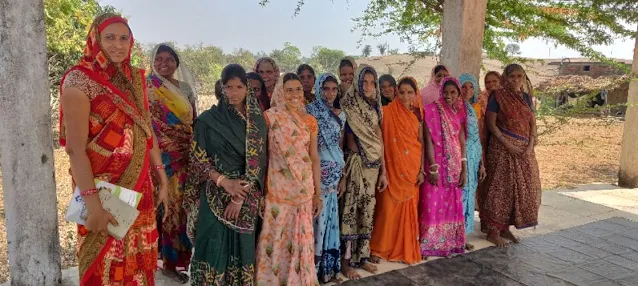
In the case of almost all these families kitchen gardens which provide a lot of nutritious vegetables and some fruits for home consumption have been playing an important role in terms of improving nutrition significantly.
By gradually moving on this path of natural farming and self-reliance, today Amritlal and his wife Surta are able to meet their needs from their four bigha farm and have no need for migrant labour. In fact they are strong enough economically now to lease in some extra land as well for cultivation. While there is a rich diversity of cereals, pulses vegetables and fruits on their farm which brings a steady income, to face sudden difficulties they also have the option of selling bamboos and goats.
Amritlal believes firmly in the path of self-reliance and sustainable livelihoods he has chosen, and has become a very effective messenger also for spreading these ideas, as what he has to tell others is supported by what he has achieved on his own fields. He is seen as a motivational force behind the planting of several thousand trees by others, and for this he received the Ummedpur Lodh Environment Award too.
In Nanamukhia village of this block, another farmer Ramu Maharaj and his wife Naani follow much the same pattern of rich biodiversity on their farm but they are constrained by water shortage to some extent. So Ramu says that while he has no compulsion now for migrating, once in a while he may go out for earning a little extra. His farm is also largely self-reliant and entirely organic, he says.
In various villages women have formed groups called Saksham Samoohs to take forward these objectives of self-reliance and sustainable livelihoods. These hold regular meetings to take forward development tasks and resolve any pending problems. In Nagli Sera village, Kanchan, who is also a facilitator for Vaagdhara, says that compulsion of going for migrant labour has declined in a big way while farm based livelihoods have improved.
Kali Devi says that while practicing organic farming on her 7 bighas of land she has been able also to purchase two buffaloes, an indicator of economic improvement. In the same village Susheela said while mentioning the diversity of crops grown by her on 5 bighas of land that leaving aside salt and edible oil she is self-reliant in meeting all the family’s food needs.

In Sundraav village Usha and Ambalal are also firmly on the path of self-reliance. One part of their 10 bigha farm is already organic, while on the other part they are moving towards this. Ambalal says organic cultivation is the right path but as it is difficult to change suddenly, he is moving more gradually towards this.
They also have two buffaloes and enough surplus milk to feed kittens and cats regularly. The traditional Halma system of various farmers helping each other at the time of peak work instead of hiring cash paid workers is still working well in this village, Ambalal says.In the case of almost all these families kitchen gardens which provide a lot of nutritious vegetables and some fruits for home consumption have been playing an important role in terms of improving nutrition significantly.
Kailash Chandra says that once there were no trees even for a little shade in front of his home but after he was motivated by Vaagdhara to plant trees, he worked with dedication to create a garden and now there are trees of jackfruit, blackberries, custard apple, sahjan, guava, lemon, papaya and other fruits, also giving shade, cool breeze and fragrance.
Women farmers such as Kanku Devi have been very active in protecting and preserving seeds, using and also reviving several traditional methods for this, contributing further to self-reliance.
To take forward the concept of self-reliance and swaraj in various ways, swaraj groups have been formed in various villages and these together form a janjati vilas manch or forum for development of tribal communities.
Women farmers such as Kanku Devi have been very active in protecting and preserving seeds, using and also reviving several traditional methods for this, contributing further to self-reliance.
To take forward the concept of self-reliance and swaraj in various ways, swaraj groups have been formed in various villages and these together form a janjati vilas manch or forum for development of tribal communities.
Mansingh, who heads this, says that diversity of organically grown vegetables and fruits have made a remarkable contribution to improving nutrition without incurring cash expenditure. Several millets grown here earlier such as Ragi, Kaang, Kutti, Bati and Kodra are to be revived here.
Efforts to check soil and water erosion have contributed much in these villages. Efforts to make better use of government schemes like MGNREGA are consistently being made. In addition social reform issues like checking wasteful ceremonial expenses have been taken up successfully. Micro plans for several villages have been prepared.
A big priority is to ensure school education and other child rights. Children who were out of school for some reason were educated in special schools and then integrated with mainstream schools. Helplines and other means are used to rescue and rehabilitate distressed children.
Special schemes like Paalanhaar have also been utilized well here to bring help to orphans. A special priority has been to try to ensure that youth do not get alienated from their communities and are able to contribute to them when they grow up and have successful careers.
These efforts, which by no means are confined to villages of just Anandpuri block but have extended to several other blocks as well in the tri-junction area of three states -- Rajasthan, Gujarat and Madhya Pradesh -- present a model of self-reliant, ecologically protective and swaraj based sustainable development whose importance has increased further in these times of climate change.
---
*Honorary convener, Campaign to Save Earth Now. His recent books include ‘India’s Quest for Sustainable Farming and Healthy Food', ‘Protecting Earth for Children' and ‘Man over Machine’. Pix: PL Patel
These efforts, which by no means are confined to villages of just Anandpuri block but have extended to several other blocks as well in the tri-junction area of three states -- Rajasthan, Gujarat and Madhya Pradesh -- present a model of self-reliant, ecologically protective and swaraj based sustainable development whose importance has increased further in these times of climate change.
---
*Honorary convener, Campaign to Save Earth Now. His recent books include ‘India’s Quest for Sustainable Farming and Healthy Food', ‘Protecting Earth for Children' and ‘Man over Machine’. Pix: PL Patel
Comments