
The bridge collapse at Morbi in Gujarat killed over 140 people, and many are missing, but no head has been rolled. According to reports, among those killed were 33 children aged between one and ten years. The 143 years old and 230 metres long suspension bridge was made during the British period. It was also claimed that the bridge was in an extremely bad condition and a private contractor was asked to renovate it.
The company was asked to complete the bridge by December, but the inauguration was advanced, and we all know why. Elections in Himachal Pradesh were declared, but not in Gujarat. The reason, apparently, was that Prime Minister Narendra Modi and Union home minister Amit Shah were continuing with their populist programmes ahead of the elections.
Modi seemed ‘pained’ to hear of the deaths of innocent at the Morbi bridge collapse, yet on the next day remained busy inaugurating various schemes in Gujarat, refusing to cancel his programmes. Ahead of his visit to Morbi, seven persons, all small fries, were arrested, including two managers, two ticket clerks, three guards and two more persons.
The lavishness with which their programmes were being held amidst the Morbi tragedy shows the highest level of insensitivity at a time when the nation was moaning. After allowing all this, the Election Commission declared dates for Gujarat elections, ironically citing the delay because of the Morbi tragedy!
While Modi was busy ‘electioneering’ in Gujarat, the “Manu-stream” media started building up another narrative. The shameless and thuggish ‘experts’ wanted people ‘not to politicise’ the issue. They had no courage to ask Modi to stop his political campaign in Gujarat at the expense of public funds; instead they pointed fingers at people.
A well-known thug on a prime time TV show actually blamed people for the collapse of the bridge. This man is known to offer ample ‘wisdom’ to people on his prime-time programmes with one-point agenda -- to defame opponents of Modi and defend his most indefensible actions.
The manner in which the contract was given to repair the suspension bridge by the Morbi municipality raises suspicion. It was the same modus operandi of the way tycoon Anil Ambani’s company was turned into ‘expert’ in defence manufacturing during the Rafael deal.
At the Morbi town, Oreva company, which makes watches and bikes, was given the ‘revadi’ for repairing and maintenance of the bride. And what did the company do? It painted the cables of the old structure, put some artificial aluminium plates, all in order to make it ready for inauguration ahead of the elections.
The bridge was being “managed” by the Oreva company since 2008. Its owner Jayasukhbhai Patel even reportedly told media that the company had invested Rs 2 crore in repair and maintenance of the bridge, adding, nothing would happen to it for next 25 years. Yet, after the incident, the police arrested two managers, two ticket clerks, three guards and two others, and nothing has happened to the Oreva group owner and the Morbi municipality leaders.
The fact that the lawyers in Morbi decided not to fight the cases of these low-level employees making them responsible and guilty before any court of law could pronounce a judgment suggests complete hypocrisy on their part. Rather than questioning those responsible for not carrying out maintenance, or those who gave it a fitness certificate, the lawyers feel the poor people are responsible for the tragedy.
Meanwhile, the government has claimed that only Rs 28 lakh were spent and not Rs 2 crore. The cable which was supposed to be changed remained where it was. Yet, the owner of the company and the municipality leaders remain above board.
Oreva owner Jaysukhbhai Patel authored a book in 2019, ‘Samasya aur Samadhan’ (Problem and Solution), where he seeks to give reasons as to what has stopped India from becoming Vishwguru. He wants to suspend elections and hand over the country to some ‘able’ man for next 15-20 years -- like what they have done in China, or much like Hitler.
No sooner Modi finished giving revdis, the Election Commission declared the dates for Gujarat polls
He is anti-reservationist and feels that only dictators can give us freedom from corruption. He is upset with land acquisition and feels the government, must act like China, as it is the owner of all the land in India, and farmers and zamindars are just leaseholders.
The book is a sample of the type of people currently being promoted by the BJP’s cronyism, and why action has not been taken against this person who violated all laws to open the bridge when it was not ready. Yet, political parties are keeping quiet on Jaysukhbhai Patel. There is reason to wonder: Why has he not been arrested?
Modi visited the Morbi hospital on November 1, two days after the tragedy. The hospital was made ‘lively’ for the Prime Minister so that he feels good when while interacting with the injured. Its walls were painted. The rescue operations were stopped. His Morbi visit was converted into an event. No sooner he finished giving ‘revadi’, the Election Commission declared the dates for Gujarat polls.
Why is there such lack of concern in Gujarat? The reason appears to be that the savarna culture in the state has become so dominant that, despite absolute failure in managing the Covid crisis, joblessness, health crisis and a despicable educational system, Modi’s Gujarat model has been been made ‘famous’ for perpetuating an anti-minority majoritarian culture.
The Aam Admi Party (AAP) which in Punjab and Delhi claimed to be following the path of Shaheed Bhagat Singh and Dr Baba Saheb Ambedkar is doing exactly the opposite of the ideologies of the two legends. While the BJP leadership at the centre cannot deny its shameless politicisation and justification of releasing the rapists of Bilkis Bano and killers of her children and family members, Arvind Kejriwal and AAP are displaying deafening silence on the issue.
All those convicted for rape and murder in the Bilkis Bano case were released for ‘good conduct’. These are the same parties and people which exploited the ‘Nirbhaya’ rape case in 2013 in Delhi. That time the common refrain among the ‘activists’ was to hang the culprits, and so the case was fast-tracked and culprits were hanged to death.
The same parties and leaders refuse to take a stand on criminals and thugs who have been released by the Central and Gujarat governments. This is India’s biggest shame -- that a man who claims to speak on behalf of 130 crore Indians refuses to take a stand when rapists and murderers are released. There have been very few protests in Gujarat against the release of Bilkis rapaists. Nor is there any protest any outrage on Morbi’s killings.
However, the positive stories -- work done by three men, Taufik Bhai, Naeem Sheikh and Hussain Pathan, who saved more than 85 people, including children – are being pushed to be the backdrop by the establishment. They have been hailed as heroes, yet the Gujarat government would not do anything to give them a heroic welcome and award them.
Modi and BJP have never bothered about political niceties. A YouTube video, now viral on social media, shows Modi heard criticising the bridge collapse in Kolkata during his election campaign in West Bengal: "It is an act of god in the sense that it happened during election time so that people may know what kind of government she (Mamta Banerjee) has been running. God has sent a message to the people -- that today this bridge has collapsed, tomorrow she will finish off entire Bengal. God's message to you all is to save Bengal.”
Right from Gujarat to Delhi, the message from those in power is clear: that they will protect their cronies and build new narrative to blame the people, especially the poor, for the fault of those in power. They will never express any regret or apology for any mistakes or misdeeds but will continue to play politics with people’s lives.
As citizens of India, we can only express our sorrow at things happening, but the question is, how long will the people in power protect cronies? How long will the Manu-stream media continue to play the role of the biggest villains of our democracy? Time is ripe for people to support alternative forms of media, which stand for people and their rights. If we do not support such initiatives, we will ourselves have to blame for the unfolding post-Morbi.
---
*Human rights defender. Facebook: https://www.facebook.com/vbrawat, twitter: @freetohumanity
The book is a sample of the type of people currently being promoted by the BJP’s cronyism, and why action has not been taken against this person who violated all laws to open the bridge when it was not ready. Yet, political parties are keeping quiet on Jaysukhbhai Patel. There is reason to wonder: Why has he not been arrested?
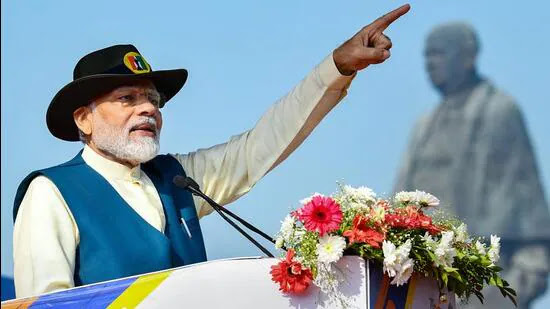 |
| Modi addresses rally at Statue of Unity a day after Morbi tragedy |
Why is there such lack of concern in Gujarat? The reason appears to be that the savarna culture in the state has become so dominant that, despite absolute failure in managing the Covid crisis, joblessness, health crisis and a despicable educational system, Modi’s Gujarat model has been been made ‘famous’ for perpetuating an anti-minority majoritarian culture.
The Aam Admi Party (AAP) which in Punjab and Delhi claimed to be following the path of Shaheed Bhagat Singh and Dr Baba Saheb Ambedkar is doing exactly the opposite of the ideologies of the two legends. While the BJP leadership at the centre cannot deny its shameless politicisation and justification of releasing the rapists of Bilkis Bano and killers of her children and family members, Arvind Kejriwal and AAP are displaying deafening silence on the issue.
All those convicted for rape and murder in the Bilkis Bano case were released for ‘good conduct’. These are the same parties and people which exploited the ‘Nirbhaya’ rape case in 2013 in Delhi. That time the common refrain among the ‘activists’ was to hang the culprits, and so the case was fast-tracked and culprits were hanged to death.
The same parties and leaders refuse to take a stand on criminals and thugs who have been released by the Central and Gujarat governments. This is India’s biggest shame -- that a man who claims to speak on behalf of 130 crore Indians refuses to take a stand when rapists and murderers are released. There have been very few protests in Gujarat against the release of Bilkis rapaists. Nor is there any protest any outrage on Morbi’s killings.
However, the positive stories -- work done by three men, Taufik Bhai, Naeem Sheikh and Hussain Pathan, who saved more than 85 people, including children – are being pushed to be the backdrop by the establishment. They have been hailed as heroes, yet the Gujarat government would not do anything to give them a heroic welcome and award them.
Modi and BJP have never bothered about political niceties. A YouTube video, now viral on social media, shows Modi heard criticising the bridge collapse in Kolkata during his election campaign in West Bengal: "It is an act of god in the sense that it happened during election time so that people may know what kind of government she (Mamta Banerjee) has been running. God has sent a message to the people -- that today this bridge has collapsed, tomorrow she will finish off entire Bengal. God's message to you all is to save Bengal.”
Right from Gujarat to Delhi, the message from those in power is clear: that they will protect their cronies and build new narrative to blame the people, especially the poor, for the fault of those in power. They will never express any regret or apology for any mistakes or misdeeds but will continue to play politics with people’s lives.
As citizens of India, we can only express our sorrow at things happening, but the question is, how long will the people in power protect cronies? How long will the Manu-stream media continue to play the role of the biggest villains of our democracy? Time is ripe for people to support alternative forms of media, which stand for people and their rights. If we do not support such initiatives, we will ourselves have to blame for the unfolding post-Morbi.
---
*Human rights defender. Facebook: https://www.facebook.com/vbrawat, twitter: @freetohumanity
Comments
Post a Comment
NOTE: Hateful, abusive comments won't be published. -- Editor