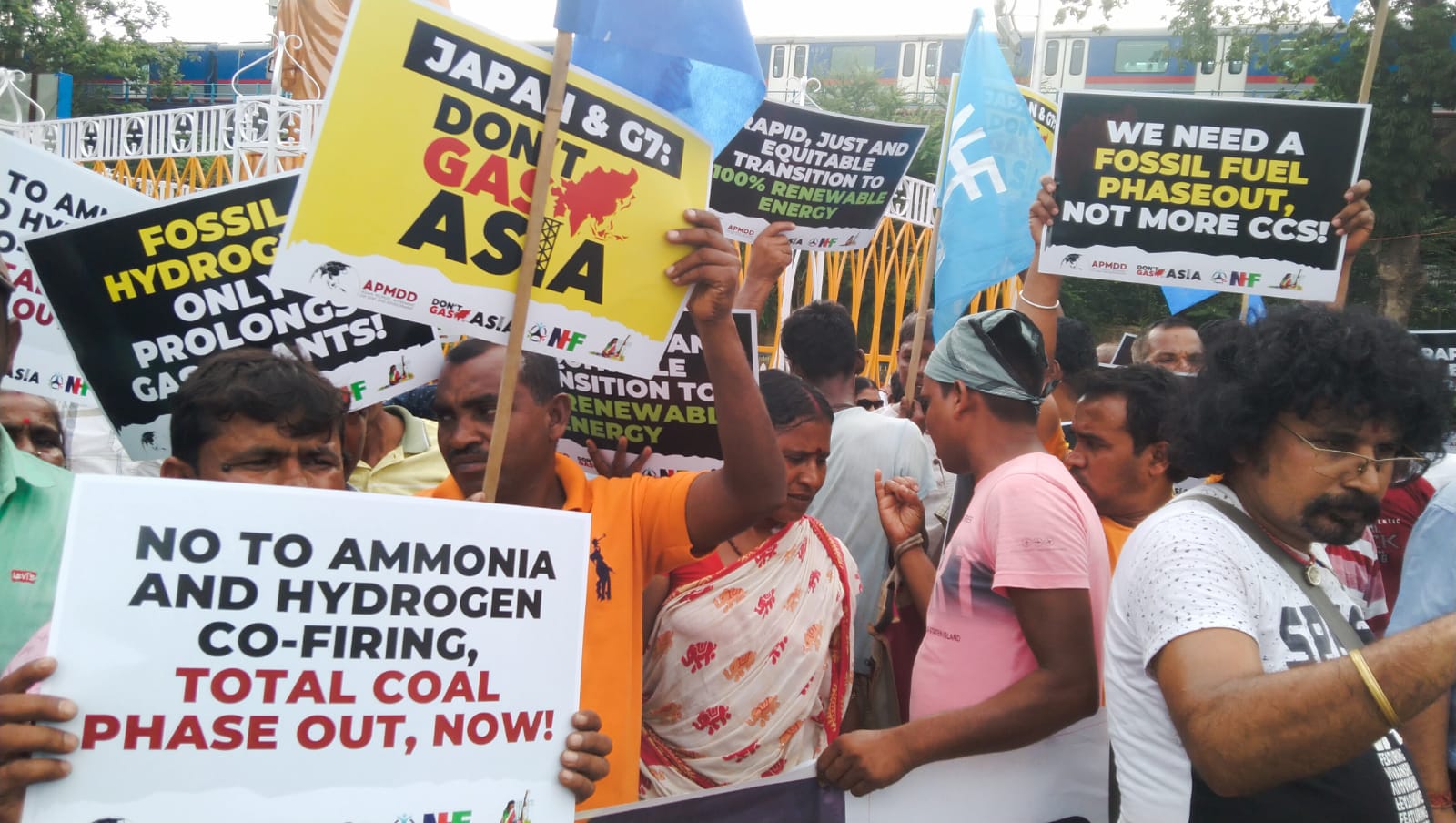
Climate campaigners and groups held rallies in 12 cities of India have protested against Japan and the G7’s continued promotion of fossil gas and technologies. The protests happened ahead of the G7 Leaders Summit scheduled on May 19-21 in Hiroshima, Japan. Japan is this year’s G7 president and the only Asian member of the grouping of seven of the world's advanced economies, including Canada, Italy, Germany, France, the United Kingdom and the United States, all prominent fossil fuel financiers.
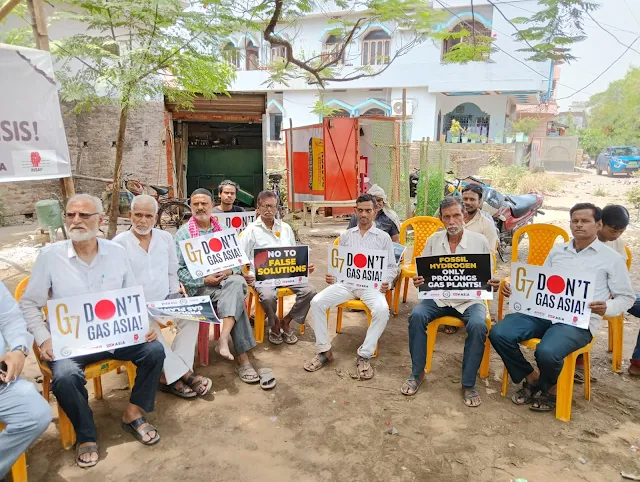
The protests in India were held outside the collector's office in Bodhgaya which has one of the largest Japanese tourist footfalls, led by the Indian Social Action Forum and All India Hawker Federation; Japanese Consulate Kolkata led by National Hawker Federation and Prasada village in Chhatisgarh led Nadi Ghati Morcha. These rallies called out the government of Japan for being among the world’s leading fossil fuel investors and their lacklustre stance towards phasing-out fossil fuels; promotion of fossil gas and false solutions like hydrogen and ammonia technology.
Japan is the largest public fossil fuel financier, with an annual average of USD 10.6 billion towards fossil fuel projects from 2019 to 2021 according to a report. At the same time there are tensions between Japan and other G7 members over their differences on carbon emissions and phase out of fossil fuel technologies.
In the recent communique from the G7 from the energy and climate ministers meeting last April affirmed their commitment to aligning with the Paris Agreement set in 2015. The ministers agreed to drastically increase solar capacity and offshore wind. However, they did not set a timeline for a gas phase-out and welcomed investments in gas subject to conditions. Technologies such as hydrogen and ammonia were also accepted as technologies that can help with the decarbonization process.
Japan is the largest public fossil fuel financier, with an annual average of USD 10.6 billion towards fossil fuel projects from 2019 to 2021 according to a report. At the same time there are tensions between Japan and other G7 members over their differences on carbon emissions and phase out of fossil fuel technologies.
In the recent communique from the G7 from the energy and climate ministers meeting last April affirmed their commitment to aligning with the Paris Agreement set in 2015. The ministers agreed to drastically increase solar capacity and offshore wind. However, they did not set a timeline for a gas phase-out and welcomed investments in gas subject to conditions. Technologies such as hydrogen and ammonia were also accepted as technologies that can help with the decarbonization process.
Renewables-based electricity is now the cheapest power option in most regions. According to research, renewables are already the default option for capacity additions in the power sector in almost all countries and dominate current investments. Renewables are also the most readily-available and cost-effective way to provide 90 per cent of all decarbonisation by 2050 -- that is, if currently installed renewable power capacity will be tripled by 2030.
 “Japan and the rest of the G7 display a blatant disregard for the pressing needs of both people and the planet, instead of meetingaa their climate finance obligations and fulfilling their commitment to end by 2022 their public financing of fossil fuels,” said Lidy Nacpil, coordinator of Asian Peoples’ Movement on Debt and Development (APMDD) and Convenor of the Asian Energy Network (AEN).
Saktiman Ghosh, General Secretary of the National Hawker Federation felt, “As the host for this year’s G20 Summit, India has a deep responsibility of steering this powerful body of countries towards a cleaner future. Japan should not be allowed to interfere and use the G7 to derail the world by promoting false solutions! We also reject the notion that the new Indo-Pacific strategy will be used to export fossil gas, non-renewable hydrogen and ammonia in the region. This new kind of energy colonialism does not have a place in the equitable future for Asia.”
”No to LNG and strongly rejecting any Finance in Fossil fuel project in Asia. We demand a Climate safe future in the Globe. Let us join to create a better EARTH”, said Gautam Bandyopadhyay of Nadi-Ghati Morcha.
Vidya Dinker, President of Indian Social Action Forum said, "The leadership of the G7 and the G20 have the mandate and more importantly, the responsibility to urgently take action to arrest temperature rise and the impacts of the climate crisis. The hope and aspirations of millions in the global south are now anchored with them. We are holding this mobilisation in Bodhgaya an important spiritual node for many Japanese, so they can carry this clarion call to their government and the other G7 leaders that all excuses have run out, fossil fuel investments need to stop now."
---
*Asian People's Movement on Debt and Development (APMDD), a regional alliance of peoples’ movements, community organizations, coalitions, NGOs and networks

Saktiman Ghosh, General Secretary of the National Hawker Federation felt, “As the host for this year’s G20 Summit, India has a deep responsibility of steering this powerful body of countries towards a cleaner future. Japan should not be allowed to interfere and use the G7 to derail the world by promoting false solutions! We also reject the notion that the new Indo-Pacific strategy will be used to export fossil gas, non-renewable hydrogen and ammonia in the region. This new kind of energy colonialism does not have a place in the equitable future for Asia.”
”No to LNG and strongly rejecting any Finance in Fossil fuel project in Asia. We demand a Climate safe future in the Globe. Let us join to create a better EARTH”, said Gautam Bandyopadhyay of Nadi-Ghati Morcha.
Vidya Dinker, President of Indian Social Action Forum said, "The leadership of the G7 and the G20 have the mandate and more importantly, the responsibility to urgently take action to arrest temperature rise and the impacts of the climate crisis. The hope and aspirations of millions in the global south are now anchored with them. We are holding this mobilisation in Bodhgaya an important spiritual node for many Japanese, so they can carry this clarion call to their government and the other G7 leaders that all excuses have run out, fossil fuel investments need to stop now."
---
*Asian People's Movement on Debt and Development (APMDD), a regional alliance of peoples’ movements, community organizations, coalitions, NGOs and networks
Comments
Post a Comment
NOTE: Hateful, abusive comments won't be published. -- Editor