
In an unprecedented move, a high-profile US State Department document on religious freedom, in what may be considered as a move to provide legitimacy to the Muslim diaspora group Indian American Muslim Council (IAMC), has quoted the NGO to suggest how anti-Christian violence has been rocking India.
The document, US State Department’s 2022 International Religious Freedom (IRF) report, says, "In its report covering events during the year, the nongovernmental organization (NGO) IAMC said Christians were 'increasingly targeted using these anticonversion laws,” as “allegations of forced conversion, no matter if false, have led many Christians to be attacked, arrested and detained by police'.”
It further quotes IAMC as stating that Christians had been “increasingly targeted using these anticonversion laws,” as “allegations of forced conversion, no matter if false, have led many Christians to be attacked, arrested and detained by police.”
According to the report, "In late January and early February, the NGO said there were 14 instances of antiChristian violence and 12 cases in which Christians were arrested for allegedly converting Hindus forcibly in Madhya Pradesh. According to the NGO, such attacks continued in March when a pastor in Jodhikapur, Uttar Pradesh, was forced to remain in his home as a crowd gathered outside while he was leading a prayer meeting."
It quotes the NGO as stating that the crowd shouted “bring the traitor out” and “rid India of Christian priests”. Local police later arrived and arrested the pastor and his wife for “unlawful conversion, criminal intimidation, and intentionally insulting religion.”
Released by Secretary Anthony Blinken and the US Ambassador-at-Large for International Religious Freedom Rashad Hussain on May 15, the document takes a deep dive into several overarching issues, including violent anti-Muslim riots, violence against Christians, criminalized religious conversion, the Karnataka state hijab ban, the punitive demolition of Muslim-owned homes and businesses.
The document has been released ahead of Prime Minister Narendra Modi's scheduled visit to Hiroshima for the G7 summit. Modi is likely to hold talks with US president Joe Biden at the summit.
It also looks at the Hinduization of educational materials in public schools, the arbitrary arrests of Muslims gathering for prayer, denial of bail for Muslim activists arrested under India’s draconian anti-terror law, arbitrary demolitions of mosques and churches, cow vigilantism and mob lynchings, and hate speeches made by Bharatiya Janata Party (BJP) leaders calling for violence against Muslims.
The document also cites specific cases of anti-Muslim violence and hate speech, including the public flogging of Muslim men in Gujarat state by off-duty police officers; Hindu militant mob attacks during on a Muslim-majority area of Madhya Pradesh state’s Khargone city during the festival Ram Navami; the release of 11 Hindu militant men who were sentenced to life in prison for gang-raping a pregnant Muslim woman, Bilkis Bano, and murdering her family members; and the offensive televised comments made by BJP spokesperson Nupur Sharma about Prophet Muhammad.
It also looks at the Hinduization of educational materials in public schools, the arbitrary arrests of Muslims gathering for prayer, denial of bail for Muslim activists arrested under India’s draconian anti-terror law, arbitrary demolitions of mosques and churches, cow vigilantism and mob lynchings, and hate speeches made by Bharatiya Janata Party (BJP) leaders calling for violence against Muslims.
The document also cites specific cases of anti-Muslim violence and hate speech, including the public flogging of Muslim men in Gujarat state by off-duty police officers; Hindu militant mob attacks during on a Muslim-majority area of Madhya Pradesh state’s Khargone city during the festival Ram Navami; the release of 11 Hindu militant men who were sentenced to life in prison for gang-raping a pregnant Muslim woman, Bilkis Bano, and murdering her family members; and the offensive televised comments made by BJP spokesperson Nupur Sharma about Prophet Muhammad.
In a special briefing presenting the document, an unnamed senior State Department official stated that he was “saddened” to see the atrocities outlined in the India section of the document, pointing out that the Holocaust Memorial Museum, “lists [India] as one of its top countries of concern… with regards to potential for mass killings there.”
“What we outline is… continued targeted attacks against religious communities, including Christians, Muslims, Sikhs, Hindu Dalits, and indigenous communities; dehumanizing rhetoric, including open calls for genocide against Muslims; lynching and other hate-fueled violence, attacks on houses of worship and home demolitions, and in some cases impunity and even clemency for those who’ve engaged in attacks on religious minorities – we’re also continuing to see, at the state level, some restrictions on religious attire,” the official said.
 The 2022 IRF document, says observers, echoes findings presented in the annual report released by the United States Commission on International Religious Freedom, which calls on the State Department to designate India as a Country of Particular Concern (CPC) for ongoing and severe violations of religious freedoms for minorities.
“We are glad to see that the US State Department has not held back in detailing the ever increasing atrocities against minorities under Prime Minister Narendra Modi’s rule,” said Rasheed Ahmed, IAMC Executive Director. “We now call upon Secretary Blinken and the State Department to listen to the facts presented by both the IRF and USCIRF reports and designate India as a Country of Particular Concern.”
“Based on the State Department’s own reporting, it is easy to see that India more than qualifies as a CPC,” said Mohammad Jawad, President of IAMC. “We urge Secretary Blinken to hold India accountable by acting on USCIRF’s recommendations.”
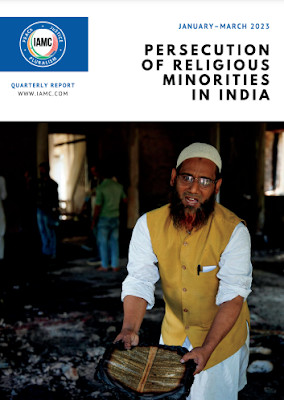
Meanwhile, IAMC has come up with its first quarterly report of this year titled "Persecution of Religious Minorities in India", in order to bring attention to the alleged disturbing escalation of atrocities experienced by minority groups “under the rule of the Hindu supremacist Bharatiya Janata Party (BJP) in India.”
This report records incidents of systematic violence, hate speech, and discrimination that occurred between January and March 2023. In addition, it provides a list of recommendations that seek to tackle the fundamental causes of religious persecution, encourage international discourse to confront this urgent concern, and cultivate a society that embraces inclusivity and tolerance.
“What we outline is… continued targeted attacks against religious communities, including Christians, Muslims, Sikhs, Hindu Dalits, and indigenous communities; dehumanizing rhetoric, including open calls for genocide against Muslims; lynching and other hate-fueled violence, attacks on houses of worship and home demolitions, and in some cases impunity and even clemency for those who’ve engaged in attacks on religious minorities – we’re also continuing to see, at the state level, some restrictions on religious attire,” the official said.

“We are glad to see that the US State Department has not held back in detailing the ever increasing atrocities against minorities under Prime Minister Narendra Modi’s rule,” said Rasheed Ahmed, IAMC Executive Director. “We now call upon Secretary Blinken and the State Department to listen to the facts presented by both the IRF and USCIRF reports and designate India as a Country of Particular Concern.”
“Based on the State Department’s own reporting, it is easy to see that India more than qualifies as a CPC,” said Mohammad Jawad, President of IAMC. “We urge Secretary Blinken to hold India accountable by acting on USCIRF’s recommendations.”
Meanwhile, IAMC has come up with its first quarterly report of this year titled "Persecution of Religious Minorities in India", in order to bring attention to the alleged disturbing escalation of atrocities experienced by minority groups “under the rule of the Hindu supremacist Bharatiya Janata Party (BJP) in India.”
This report records incidents of systematic violence, hate speech, and discrimination that occurred between January and March 2023. In addition, it provides a list of recommendations that seek to tackle the fundamental causes of religious persecution, encourage international discourse to confront this urgent concern, and cultivate a society that embraces inclusivity and tolerance.
Comments
Post a Comment
NOTE: Hateful, abusive comments won't be published. -- Editor