WTO failed to facilitate timely, appropriate response to food, health crises during Covid

Focus on the Global South insists: Developing countries should walk out of WTO Ministerial, it is time to start process of dismantling WTO. A note:

On the penultimate day of the 12th Ministerial Conference (MC) of the World Trade Organisation (WTO) currently taking place in Geneva, leaders from trade unions, farmers organisations and civil society called upon developing country negotiators to reject compromise outcomes at the WTO MC 12 and instead reclaim policy space lost during the Uruguay Round by taking strategic steps to dismantle the WTO.
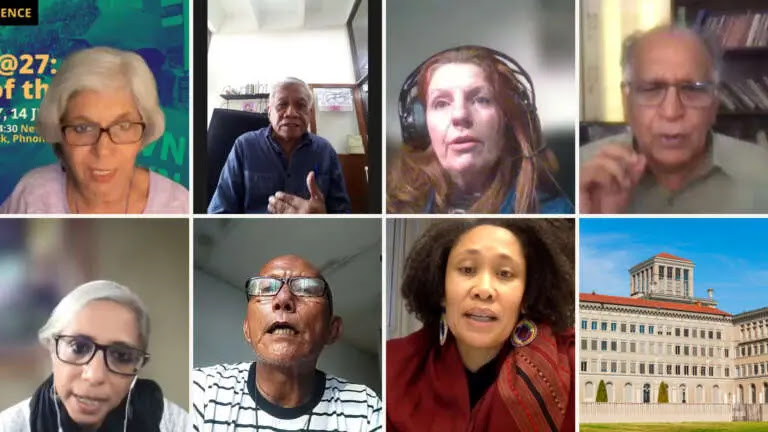
They were speaking at an online press conference titled “WTO@27: End of the Road” convened by Focus on the Global South to take stock of the current negotiations and look at the way ahead for global trade policy. Speakers from the Philippines, South Africa, India, Pakistan and Australia shared their insights on the negotiating texts currently being tabled at the MC12, assessed the WTOs records especially its role during the pandemic, and articulated the way forward for a genuine democratic multilateralism that puts economic, social and environmental justice at the forefront.
Panelists included Professor Walden Bello from Focus on the Global South, Kate Lappin from Public Services International, Farooq Tariq from Pakistan Kissan Rabita Committee and La Via Campesina, Sagari Ramdas from Kudali Learning Centre and Food Sovereignty Alliance, Pablo Rosales from PANGISDA-Pilipinas, and Dr. Lauren Paremoer from the People’s Health Movement (PHM). Shalmali Guttal, Executive Director of Focus on the Global South, moderated the press conference.
In her opening remarks, Shalmali Guttal pointed to the crisis of legitimacy that the WTO is facing: “The WTO has failed to facilitate timely, appropriate responses to food and health crises—which are most stark during the COVID pandemic on the issue of IPRs on testing, treatment and vaccines. There has not been a single positive outcome for developing countries from the WTO. The last MC held in Buenos Aires had no outcome because of this. Now in Geneva, they want to avoid a repeat of that fiasco and so there is a strong push for compromises at the MC12.”
‘WTO declarations with some nice language does not mean there is actual consensus on contentious issues. Using the current crisis of the WTO, developing countries must move from defensive to offensive positions and reclaim the policy space lost in the Uruguay Round,’ said Walden Bello.
Kate Lappin argued that as the world continues to face vaccine apartheid, we need to ensure that the WTO has no role whatsoever in global health policy including on access to vaccines and treatment. Lappin also noted that at the MC12, developed countries are pushing through very anti-democratic rules around domestic regulations in the services sector that will constrain legitimate sovereign policy making spaces of governments.
Farooq Tariq spoke on the impact of the Agreement on Agriculture (AoA) on rural farming communities in the global south. He said that AoAs free trade, pro corporate farming model has brought food riots, poverty, hunger and misery to millions of farmers in the global south. “They are trying to control everything,” said Tariq. “WTO agreements limit peasants’ ability to grow seeds. Industrial agriculture exploits cheap migrant labor, particularly of women & girls”. Tariq asserted that the way forward for agriculture was the La Via Campesina proposal for a new international framework based on food sovereignty.
Sagari Ramdas spoke about how three decades of neoliberal pro corporate WTO policies in agriculture have enabled the reproduction of old patterns of colonial exploitation. She also highlighted the Indian Government’s duplicitous position on the WTO. “On the one hand at Geneva, they are defending farmers and the right to public stockholding. But back home in Delhi they are embracing neoliberal policies that cut subsidies and impoverish small farmers. India’s embrace of a pro corporate model of farming has decimated cooperatives and led to dispossession and displacement of millions of small-scale food producers – especially women from indigenous and marginalised backgrounds that represent a vast majority of India’s agricultural workforce,” said Ramdas.
Pablo Rosales pointed out how the Philippine government failed to improve the conditions of small-scale fisherfolk even as it promised to do so by joining the WTO in 1995. The fisherfolk remain as one of the poorest sections of society due to greater liberalisation and deregulation of fisheries. ‘Our experience over the past two decades has led us to demand that fisheries should be out of the WTO’, asserted Rosales.
Lauren Paremour from PHM said that the current TRIPS text being negotiated in Geneva is not the waiver proposal submitted by South Africa and India, but a far more limited text drafted by the WTO Secretariat that makes it more cumbersome to apply flexibilities during COVID19 than otherwise. “The best option for developing countries on the current TRIPS text at the MC12 is to reject it and walk away. No outcome is better than a bad one.”
Panelists at the press conference were of the opinion that there should be no compromise by developing countries at the MC 12. While the short term goal would be to block any bad outcomes at MC 12 and resist any further encroachment by the WTO in new arenas such as the digital economy and e-commerce, the long term strategic goal for social movements across the world should be for dismantling the WTO. Walden Bello concluded that, instead of the WTO, developing countries should be looking at various UN fora and mechanisms, and multilateral agreements built on as the Universal Declaration on Human Rights to promote economic development, cooperation, sustainable development and well-being.

Comments

TRENDING

From algorithms to exploitation: New report exposes plight of India's gig workers

By Jag Jivan   The recent report, "State of Finance in India Report 2024-25," released by a coalition including the Centre for Financial Accountability, Focus on the Global South, and other organizations, paints a stark picture of India's burgeoning digital economy, particularly highlighting the exploitation faced by gig workers on platform-based services. 

'Condonation of war crimes against women and children’: IPSN on Trump’s Gaza Board

By A Representative   The India-Palestine Solidarity Network (IPSN) has strongly condemned the announcement of a proposed “Board of Peace” for Gaza and Palestine by former US President Donald J. Trump, calling it an initiative that “condones war crimes against children and women” and “rubs salt in Palestinian wounds.”

Gig workers hold online strike on republic day; nationwide protests planned on February 3

By A Representative   Gig and platform service workers across the country observed a nationwide online strike on Republic Day, responding to a call given by the Gig & Platform Service Workers Union (GIPSWU) to protest what it described as exploitation, insecurity and denial of basic worker rights in the platform economy. The union said women gig workers led the January 26 action by switching off their work apps as a mark of protest.

India’s road to sustainability: Why alternative fuels matter beyond electric vehicles

By Suyash Gupta*  India’s worsening air quality makes the shift towards clean mobility urgent. However, while electric vehicles (EVs) are central to India’s strategy, they alone cannot address the country’s diverse pollution and energy challenges.

Jayanthi Natarajan "never stood by tribals' rights" in MNC Vedanta's move to mine Niyamigiri Hills in Odisha

By A Representative The Odisha Chapter of the Campaign for Survival and Dignity (CSD), which played a vital role in the struggle for the enactment of historic Forest Rights Act, 2006 has blamed former Union environment minister Jaynaynthi Natarjan for failing to play any vital role to defend the tribals' rights in the forest areas during her tenure under the former UPA government. Countering her recent statement that she rejected environmental clearance to Vendanta, the top UK-based NMC, despite tremendous pressure from her colleagues in Cabinet and huge criticism from industry, and the claim that her decision was “upheld by the Supreme Court”, the CSD said this is simply not true, and actually she "disrespected" FRA.

Stands 'exposed': Cavalier attitude towards rushed construction of Char Dham project

By Bharat Dogra*  The nation heaved a big sigh of relief when the 41 workers trapped in the under-construction Silkyara-Barkot tunnel (Uttarkashi district of Uttarakhand) were finally rescued on November 28 after a 17-day rescue effort. All those involved in the rescue effort deserve a big thanks of the entire country. The government deserves appreciation for providing all-round support.

Whither space for the marginalised in Kerala's privately-driven townships after landslides?

By Ipshita Basu, Sudheesh R.C.  In the early hours of July 30 2024, a landslide in the Wayanad district of Kerala state, India, killed 400 people. The Punjirimattom, Mundakkai, Vellarimala and Chooralmala villages in the Western Ghats mountain range turned into a dystopian rubble of uprooted trees and debris.

Over 40% of gig workers earn below ₹15,000 a month: Economic Survey

By A Representative   The Finance Minister, Nirmala Sitharaman, while reviewing the Economic Survey in Parliament on Tuesday, highlighted the rapid growth of gig and platform workers in India. According to the Survey, the number of gig workers has increased from 7.7 million to around 12 million, marking a growth of about 55 percent. Their share in the overall workforce is projected to rise from 2 percent to 6.7 percent, with gig workers expected to contribute approximately ₹2.35 lakh crore to the GDP by 2030. The Survey also noted that over 40 percent of gig workers earn less than ₹15,000 per month.

Fragmented opposition and identity politics shaping Tamil Nadu’s 2026 election battle

By Syed Ali Mujtaba*  Tamil Nadu is set to go to the polls in April 2026, and the political battle lines are beginning to take shape. Prime Minister Narendra Modi’s visit to the state on January 23, 2026, marked the formal launch of the Bharatiya Janata Party’s campaign against the ruling Dravida Munnetra Kazhagam (DMK). Addressing multiple public meetings, the Prime Minister accused the DMK government of corruption, criminality, and dynastic politics, and called for Tamil Nadu to be “freed from DMK’s chains.” PM Modi alleged that the DMK had turned Tamil Nadu into a drug-ridden state and betrayed public trust by governing through what he described as “Corruption, Mafia and Crime,” derisively terming it “CMC rule.” He claimed that despite making numerous promises, the DMK had failed to deliver meaningful development. He also targeted what he described as the party’s dynastic character, arguing that the government functioned primarily for the benefit of a single family a...