The implementation of the Forest Rights Act (FRA), 2006 in Gujarat has been tardy. A total of 1,90,051 claims from 3,199 villages in 12 districts of the state have been filed individually and collectively for obtaining land ownership certificates under the Act. It consists of 1,82,869 individual claims and 7,182 community claims.
Of these, the state government has approved only 80,540 individual claims and 4,599 community claims. That means the state government has rejected 1,04,912 claims, about 56 per cent, and refused to grant land entitlement certificates to tribals and their communities who have lived there for decades.
We have also noticed that even for the claims that are accepted, the tribal farmers are given far less land than their claims. The land allocated is not equal to the land they have been cultivating.
Under FRA, receipts of fines imposed on tribal farmers by government officials for cultivating forest land is to be accepted as evidence of land ownership. Also, voter identity card, ration card, passport, building tax receipt, proof of residence, proof of check dams on agricultural land, hut etc. are also allowed as evidence. Yet, these are not taken into account.
Evidence from Panchmahals district suggests that not only these, but even the physical evidences like electricity and trees etc. are not taken into consideration in order to hand over the ownership of land.
People belonging to castes categorized under other backward class (OBC), known as Bakshi Panch in Gujarat, have given evidence of three generation of cultivating land. But their claims are rarely accepted.
On the other hand, in an effort to frustrate the forest dwellers’ claims over forest land, the state forest department forcibly plants trees on the lands of farmers whose claims have been denied and takes possession of the land.
In Virpur and Balasinor talukas the application forms submitted for the claims are not forwarded to the Forest Rights Committees for filing. The government authorities even reject claims approved by Gram Sabhas in their official meetings.
Implementation of MGNREGA
Quite like FRA implementation, in Gujarat, the implementation of the Mahatma Gandhi National Rural Employment Guarantee Act (MGNREGA) too has been inadequate. As on March 14, 2022, this financial year, 46.27 lakh job cards were issued in Gujarat but out of these only 18.61 lakh were active.The number of active workers in Gujarat is 31.52 lakh. Of these, 5.81 per cent belong to Scheduled Castes and 39.04 per cent belong to Scheduled Tribes. Details of how many days of employment is given in a year and how much daily wage is paid can be seen in the accompanying table.
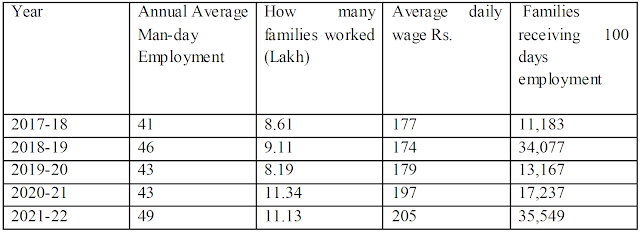
- As per the notification issued by the Central government on April 1, 2021, Rs 229 as wage has to be paid, but on an average, Rs 205 is paid. This is how it has been for years!
- Under Section-3 of the Act, the state government is required to provide employment for up to 100 days, but in Gujarat, employment is not provided for more than 50 days. Despite the corona epidemic, only 43 days of employment was provided in 2020- 21 followed by 49 days in 2021-22. Despite having 18.61 lakh active job cards, less than 35,000 were given 100 days of employment in the last five years.
- Increase in wages during the last five years has been to the tune of 15.82 per cent. That is, average increase in wages has been 3.16 per cent per year. Considering the rate of inflation for the last five years, the increase in wages ought to be five per cent per year. This shows that the real wages have declined.
- According to section-6(2) of the Act, the wages under MGNREGA must be equal to the minimum wage fixed for farm labour. At present the minimum wage of farm labour in Gujarat officially is Rs 324.20. But the official daily wage under MGNREGA is Rs 229.
- Under MGNREGA, many workers are not paid on time even though it is legally mandatory to pay them within 15 days. For example, the information that we have collected suggests, as on March 14, arrears remained to be paid to 4,000 workers in Poshina taluka, 3,800 workers in Khedbrahma taluka, 3200 workers in Wadali taluka and 3,000 workers in Idar taluka. The same is true of Aravalli district. In many places wages are paid after two months.
- Spots where work under MGNREGA is carried out, arrangements like drinking water, first aid, shade etc. are not made as per the guidelines under the law.
- For jobs like deepening of lake, installing electricity poles, construction of roads etc. in forest areas, the officials of the forest department stop work. Because of this the tribals do not get employment under MGNREGA.
- MGNREGA is a demand-based employment law. But when a worker goes to ask for work, the acknowledgment for the same by the panchayat is not given. As a result, there is no proof if the work is provided, hence no claim for unemployment benefits can be made.
- Unemployment allowance is not given to those who are not given work if they apply for it.
- Those in charge of implementing MGNREGA are not permanent employees of the government, they work on contract and are temporary. If they are made permanent, the implementation of the law can improve.
*Respectively: President, Eklvaya Sangathan; general secretary, MGNREGA Workers' Union; president, MGNREGA Workers’ Union
Comments
Post a Comment
NOTE: Hateful, abusive comments won't be published. -- Editor