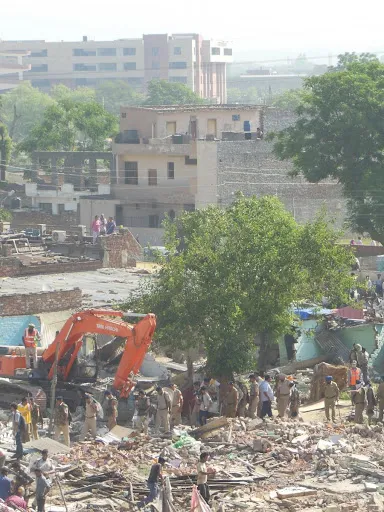
In recent times urban poor households have faced great difficulties due to the pandemic as well as loss of livelihoods and income. In such times they need help and certainly nothing should be done which will increase their difficulties.
So it is really very disturbing to know that thousands of hut and slum dwellers have been recently threatened by demolitions in two leading and prosperous cities of North India—Ambala (Haryana) and Chandigarh. This comes on top of large scale eviction and demolitions some months back in Faridabad, followed by somewhat smaller scale eviction of Banjara households in Gurugram ( Haryana).
The threatened evictions in Ambala and Chandigarh can still be stopped. There is a strong case for protecting these poorest and most vulnerable households and one hopes that senior lawyers and activists of these cities, as also others who value justice and rights of the poor, will come forward to prevent the unjust snatching away of the shelter of these households.
The Ambala demolition is all the more unjustified as it involves the demolitions of dwellings inhabited by Bajigar-Taprivas communities. Most of the people here belong to denotified tribes/ communities and recently a senior Supreme Court judge had made a special plea for justice to these communities.
The threatened evictions in Ambala and Chandigarh can still be stopped. There is a strong case for protecting these poorest and most vulnerable households and one hopes that senior lawyers and activists of these cities, as also others who value justice and rights of the poor, will come forward to prevent the unjust snatching away of the shelter of these households.
The Ambala demolition is all the more unjustified as it involves the demolitions of dwellings inhabited by Bajigar-Taprivas communities. Most of the people here belong to denotified tribes/ communities and recently a senior Supreme Court judge had made a special plea for justice to these communities.
Here we have one of those rare settlements where they have been relatively well settled over a period of time, with several essential facilities already provided, and hence eviction will badly disrupt their community life.
Several of them have been associated with folk arts in the past and as the demolition of Kathputli Colony a few years back in Delhi has shown, such demolitions and scattering of community can also destroy any chances of reviving their heritage skills. These people have already stated that they have been careful to keep their distance from railway lines and this should not be used as a pretext to evict them.
In Chandigarh a much higher number of slum dwellers are threatened with demolition particularly in colony number 4 of industrial area phase one and nearby places like Sanjay Colony.
Several of them have been associated with folk arts in the past and as the demolition of Kathputli Colony a few years back in Delhi has shown, such demolitions and scattering of community can also destroy any chances of reviving their heritage skills. These people have already stated that they have been careful to keep their distance from railway lines and this should not be used as a pretext to evict them.
In Chandigarh a much higher number of slum dwellers are threatened with demolition particularly in colony number 4 of industrial area phase one and nearby places like Sanjay Colony.
To the credit of the authorities it must be also be stated that some households living here previously were earlier resettled at another place in a more or less satisfactory way. However a large number of other households were denied this opportunity of proper resettlement and they are the ones who are threatened now.
From media reports it is evident that according to the perspective of the authorities what is considered to be important is that these people who are now threatened with demolition lack some records or papers. However according to the same reports those who are threatened include elderly people who have seen Chandigarh grow with them from early years.
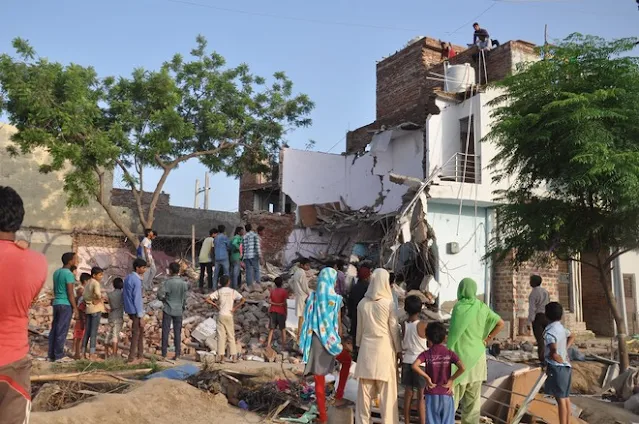 So if the authorities have a little more patience and spend some more time wth threatened households, they too will realize that people who have been living in the city for many years and have contributed to the city, its buildings and industries with their labour also have a right to live in the city. They may have lost or misplaced some of their papers and records but can this be reason enough to snatch their roof from them in such difficult times?
Chandigarh takes pride in being a modern city and some officials have been saying that their target is to free the city from jhuggies or shanties by the end of this year. But what about the increasing problems and deprivation of the evicted people? Are their sufferings of no consequence? Does their right to shelter have no place in the modernisation and beautification drives? It is sincerely hoped tht a better sense of justice will prevail and these demolitions and evictions will be avoided.
---
*Convener, Campaign to Save Earth Now; ecent books include ‘Man over Machine ( Gandhian ideas for Our Times)' and ‘India’s Quest for Sustainable Farming and Healthy Food’. Pix: Courtesy “Dainik Tribune” (March 4)
From media reports it is evident that according to the perspective of the authorities what is considered to be important is that these people who are now threatened with demolition lack some records or papers. However according to the same reports those who are threatened include elderly people who have seen Chandigarh grow with them from early years.
Chandigarh takes pride in being a modern city and some officials have been saying that their target is to free the city from jhuggies or shanties by the end of this year. But what about the increasing problems and deprivation of the evicted people? Are their sufferings of no consequence? Does their right to shelter have no place in the modernisation and beautification drives? It is sincerely hoped tht a better sense of justice will prevail and these demolitions and evictions will be avoided.
---
*Convener, Campaign to Save Earth Now; ecent books include ‘Man over Machine ( Gandhian ideas for Our Times)' and ‘India’s Quest for Sustainable Farming and Healthy Food’. Pix: Courtesy “Dainik Tribune” (March 4)
Thank you for this post on the demolition drive that has hit the poor and vulnerable communities of Chandigarh and Ambala hard. I really appreciate the comments on how this affected them. I also really appreciate the articles that were included in this blog post. It's really eye-opening to read about how the Buddha was treated and how the Hindu rulers were able to destroy Buddhist shrines, which is really sad to read.
ReplyDeleteIs Georgia a Good Place to Retire to