 |
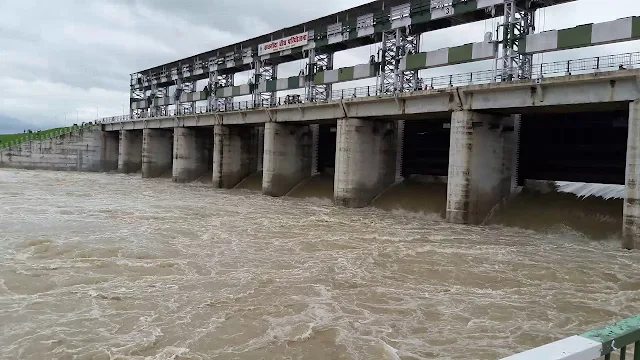
| Kachnauda dam |
Despite increasing budgets for water conservation and irrigation, real benefits are not reaching the villages of Bundelkhand region in Uttar Pradesh. Wrong priorities, poor planning, alienation from people and corruption have all combined to deny badly needed benefits of widely publicized government schemes to the long-suffering people of Bundelkhand.
The recent revival of Kachnauda irrigation scheme in Lalitpur district is an example of the authorities refusing to learn from past mistakes. This scheme had been abandoned over a decade back due to the strong opposition of people of several villages.
I had visited these villages along with some leading social activists of Bundelkhand region and we had together prepared a report which was widely discussed. After this the project remained suspended for a long time and villagers had taken it for granted that it will not be pursued now. So when suddenly, very recently, they saw activities relating to this starting again they were alarmed and started running around to protect their farms from being damaged by ill-planned construction work.
The controversial project is Kachnauda dam and canal project on Sajnam river in Lalitpur district (Uttar Pradesh). The earliest version of the project was actually not considered harmful by the people and was not opposed by them. This aimed at taking the canal water to a dry existing canal of an earlier project at a proper site with minimal adverse effects.
However around year 2010 this was suddenly changed. The changed version unnecessarily constructs an elevated canal over a long distance parallel to the existing canal of a previous project. There is no need for this extra elevated construction as the dry canal of a previous project already exists in the area. What is more, the new alignment of canal takes the canal to a height of about 25 feet and even higher. The nearby villagers complain with one voice that this can potentially destroy their villages.
As the people of Bamhori Sehna village, (panchayat Bhailoni Lodh, Block Bar) including elected panchayat representatives, told us (this writer and a team of leading social activists from Bundelkhand) when we visited their village at that time, they were never informed earlier that the canal will be taken from such a height, higher than their kutcha homes. They said that the seepage from this will destroy their houses as well as their fields. The wall will create a barrier dividing fields and temples on one side and houses on the other side.
Thus normal drainage will be badly affected leading to much greater threat of waterlogging and floods and eventual destruction of agriculture in the village. Even a very partial construction had led to the waterlogging of the Dalit basti.
The soil taken for very high construction will also ruin fertile fields, the farmers said. The farmland here is less but it is very fertile. If this fertile land is lost the farmers here will be ruined, villagers told us. In addition a very important hundred year old tank will be lost due to huge trenches which were being dug then to obtain soil using heavy machines.
People of about six villages with a total population of about 10,000 will be very adversely affected by the changed version of the project, we were told by people at that time. These villages in Bar block include Bamhori Sehna, Bhailoni Lodh, Bar, Motikhera, Dasrara, Bachravni and parts of Turka village.
Karan Singh, a farmer of Bamhori Sena village said, "We are convinced that this project will ruin our village if allowed to go ahead. We want the project to go back to its old version in which our villages are not adversely affected."
Women had been in the forefront of opposing this project. Guddi Devi said, "When we went in a group to stop the work of this destructive project, we were threatened that we will be beaten up and a truck will be sent to run over all." Devi Singh, a teacher of Moti Khera village says, "We realised a bit late about the disastrous implications of the revised project but since then we are firmly opposed to this project."
People of about six villages with a total population of about 10,000 will be very adversely affected by the changed version of the project, we were told by people at that time. These villages in Bar block include Bamhori Sehna, Bhailoni Lodh, Bar, Motikhera, Dasrara, Bachravni and parts of Turka village.
Karan Singh, a farmer of Bamhori Sena village said, "We are convinced that this project will ruin our village if allowed to go ahead. We want the project to go back to its old version in which our villages are not adversely affected."
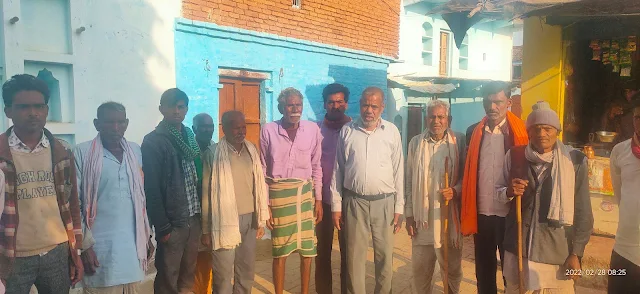 |
| Group farmers expressing concern over the project |
Clearly such glaring wastage of funds had to be checked. Fortunately the mobilisation of people had the desired impact and the work on this project was stopped. This was not revived for over a decade.
However recently farmers here saw activities like shutting off old drainage channels and building new ones which indicated that the abandoned project was being revived around election time. Often it is during election time that the powerful construction and contractor lobby asserts itself to get a lot of new business.
Shyam Lal, a farmer of Bamhori Sehna village says—If the new drainage is created my standing wheat crop will be harmed badly and my fields will suffer longer-term harm too. Ram Gopal, another farmer of this village says, "The new drainage is being created in a very wrong way and during the rains the water will enter our fields and erode them."
Mangal Singh, the famous farmer-scientist known widely for his invention of Mangal Turbine and his understanding of water and irrigation issues, lives in a nearly village and is very familiar with the area. He says—At the time of changing this project a decade back, the budget was suddenly increased very heavily. So how can you make a project more harmful while also increasing its budget at the same time? Clearly it needs to be explained to people why they are being subjected to such harm and at the same time so much money is being wasted.
Yes, this is what the authorities should do immediately. They should organize jan sunwai or public hearing in the area where the affected people are able to give their viewpoint in a free and frank way, whle the government also explains its plans in a completely transparent way. If democratic functioning and transparency and accountability are practiced, it is still possible to avoid massive wastage of funds as well as even more serious harm to many villagers.
During repeated visits to this region in recent years, particularly at the time of acute drought, almost all the people contacted by us agreed that particularly during the last decade there have been significant changes in weather patterns which have adversely affected farmers and farming.
However recently farmers here saw activities like shutting off old drainage channels and building new ones which indicated that the abandoned project was being revived around election time. Often it is during election time that the powerful construction and contractor lobby asserts itself to get a lot of new business.
Shyam Lal, a farmer of Bamhori Sehna village says—If the new drainage is created my standing wheat crop will be harmed badly and my fields will suffer longer-term harm too. Ram Gopal, another farmer of this village says, "The new drainage is being created in a very wrong way and during the rains the water will enter our fields and erode them."
Mangal Singh, the famous farmer-scientist known widely for his invention of Mangal Turbine and his understanding of water and irrigation issues, lives in a nearly village and is very familiar with the area. He says—At the time of changing this project a decade back, the budget was suddenly increased very heavily. So how can you make a project more harmful while also increasing its budget at the same time? Clearly it needs to be explained to people why they are being subjected to such harm and at the same time so much money is being wasted.
Yes, this is what the authorities should do immediately. They should organize jan sunwai or public hearing in the area where the affected people are able to give their viewpoint in a free and frank way, whle the government also explains its plans in a completely transparent way. If democratic functioning and transparency and accountability are practiced, it is still possible to avoid massive wastage of funds as well as even more serious harm to many villagers.
Bundelkhand needs better water conservation
Bundelkhand is spread over about 69,000 sq km of land in seven districts of Uttar Pradesh (Chitrakut, Banda, Jhansi, Jalaun, Hamirpur, Mahoba and Lalitpur) and six districts of Madhya Pradesh (Chhatarpur, Tikamgarh, Damoh, Sagar, Datia and Panna).During repeated visits to this region in recent years, particularly at the time of acute drought, almost all the people contacted by us agreed that particularly during the last decade there have been significant changes in weather patterns which have adversely affected farmers and farming.
Comparing the recent drought years with the situation 25 to 30 years earlier, people say that rainfall has decreased, the number of rainy days has decreased, rain tends to be concentrated in a smaller number of days, cases of untimely rain are more common (frequently harming farmers instead of helping them). The damage caused by hailstorms, frost and storms has also increased.
In these conditions there is urgent need for better water conservation work, but unfortunately highly wasteful projects are being inflicted on the region.
---
*Honorary Convener, Campaign to Save Earth Now. His recent books include “India’s Quest for Sustainable Farming” and “Healthy Food and Man Over Machine”
In these conditions there is urgent need for better water conservation work, but unfortunately highly wasteful projects are being inflicted on the region.
---
*Honorary Convener, Campaign to Save Earth Now. His recent books include “India’s Quest for Sustainable Farming” and “Healthy Food and Man Over Machine”
Comments
Post a Comment
NOTE: Hateful, abusive comments won't be published. -- Editor