
Three-quarters of annual rain in the Himalayas arrives in the monsoon season from June to September. Within this rainy period are sudden and extremely intense cloudbursts, which often “pop” over a relatively small area (akin to a cloud bursting open like a balloon).
As climate change is making these cloudbursts and other forms of heavy rainfall more intense and more frequent in the Himalayan foothills, the hilly slopes are becoming saturated more frequently, and thus unstable. Rainfall-triggered landslides are already happening extensively across the Himalayas, and things are likely to get worse.
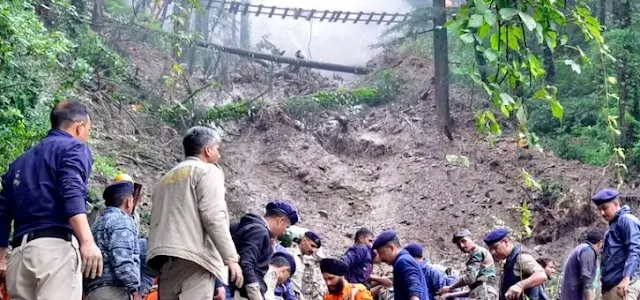
From July to August 2023, the Indian Himalayas, particularly the state of Himachal Pradesh in the northern part of the country, experienced an unprecedented number of cloudbursts which triggered thousands of devastating landslides. The state’s disaster management authority reported that by the end of August, heavy rain and rainfall-triggered landslides had caused 509 fatalities, destroyed at least 2,200 homes and damaged a further 10,000. It is estimated that Himachal Pradesh’s losses from this period amount to US$1.2 billion. Much of the destruction took place during two short periods, one in mid-July and one in mid-August.
The level of damage to buildings, roads and bridges is extremely difficult to comprehend. Several sections of national and state roads have been washed away, a temple in Shimla collapsed and killed 20 people, rural dwellings largely constructed on sloped ground were washed away by rain, and houses are still sliding downhill.
Schools and hospitals have been damaged, posing an ongoing threat to lives. A school in Kullu district was closed for 52 days because the bridge which connected it to a town had been washed away. Local people have had no option but to live in tents with minimal facilities. They are hugely concerned about their safety ahead of a cold and snowy winter.
Four days of heavy rainfall in July 2023 triggered landslides that blocked around 1,300 roads including five national highways, leaving the state almost cut off from the rest of India. This had huge knock-on effects as 1,255 bus routes were suspended, 576 buses were stranded, more than 70,000 tourists had to be evacuated, and people could not access key facilities and services. This impeded emergency responders, causing critical delays in search and rescue operations as well as delivery of aid.
Across the whole of India, the summer monsoon and its related cloudbursts are decreasing. But in the Himalayan foothills, they are increasing significantly – partly because when warm moist air encounters the Himalayan barrier it rapidly lifts and cools, forming large clouds that then dump their rain. With intense rain happening more and more often in the Himalayan foothills, it is likely that 2023’s summer of disasters will occur again.
 The region has largely been deforested, removing tree roots which reinforce the ground and form a crucial barrier that stops soils washing away. And unplanned developments and haphazard construction have destabilised already fragile slopes.
Initial reports on this year’s landslides suggest the worst damages occurred along artificially cut slopes (for roads or buildings), where there has been a lack of proper provisioning for drainage and slope safety. In both India and Nepal, many of the hill roads have been haphazardly constructed, which makes landslides during rainfall more likely. Construction guidelines and building codes are outdated and have been ignored anyway, and there is little assessment of the link between urbanisation and landslide risk.
One obvious solution is to prevent rain from penetrating the ground, so the slopes avoid losing any strength. However, if the soil is entirely prevented from absorbing any rain, the water will instead run off the surface and cause greater flooding problems further downhill.
One engineering solution is to place an artificial soil layer above the natural soil to temporarily hold water in the surface when it is raining extremely hard, preventing it penetrating deeper within the slope. This “climate adaptive barrier layer” will then release water back to the atmosphere during a later drying period.
As the heavy rain intensifies, it will be hugely important for the Himalayas to implement new user-friendly and reliable construction guidelines that factor in how the climate is changing. Landslides can’t be avoided entirely, and India certainly won’t be able to reverse global warming and the increase in cloudbursts any time soon. But these preventive actions should at least make communities more resilient to the changing climate.
---
*Respectively: Assistant Professor, School of Civil & Environmental Engineering, Indian Institute of Technology Mandi; PhD Candidate, Geotechnical Engineering, Indian Institute of Technology Mandi; Postdoctoral research associate, Durham University. Source: The Conversation
Unnecessarily vulnerable
Although climate change may be to blame for the rise in cloudbursts, in an ideal world rainfall alone needn’t lead to disastrous landslides. But the Himalayas have been made more vulnerable by human actions.
Initial reports on this year’s landslides suggest the worst damages occurred along artificially cut slopes (for roads or buildings), where there has been a lack of proper provisioning for drainage and slope safety. In both India and Nepal, many of the hill roads have been haphazardly constructed, which makes landslides during rainfall more likely. Construction guidelines and building codes are outdated and have been ignored anyway, and there is little assessment of the link between urbanisation and landslide risk.
One obvious solution is to prevent rain from penetrating the ground, so the slopes avoid losing any strength. However, if the soil is entirely prevented from absorbing any rain, the water will instead run off the surface and cause greater flooding problems further downhill.
One engineering solution is to place an artificial soil layer above the natural soil to temporarily hold water in the surface when it is raining extremely hard, preventing it penetrating deeper within the slope. This “climate adaptive barrier layer” will then release water back to the atmosphere during a later drying period.
As the heavy rain intensifies, it will be hugely important for the Himalayas to implement new user-friendly and reliable construction guidelines that factor in how the climate is changing. Landslides can’t be avoided entirely, and India certainly won’t be able to reverse global warming and the increase in cloudbursts any time soon. But these preventive actions should at least make communities more resilient to the changing climate.
---
*Respectively: Assistant Professor, School of Civil & Environmental Engineering, Indian Institute of Technology Mandi; PhD Candidate, Geotechnical Engineering, Indian Institute of Technology Mandi; Postdoctoral research associate, Durham University. Source: The Conversation
Comments
Post a Comment
NOTE: Hateful, abusive comments won't be published. -- Editor