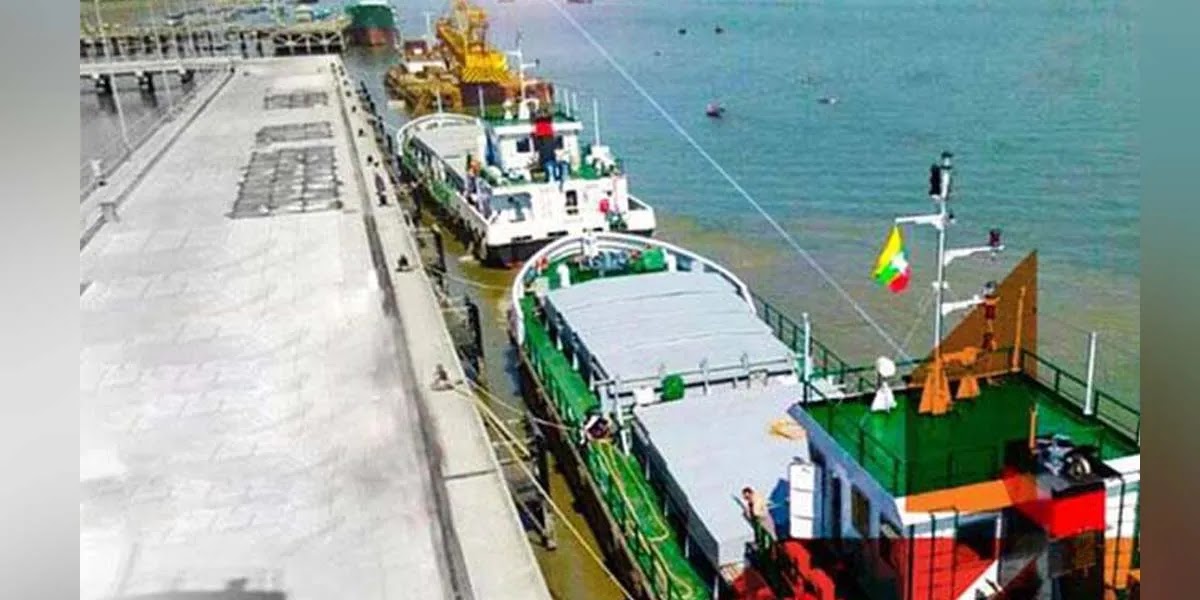
There has been a recent surge in the number of Chin refugees entering Mizoram from the adjacent nation as a result of airstrikes by the Myanmar Army on ethnic insurgents and intense fighting along the border between India and Myanmar. Uncertainty has surrounded India's Kaladan Multimodal Transit Transport project, which uses Sittwe port in Myanmar, due to the recent outbreak of hostilities along the Mizoram-Myanmar border.
Construction on the road portion of the Kaladan project, which runs from Paletwa in Myanmar to Zorinpui in Mizoram, was resumed thanks to the time of relative calm during the intermittent period. However, recent unrest has increased concerns about missing the revised commissioning goal dates. The project's goal is to link northeastern states with the rest of India via an alternate route, using the Sittwe port in Myanmar.
In addition to this route, India can also connect the region with the rest of India through Assam by using the Chittagong port in Bangladesh to link it with Tripura, the Indo-Bangladesh Protocol route to connect it with Bangladesh's inland waterways, and the Brahmaputra train line to connect Kolkata, Dhaka, and Agartala via Akhaura. Bangladesh and India are connected via the highly acclaimed Agartala-Akhaura international railway. Before independence, there existed a rail connection between Agartala and other locations.
At this moment, the railway that runs between Akhaura and Agartala is beginning to prosper. Additionally, the ports of Chattogram and Mongla in Bangladesh are open to Indian businessmen sending products under an agreement between Bangladesh and India. India and Bangladesh have decided to proceed with a railway project that would promote tourism, commerce, and economic growth between the two nations.
The initiative will improve border connections, encourage small enterprises, increase tourism in the northeast, and allow Indian entrepreneurs to ship products via Bangladeshi ports. The Ramgarh Land Port will benefit India.Trade between Bangladesh and Myanmar and regional growth India and Bangladesh must be friends for the sake of their respective countries. The enhanced road and rail links between Bangladesh and India would provide new avenues for trade and business.
The distant Chittagong Hill Tracts of Bangladesh, where the Ramgarh land port is now being built in the Khagrachari district, would benefit the nation's economy overall as well as that of this area. It may be a crucial project for the growth of local businesses and the economy. The utilisation of this port would assist the nation's commercial hub, Chittagong, as well as the seven states known as the "Seven Sisters" in northeastern India, Cox's Bazar, Chittagong Hill Tracts, and other tourist destinations.
The expansion of commerce and mutual ties would strengthen the amicable ties between Bangladesh and India. India would be able to get commodities in less time and at a lower cost if Ramgarh Port is built since Chittagong Seaport is just 112 km away, making transshipment to India considerably simpler. Road connectivity between Tripura and the northeastern Indian states of Meghalaya, Assam, Manipur, Mizoram, Nagaland, and Arunachal Pradesh will be created. In light of this, Bangladesh desires friendship with India for the benefit of its own growth.
Via the Line of Credit (LoC) mechanism, India has made a number of investments in Bangladesh, notably the upgrading of the Ramgarh road. Chittagong and Dhaka would be linked to Sabrum in Tripura and Ramgarh in Khagrachari with the implementation of this project. The completion date of the work is set for December 31, 2024. The road's construction will be handled by Indian firm Ashoka Buildcon Limited.
Residents of Tripura are able to utilise both Chittagong airport and ports. The new economic route connecting the two nations will be the land port of Ramgarh. Then, visiting Cox's Bazar, which has one of the longest beaches in the world, would be simpler for Indian visitors. Additionally, it will be easier for residents of Chittagong and the Chittagong Hill Tracts to go to Northeast India, and commerce between India and the Rakhine and Chin regions of Myanmar would speed up.
The people of the three nations will benefit from the operationalization of the Ramgarh land port, which will provide new opportunities. Japan, a strong friend of Bangladesh and India, is eager to become involved in the area. The geopolitics of the area may gain a major geo-economic component from the Northeast-Bangladesh economic corridor. Japan's contribution to the establishment of an industrial value-chain linking Bangladesh and Northeast India as well as the northeastern region (NER) to the Bay of Bengal might have a major impact on regional connetivity.
In addition to alleviating travel time and distance constraints and mitigating security and instability issues, the strategic significance of the alternate routes via Bangladesh may lie in their potential to lessen reliance on the slender Chicken Neck Corridor for surface connectivity between the northeastern region and the rest of India. Indian businessmen, investors, and tourist sector players who are investigating new trade and commerce potential via seaports and connection projects in Myanmar are concerned about the security instability in that country.
In this instance, India's best bet may be to employ Bangladeshi ports, such Chittagong port, as well as projects involving interior waterways, railroads, and roads. In order to keep anti-Indian forces from undermining India's plans to expand bilateral and multilateral engagements under the Act East Policy and Neighbourhood First policy and establish the northeast region as the entry point to the sub-region, India must continue to be on guard against these forces.
Concerns for the stability in Rakhine State and Chin State, as well as the possibility that the Kaladan project may remain precarious for an extended length of time, have also been raised by reports of Arakan Army columns entering Chin State, Myanmar, and occupying a number of towns, including Paletwa. Time and expense will increase much more if the Kaladan project is delayed. Between 2010 and 2022, the project's expected cost increased from Rs 530 crore to Rs 3200 crore.
The project component consists of the previously finished construction of the Sittwe port and inland waterways that run 158 km along the River Kaladan from Sittwe to Paletwa. Despite Sittwe Port's May opening, the multimodal project has not yet been put into service because domestic unrest in Myanmar has slowed down and delayed the work of the road portion, which runs 110 km from Paletwa to Zorinpui.
The first Indian cargo ship to sail from Kolkata port and travel the 539 km sea route between Kolkata and Sittwe was flagged off by Union Minister for Ports, Shipping, and Waterways, AYUSH Sarbananda Sonowal, and Deputy Prime Minister and Union Minister for Transport and Communications, Admiral Tin Aung San of Myanmar. Together, they inaugurated the port.
India has to tread carefully when it comes to Myanmar's unstable domestic affairs. It needs to be conscious of the ways in which Revel groups in Myanmar might undermine peace in the northeastern regions by using them as a launching pad. Forces hostile to India's interests would support rebel organisations in the northeast and encourage drug dealers to supply the area with illegal substances.
Thus, the concern has been raised by the growing number of Myanmar refugees seeking safety in Mizoram. However, India's Bangladesh alternative saves money, and time, and is reliable and safe. In order to maintain India's cross-border connection and hasten development in the northeastern area, it is still necessary to use Bangladesh alternatives like land ports, sea ports, and corridors.
---
*Bangladeshi columnist, security and strategic affairs analyst, teacher
Thus, the concern has been raised by the growing number of Myanmar refugees seeking safety in Mizoram. However, India's Bangladesh alternative saves money, and time, and is reliable and safe. In order to maintain India's cross-border connection and hasten development in the northeastern area, it is still necessary to use Bangladesh alternatives like land ports, sea ports, and corridors.
---
*Bangladeshi columnist, security and strategic affairs analyst, teacher
Comments
Post a Comment
NOTE: Hateful, abusive comments won't be published. -- Editor