
Varavara Rao was born in 1940 and became an established poet in his early teens. At the age of 17 years, he was published in the journal called “Telugu Swatantrata”, which gave him status as a modern poet. At 18, he wrote ‘Don’t Fear, Dawn Will Break’ which was considered one of his best poems. At 26, he started a journal called “Modern Literature in Telugu”. His first poetry collection came out in 1968. Since then, around 17 volumes of poetry have come out.
He is considered the leading twentieth-century poet of Telugu, spoken by approximately ninety-six million people. He is the author of fifteen volumes of politically oriented, modernist poetry that shimmer the spark of social and economic justice.
A Brahmin by birth, a Communist by disposition, he defends the progressive elements of India’s minorities: Dalits, the indigenous tribal Adivasis who have revolted against the government’s violation of their lands and rights, Muslims who have been incarcerated for publicly protesting or eating beef, and other victims of Hindutva.
Few poets have dared to write with such ferocity and relentless spirit or displayed such touches of genius. No poet has so intensively or illustratively shimmered the flame of resistance or resonated the spirit to extinguish Hindutva or Brahmanism in the last 4 decades. His poetry manifests how the state’s policies, actions and machinery breed inequality and injustice, creating an effect of a soul of the oppressed masses.
Rao is a mascot in unfurling the resilience of poetry like an inextinguishable light, amidst surveillance and propaganda, which transcends neo-liberal boundaries, to send shivers down the spine of the ruling classes and their institutions.
Rao was arrested in 2018 on charges of inciting caste violence and plotting to assassinate the Indian Prime Minister. He was released on bail in 2022 on health grounds. The publication of this anthology of Rao’s poetry was much delayed due to legal constraints. Some words used by Rao were deleted from the translation to avoid inviting sedition.
A life in poetry
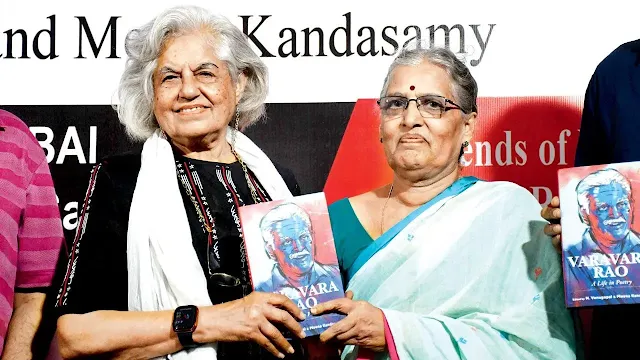
Rao’s newly-published collection of poetry ‘Varavara Rao: A Life In Poetry’, edited by N Venugopal and Meena Kandasamy, is not only an illustration of at least 60 years of post-colonial India, but it’s also a light at the end of the tunnel when communal and corporate fascism is shimmering at a helm.. With untold artistry and creativity, he dips his pen for farmers, for Dalits, for women, and for all who are inflicted wounds by the menace of capitalism and state oppression. He shimmers light in the right direction.In this collection of 48 poems, pain and blood is continuous or recurrent. They give the reader hope for progress, too. One must thank N Venugopal, Meena Kandasamy and Penguin for opening up the poems for non-Telugu readers.
His poetry is the perfect blending between modernity and tradition. His work has roots in classical Telegu poetry which he radicalised, in a most simplistic form.
This translation personifies the spirit of a rebellious poet without melodramatic overtones. The original Telugu name of each poem is given in the footnote with a brief text summarising the context, to make the poems comprehended by everyone.
A most illustrative introductory note summarises the significance of Rao’s poetry in the context of the oppressive social order, his political line and how it evolved over generations. It calls them a product of history, or reaction to political events.
The note touches upon how Rao launched a vendetta in his poems against Brahmanism, classed the state as a stooge of the bourgeoisie, and how he encompassed censorship, surveillance, violence and terror. In spite of covering several decades, governed by different regimes, Rao’s style remained unchanged.
Renowned author and activist Meena Kandasamy highlights the radical power that poetry like Rao’s exudes and the significance of poetry for on-ground activists:
“No matter what sacrifices we had to make, for me, the most important thing was, I look at his work as an archive of what dissent means in India and what it means to challenge the state in India. So much of our freedom struggle was to be able to govern ourselves and build democracy. When I read his poetry, I am reminded of what Ambedkar said, when the difference between class and caste is maintained, between the sexes, you go building economic policies, you are building a palace on a dungheap...
“He is possibly one of the most incarcerated poets, to have spent a huge amount of time in prison. How does a poet navigate these situations? Despite being so close to the situation where becoming a political mouthpiece is easy, Rao is in prison...
“How does a poet like Rao land up in English literature writing? Are we able to embrace a poet as political and revolutionary as him considering how elitist these spaces are, spaces of gatekeeping? This translation for me is something similar, just like the space other languages have for politically disruptive poetry.”
Society, in the eyes of the radical poet, is not just caught in the crossroads of the struggle for justice, but it also has battle lines drawn in the struggle to reclaim truth.
Several poems are a reflection of contemporary events. ‘Assassination of Satyam’ is an ode to the Adivasi leader Vempatapu Satyanarayana, aka Satyam (truth), killed after an armed struggle against government forces in 1970. ‘Bhopal’ memorializes the ghastly Union Carbide 1984 gas leak when “human habitations” became “crematoriums” for 3,000 victims due to “fingers that fumble in the dark.”
Other poems deal with visible events, often involving children.
In ‘Where Has the Puppy Gone’, a young boy questions the loss of his pet, with hopes of seeing it in heaven. In ‘No Classes Tomorrow,’ a prisoner in a police van waves to a crowd of children on their way home from school with his handcuffed, raised fist. He muses, “They sniff a message” that “‘Tomorrow there won’t be any classes’” due to crowds of protesters against this arrest, as they “ran with wild joy/ Without looking back.”
Rao is a visionary who believes:
“There is a stir beyond the mountainous barriers of caste.
See, the shades of blood harvest
Fragmented rays behind the hill.
Now, there is no place for fear.
Certainly, the dawn will come.”
His poetry never advocates weapons or violence here. His words voice the unconcealed truth. As in these lines from the poem ‘The Butcher’:
“The real butcher is
The state.”
This poem dating back to 1985 distinguishes between the life of a professional butcher with the one who kills randomly, without any purpose. The reference is the legal testimony of a butcher who witnessed the killing of a student activist in Kamareddy in Telangana.
 In present-day India when the poetic community is mercilessly vindicated Rao is quite erudite and obvious in his stand in ‘Intellectual’:
“When crime seizes power
Hunts down people
Holds them criminal-
Anyone who remains silent
Becomes a criminal.”
Rao denies the hyperbolic aesthetic, sometimes narcissistic delight, which believes ‘arts for art’s sake’. He has no qualms in saying:
“There is no self-deception greater than
Separating poetry and life.”
Rao is not a poet who indulges in gazing at the beauty of the moon rather he sees the moon in the very eyes of the hungry, oppressed people.
To Rao everyone in pursuit of justice is his friend.. He dipped his pen in solidarity with policemen who were demanding better salaries and working conditions in May 1978. The poet writes in ‘Yes He Too Is A Man’:
“He was called a man when he was born
He was called a man when he grew up
But the day he joined the police to earn his bread
His name became lathi, van and rifle.”
Rao illustrates that the dream of a casteless, equal world is possible only with the emancipation of women:
“Woman!
Your tears will not crush your oppressor
And bathe your rage in flames of fury.
Speak for your rights.
Step in unison with the marching feet.
Leave the system that treats you as an object.
Become a force, become an individual.
Join hands to overthrow the patriarchy.
As the flaming red sun rises
There shall be triumph.”
When most of the modern writers are now writing from cozy surroundings of language and life, Rao’s poetry serves the people. The stinking mass of the real India is illustratively expressed in his words. Whatever extent the upper class ridiculed his poetry as ‘raw’ they forget that only what is raw is real. His poetry is a slogan for looking beyond the four walls and witness the grievances of the common men. His poetry most artistically weaves all the malices or tumours of caste, class, and gender, wounds to heal.
In Rao’s poetry words are his only weapons. In the poem, ‘What We Need Is Poetry’ he projects the poetry of democracy:
“The poetry that's a metaphor of our fights
And another world
The poetry of democracy.”
In this collection of 48 poems, pain and blood is continuous or recurrent but gives a reader hope for progress: “In every republic there will be some who walk down to the water with his life vests and bread, while others lead soldiers to the trapdoors in the cellar. You stand at the edge beating a drum.”
The poetry of Rao is tightly wound up with his motherland Telangana, which witnessed a prolonged armed struggle by peasants that began in 1946 and continued after Independence. The state used the army to crush it. But the reasons behind the armed resistance -- the feudal system, unequal distribution of land, and ill-treatment of the peasantry -- was not eradicated with the struggle’s suppression.
Inequality continued as powerful landlords and politicians usurped and gained hegemony of state power. Rao dwells with this conflict reflecting the malignancy in society.
“People of the day before may be missing yesterday
Yesterday’s memorial may have gone today.
Yet, Indravelli prevailed yesterday, today and the day before.”
Indravelli is one of the places associated with the Adivasi struggle for land, water and forest.
In ‘Paradise of Love', the poet pays tribute to Warangal, the small town on the edge of Hyderabad where he grew up, was educated, and taught students. Warangal, as the base of the armed movement, has bred independent thinkers.
“Oh, the city that taught me
Even as it learnt from me.
The city that spreads my words
While teaching me how to talk.”
One of the longer poems, called ‘Déjà vu, translated by K Balagopal, is about the 1986 agitation in undivided Andhra Pradesh when the State planned to elevate the percentage of reservation:
“You are meritorious
You can break the windows of buses
In a shape as symmetric as the sun’s rays.”
The refraction of light is most artistically projected by the words to illustrate two contrasting worlds -- one dominated by privileged upper-caste boys who are trapped or confined in function halls and blow up by the media, and the other boys without privileged class background languishing in prison.
In ‘Assassination of Satyam’, he illustrates the bourgeois fascist dictatorial character of capitalist parliamentary democracy of the state which patronises loot and exploitation and terrorises all resistance.
“See if it really the truth that is dead,
It is the government that just saying that,
The truth has died. The government that lied at every step of its making
In the parliament, at the court, saving its face,
From the entanglements of law.”
---
*Freelance journalist
Rao is a visionary who believes:
“There is a stir beyond the mountainous barriers of caste.
See, the shades of blood harvest
Fragmented rays behind the hill.
Now, there is no place for fear.
Certainly, the dawn will come.”
His poetry never advocates weapons or violence here. His words voice the unconcealed truth. As in these lines from the poem ‘The Butcher’:
“The real butcher is
The state.”
This poem dating back to 1985 distinguishes between the life of a professional butcher with the one who kills randomly, without any purpose. The reference is the legal testimony of a butcher who witnessed the killing of a student activist in Kamareddy in Telangana.

“When crime seizes power
Hunts down people
Holds them criminal-
Anyone who remains silent
Becomes a criminal.”
Rao denies the hyperbolic aesthetic, sometimes narcissistic delight, which believes ‘arts for art’s sake’. He has no qualms in saying:
“There is no self-deception greater than
Separating poetry and life.”
Rao is not a poet who indulges in gazing at the beauty of the moon rather he sees the moon in the very eyes of the hungry, oppressed people.
To Rao everyone in pursuit of justice is his friend.. He dipped his pen in solidarity with policemen who were demanding better salaries and working conditions in May 1978. The poet writes in ‘Yes He Too Is A Man’:
“He was called a man when he was born
He was called a man when he grew up
But the day he joined the police to earn his bread
His name became lathi, van and rifle.”
Rao illustrates that the dream of a casteless, equal world is possible only with the emancipation of women:
“Woman!
Your tears will not crush your oppressor
And bathe your rage in flames of fury.
Speak for your rights.
Step in unison with the marching feet.
Leave the system that treats you as an object.
Become a force, become an individual.
Join hands to overthrow the patriarchy.
As the flaming red sun rises
There shall be triumph.”
When most of the modern writers are now writing from cozy surroundings of language and life, Rao’s poetry serves the people. The stinking mass of the real India is illustratively expressed in his words. Whatever extent the upper class ridiculed his poetry as ‘raw’ they forget that only what is raw is real. His poetry is a slogan for looking beyond the four walls and witness the grievances of the common men. His poetry most artistically weaves all the malices or tumours of caste, class, and gender, wounds to heal.
In Rao’s poetry words are his only weapons. In the poem, ‘What We Need Is Poetry’ he projects the poetry of democracy:
“The poetry that's a metaphor of our fights
And another world
The poetry of democracy.”
In this collection of 48 poems, pain and blood is continuous or recurrent but gives a reader hope for progress: “In every republic there will be some who walk down to the water with his life vests and bread, while others lead soldiers to the trapdoors in the cellar. You stand at the edge beating a drum.”
The poetry of Rao is tightly wound up with his motherland Telangana, which witnessed a prolonged armed struggle by peasants that began in 1946 and continued after Independence. The state used the army to crush it. But the reasons behind the armed resistance -- the feudal system, unequal distribution of land, and ill-treatment of the peasantry -- was not eradicated with the struggle’s suppression.
Inequality continued as powerful landlords and politicians usurped and gained hegemony of state power. Rao dwells with this conflict reflecting the malignancy in society.
“People of the day before may be missing yesterday
Yesterday’s memorial may have gone today.
Yet, Indravelli prevailed yesterday, today and the day before.”
Indravelli is one of the places associated with the Adivasi struggle for land, water and forest.
In ‘Paradise of Love', the poet pays tribute to Warangal, the small town on the edge of Hyderabad where he grew up, was educated, and taught students. Warangal, as the base of the armed movement, has bred independent thinkers.
“Oh, the city that taught me
Even as it learnt from me.
The city that spreads my words
While teaching me how to talk.”
One of the longer poems, called ‘Déjà vu, translated by K Balagopal, is about the 1986 agitation in undivided Andhra Pradesh when the State planned to elevate the percentage of reservation:
“You are meritorious
You can break the windows of buses
In a shape as symmetric as the sun’s rays.”
The refraction of light is most artistically projected by the words to illustrate two contrasting worlds -- one dominated by privileged upper-caste boys who are trapped or confined in function halls and blow up by the media, and the other boys without privileged class background languishing in prison.
In ‘Assassination of Satyam’, he illustrates the bourgeois fascist dictatorial character of capitalist parliamentary democracy of the state which patronises loot and exploitation and terrorises all resistance.
“See if it really the truth that is dead,
It is the government that just saying that,
The truth has died. The government that lied at every step of its making
In the parliament, at the court, saving its face,
From the entanglements of law.”
---
*Freelance journalist
Comments