
The latest Indian Institute of Management-Ahmedabad’s (IIM-A’s) Business Inflation Expectations Survey (BIES) has said that while one year ahead business inflation expectation has remained steady around 4.70% during September-November 2022, there have been “clear signs of the economy slowing down”.
According to a BIES note, “Firms’ sales expectations have subdued. With moderation in sales expectations, profit margins expectations have deteriorated sharply.”
BIES claims to provide ways to examine the amount of slack in the economy by polling a panel of business leaders about their inflation expectations in the short and medium term. The survey asks questions about year-ahead cost expectations and the factors influencing price changes, such as profit, sales levels, etc.
 The survey is called “unique”, in that it goes straight to businesses -- the price setters -- rather than to consumers or households, to understand their expectations of the price level changes. “One major advantage of BIES is that one can get a probabilistic assessment of inflation expectations and thus get a measure of uncertainty. It also provides an indirect assessment of overall demand condition of the economy”, the note says.
Stating that results of the survey are “useful in understanding the inflation expectations of businesses and complement other macro data required for policy making”, as companies are selected primarily from the manufacturing sector, with responses of around 1,000 companies, the note says, “The distribution of responses on y-o-y cost increase during September-November 2022 indicates the mode to be stabilizing around 5-6%.”
 A monthly survey, it adds, “The percentage of firms perceiving over 10% cost increase y-o-y has further declined. Over 17% of the firms in November 2022 round of the survey perceive that costs have increased very significantly (over 10%) – down from 19% recorded in October 2022.”
It continues, “Firms’ sales expectations have remained subdued. Percentage of firms reporting ‘much less than normal’ sales has sharply increased to 33% in November 2022, from 26% reported in October 2022.Around 22% of the firms in November 2022 report that sales are ‘about normal’, further down from 25% reported in October 2022.”
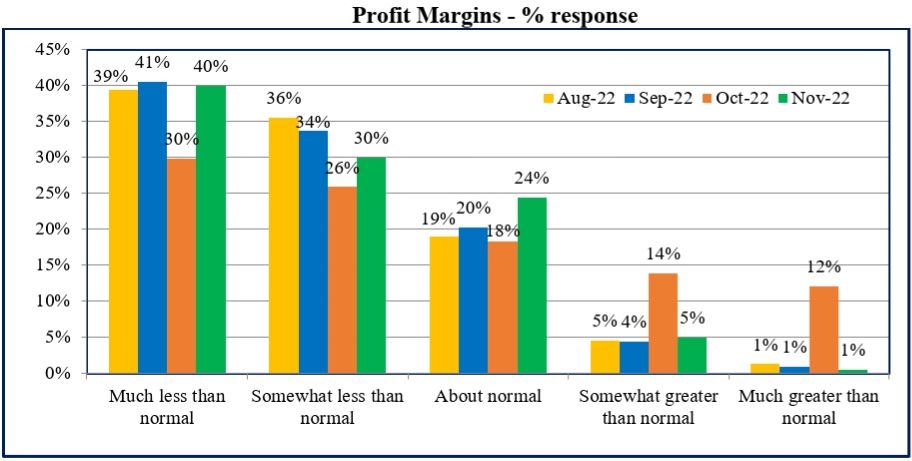
The note further says, “With moderation in sales expectations, profit margins expectations have deteriorated sharply.” It adds, “Over 40% of the participating firms in November 2022 perceive profit margins are ‘much less than normal’ – significantly up from 30% reported in October 2022.”
BIES claims to provide ways to examine the amount of slack in the economy by polling a panel of business leaders about their inflation expectations in the short and medium term. The survey asks questions about year-ahead cost expectations and the factors influencing price changes, such as profit, sales levels, etc.

Stating that results of the survey are “useful in understanding the inflation expectations of businesses and complement other macro data required for policy making”, as companies are selected primarily from the manufacturing sector, with responses of around 1,000 companies, the note says, “The distribution of responses on y-o-y cost increase during September-November 2022 indicates the mode to be stabilizing around 5-6%.”
It continues, “Firms’ sales expectations have remained subdued. Percentage of firms reporting ‘much less than normal’ sales has sharply increased to 33% in November 2022, from 26% reported in October 2022.Around 22% of the firms in November 2022 report that sales are ‘about normal’, further down from 25% reported in October 2022.”
The note further says, “With moderation in sales expectations, profit margins expectations have deteriorated sharply.” It adds, “Over 40% of the participating firms in November 2022 perceive profit margins are ‘much less than normal’ – significantly up from 30% reported in October 2022.”
Comments
Post a Comment
NOTE: Hateful, abusive comments won't be published. -- Editor