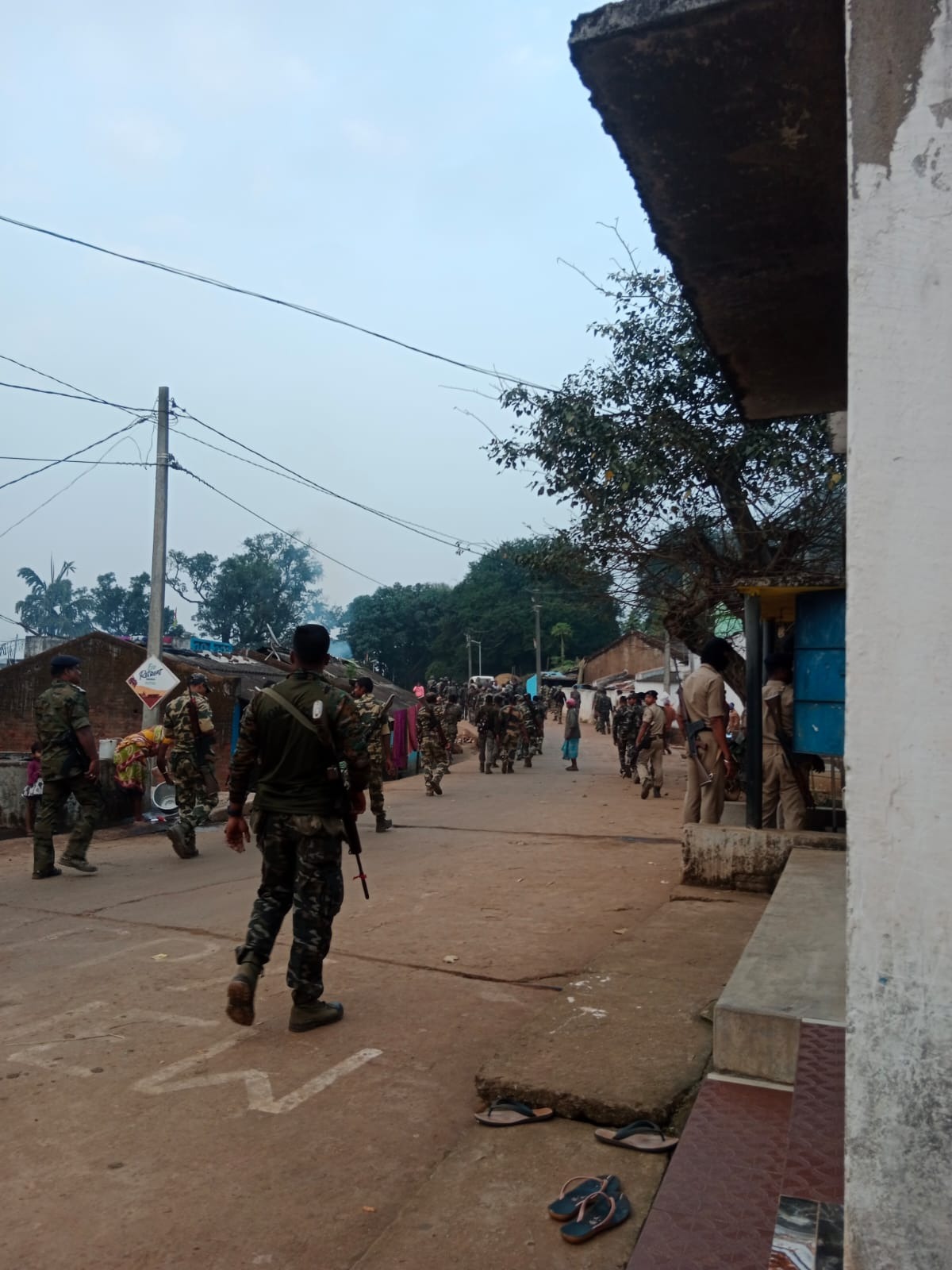
Armed cops, paramilitary sent to 'protect' top mining group, 'oppose' Odisha tribal rights

Counterview Desk 

The civil rights group, Forum Against Corporatization And Militarization (FACAM), New Delhi, insisting on the need to resist “intimidation and repression on the people of Mali Parbat opposing Hindalco mining”, has said that the hill, “rich with bauxite, sacred to local tribes in Koraput district of Odisha, is facing threat of destruction” from the mining giant Hindalco (Aditya Birla Group), which “is seeking to mine 268.1 hectares of land.”
In a “solidarity statement, it said, “The people are opposing the proposed mining for almost 2 decades and now are facing militarisation, intimidation and arrests.” Stating that matter is being fought in Court, apart from the “tooth to nail’ ground struggle”, it added, on January 5, 2023, the Odisha High Court ordered the district administration of Koraput to conduct a ‘free and fair Gram Sabha’ with participation of locals in the decision of land concerning the proposed mining as mandated under Panchayat Extension of Schedule Areas Act (PESA).”
“However”, it regretted, “the preparations to conduct a ‘free and fare Gram Sabha’ by the district administration meant hundreds of police and paramilitary, armed to the teeth, parading around the villages -- threatening and intimidating the villagers and slapping false cases on the leaders of Mali Parbat Suraksha Samiti, a body that heads the anti mining movement.”

Text:

Mali Parbat, a hill rich with Bauxite, sacred to local tribes in Koraput District of Odisha, is facing threat of destruction as Mining Giant Hindalco (Aditya Birla Group) is seeking to mine 268.1 hectares of land. The people are opposing the proposed mining for almost 2 decades and therefore, facing brute militarisation, intimidation and arrests. The matter is also being fought in Court, apart from the ‘tooth to nail’ ground struggle. Recently, on 5th January, 2023, Odisha High Court ordered the district administration of Koraput to conduct a ‘free and fair Gram Sabha’ with participation of locals in the decision of Land concerning the proposed mining as mandated under Panchayat Extension of Schedule Areas Act. However, the preparations to conduct a ‘free and fare Gram Sabha’ by the District administration meant hundreds of Police and Paramilitary, armed to the teeth, parading around the villages- threatening and intimidating the villagers and slapping false cases on the leaders of Mali Parbat Suraksha Samiti (a body that heads the anti mining movement). This was done before the holding of ‘free and fair Gram Sabha’ in order to intimidate the villagers to give-in to the corporate-state’s nexus behind Hindalco mining and gain their forced ‘free consent’ to loot and plunder of resources and destruction of environment. Currently, 28 activist and people of Mali Parbat Anti mining struggle are behind bars. Amid much militarisation and subsequent intimidation, the Gram Sabha was conducted on 7th Jan,2023, as directed by the Odisha High Court. Despite continuous threats, the majority of 72 out of 81 representatives of Mali Parbat region has opposed the mining, in the said meeting. The next hearing of the matter in Odisha High Court is on 15th Jan, 2023.
Environmental Clearance (EC) process for the purposes of mining in Mali Parbat, started in 2003, sparking the resistance movement that is continuing till date. In 2006 the environmental Clearance was given and Hindalco was granted mining lease in 2007. Due to people’s struggle, Hindalco could not carry out mining and the EC expired in 2011, however, Hindalco started mining illegally after the EC expired, with the collaboration of state and aid of the paramilitary forces being poured in large numbers. The mining stopped again, in 2014-15, due to surge in the people’s movement and the mining lease got expired in 2019. In 2021, the process to renew the lease of 268.1 hectare of land began, which saw two fake Gram Sabhas (village council meeting) being conducted, amid heavy deployment of police and paramilitary forces. Both the Gram Sabha meetings conducted in September and November of 2021, saw a deployment of around 4000 Police and Paramilitary personnel. The second Gram Sabha, conducted in November, 2021 saw strong opposition of the locals, as it was conducted only with 300 pro- Hindalco persons, debarring 1500 people from joining the gram sabha. Both Gram Sabhas were hailed by Koraput District administration as Highly successful. In the 3rd Gram Sabha conducted on 7th Jan, 2023, state government deployed 20 Battalions of Indian Reserve Battalions (IRB), Central Reserve Police Force (CRPF) and Border Security Force (BSF), despite clear direction of Odisha High Court to conduct free and fair Gram Sabha so that the locals can join it without fear and intimidation.
It is important to understand that this is the general modus operandi of the unholy State-Corporate alliance to intimidate and break the people’s movement against loot of resources by mining giants aided by imperial capital. Such is the case of Mining in Surjagarh Hills, Maharashtra, Rowghat mining and proposed mining in Amdai Ghati hills, Chhatisgarh, Niyamgiri Hills in Odisha, among many more. These anti-mining movements are the biggest blockade to the imperialist extraction machinery and to break these very movements is the objective behind rampant militarization of these states by building paramilitary camps in the fancy military terminology of “forward operational bases” that are nothing but Carpet security for extraction machinery of big corporates, such is the experience of past and present anti mining movements. These Paramilitary Camps or “forward operational bases” are part of Operation Samadhan-Prahar, launched as an extension of Operation Green-Hunt, to supposedly defeat the Maoist movement. However, It is clear that these camps and rampant deployment of forces, in the name of fighting the ‘Maoists’, are acting as a tool to suppress anti mining movements like Mali Parbat movement against Hindalco mining.
Forum Against Corporatization and Militarization strongly condemns the intimidation tactics used by the state against people of Mali Parbat region, who are struggling against Hindalco’s predatory mining of Mali Parbat to save 36 natural water streams and hundreds of Hectares of land and forest, set to be devastated by the blasting and other processes to mine the bauxite. We also demand the following:
  • Stop slapping false cases on the people opposing the Hindalco mining of Mali Parbat.
  • Release all the arrested activists of Mali Parbat Suraksha Samiti and people opposing the mining.
  • Withdraw the various Battalions of paramilitary forces from the region.
  • Respect the majority position of the locals in 7th Jan Gram Sabha and stop mining in the region.
  • Restore the autonomy of Gram Sabhas as mandated under Panchayat Extension of Schedule Areas Act.
  • Stop Operation Samadhan-Prahar.

Comments

TRENDING

Stronger India–Russia partnership highlights a missed energy breakthrough

By N.S. Venkataraman*  The recent visit of Russian President Vladimir Putin to India was widely publicized across several countries and has attracted significant global attention. The warmth with which Mr. Putin was received by Prime Minister Narendra Modi was particularly noted, prompting policy planners worldwide to examine the implications of this cordial relationship for the global economy and political climate. India–Russia relations have stood on a strong foundation for decades and have consistently withstood geopolitical shifts. This is in marked contrast to India’s ties with the United States, which have experienced fluctuations under different U.S. administrations.

From natural farming to fair prices: Young entrepreneurs show a new path

By Bharat Dogra   There have been frequent debates on agro-business companies not showing adequate concern for the livelihoods of small farmers. Farmers’ unions have often protested—generally with good reason—that while they do not receive fair returns despite high risks and hard work, corporate interests that merely process the crops produced by farmers earn disproportionately high profits. Hence, there is a growing demand for alternative models of agro-business development that demonstrate genuine commitment to protecting farmer livelihoods.

The Vande Mataram debate and the politics of manufactured controversy

By Vidya Bhushan Rawat*  The recent Vande Mataram debate in Parliament was never meant to foster genuine dialogue. Each political party spoke past the other, addressing its own constituency, ensuring that clips went viral rather than contributing to meaningful deliberation. The objective was clear: to construct a Hindutva narrative ahead of the Bengal elections. Predictably, the Lok Sabha will likely expunge the opposition’s “controversial” remarks while retaining blatant inaccuracies voiced by ministers and ruling-party members. The BJP has mastered the art of inserting distortions into parliamentary records to provide them with a veneer of historical legitimacy.

A comrade in culture and controversy: Yao Wenyuan’s revolutionary legacy

By Harsh Thakor*  This year marks two important anniversaries in Chinese revolutionary history—the 20th death anniversary of Yao Wenyuan, and the 50th anniversary of his seminal essay "On the Social Basis of the Lin Biao Anti-Party Clique". These milestones invite reflection on the man whose pen ignited the first sparks of the Great Proletarian Cultural Revolution and whose sharp ideological interventions left an indelible imprint on the political and cultural landscape of socialist China.

Thota Sitaramaiah: An internal pillar of an underground organisation

By Harsh Thakor*  Thota Sitaramaiah was regarded within his circles as an example of the many individuals whose work in various underground movements remained largely unknown to the wider public. While some leaders become visible through organisational roles or media attention, many others contribute quietly, without public recognition. Sitaramaiah was considered one such figure. He passed away on December 8, 2025, at the age of 65.

Epic war against caste system is constitutional responsibility of elected government

Edited by well-known Gujarat Dalit rights leader Martin Macwan, the book, “Bhed-Bharat: An Account of Injustice and Atrocities on Dalits and Adivasis (2014-18)” (available in English and Gujarati*) is a selection of news articles on Dalits and Adivasis (2014-2018) published by Dalit Shakti Prakashan, Ahmedabad. Preface to the book, in which Macwan seeks to answer key questions on why the book is needed today: *** The thought of compiling a book on atrocities on Dalits and thus present an overall Indian picture had occurred to me a long time ago. Absence of such a comprehensive picture is a major reason for a weak social and political consciousness among Dalits as well as non-Dalits. But gradually the idea took a different form. I found that lay readers don’t understand numbers and don’t like to read well-researched articles. The best way to reach out to them was storytelling. As I started writing in Gujarati and sharing the idea of the book with my friends, it occurred to me that while...

New RTI draft rules inspired by citizen-unfriendly, overtly bureaucratic approach

By Venkatesh Nayak* The Department of Personnel and Training , Government of India has invited comments on a new set of Draft Rules (available in English only) to implement The Right to Information Act, 2005 . The RTI Rules were last amended in 2012 after a long period of consultation with various stakeholders. The Government’s move to put the draft RTI Rules out for people’s comments and suggestions for change is a welcome continuation of the tradition of public consultation. Positive aspects of the Draft RTI Rules While 60-65% of the Draft RTI Rules repeat the content of the 2012 RTI Rules, some new aspects deserve appreciation as they clarify the manner of implementation of key provisions of the RTI Act. These are: Provisions for dealing with non-compliance of the orders and directives of the Central Information Commission (CIC) by public authorities- this was missing in the 2012 RTI Rules. Non-compliance is increasingly becoming a major problem- two of my non-compliance cases are...

Proposals for Babri Masjid, Ram Temple spark fears of polarisation before West Bengal polls

By A Representative   A political debate has emerged in West Bengal following recent announcements about plans for new religious structures in Murshidabad district, including a proposed mosque to be named Babri Masjid and a separate announcement by a BJP leader regarding the construction of a Ram temple in another location within Behrampur.

Global LNG boom 'threatens climate goals': Banks urged to end financing

By A Representative   The world is on the brink of an unprecedented surge in Liquefied Natural Gas (LNG) development, with 279 new projects planned globally, threatening to derail international climate goals and causing severe local impacts. This stark warning comes from a coalition of organizations—including Reclaim Finance, Rainforest Action Network, BankTrack, and others—that today launched the " Exit LNG " website, a new mapping project exposing the extent of the expansion, the companies involved, and their bank financiers.