
Vision is not just critical to an individual’s growth and development but has direct implications for national and global development. It holds the potential to boost the global economy in a fair and equitable manner. It enables everyone to live their lives to the fullest, releasing their potential to learn, to work, and to lead fulfilled and productive lives.
Blindness and Visual Impairment was defined as presenting Visual acuity (VA) <3/60and <6/18 in the better eye, respectively. However, on closely observing the situation in India, prevalence of blindness remains a major health and social issue in a vast country like India which has a population of over 1.4 billion and where access to health care, education and decent livelihood for all remains a pipeline dream.
The population coverage and treatment resources are disproportionately distributed. Additionally, social, economic, and demographic factors can reduce an intervention’s success. A large proportion of the “neglected population” (Rao, 2015) constituting people from urban slums or tribal areas, illiterates from socially and economically backward groups, women and children, people with disabilities, migrants, and refugees, are at the receiving end of relatively poor health care. Inequity in healthcare can take place at the level of availability, accessibility, and affordability.
Prevalence of Blindness in India
According to the National Blindness and Visual Impairment Survey of 2015-19, the Rural-urban wise prevalence of blindness in the Indian population above 50 years is given below. The prevalence of blindness is higher in the rural population as compared to the urban population. It can be attributed to poor access to health care services in rural areas, exacerbated further by poor road conditions, higher levels of poverty, higher dependence on public transport that are often overcrowded and or untimely.

Women bear a disproportionate burden of health inequity anywhere around the world, and the case is no different for visual impairment. 609 million out of the 1.1 billion people around the world with vision loss are women, which is about 55% (Vision Loss Expert Group/Global Burden of Disease (VLEG/GBD) 2020 Model). The gender disparity widens further where eye care is concerned. In a 2020 study, women were found to have 35% higher odds of being blind and 69% higher odds of being cataract blind, but with 27% lower odds of getting cataract surgery (Prasad et al., 2020).
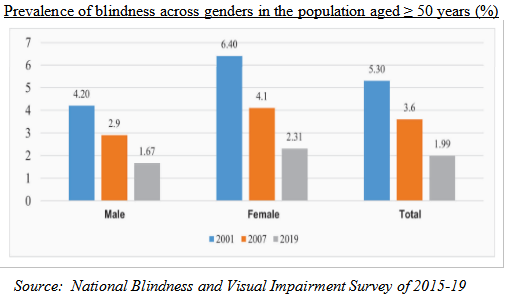
In India as well, the trends and disparities between men and women in terms of the prevalence of blindness in the population above 50 years can be identified by the graph below:
According to the study on ‘Bridging the gap: Tapping the agriculture potential for optimum nutrition’ jointly by ASSOCHAM and EY, India houses the world's highest number of malnourished children (Shenoy 2017). The Government of India will need to focus on improving nutritional security in the country. Considering that Vitamin-A deficiency is associated with childhood blindness, this becomes all the more urgent.
The literacy-wise prevalence of blindness in the population above 50 years is given below. Evidently, blindness is substantially higher among illiterates as compared to other categories. The estimates for 5th to 9th class pass and 10th class pass and above are roughly comparable, while the prevalence for 4th class pass is marginally higher than the former.

Affordability of Healthcare Services:
Income levels are crucial determinants of affording quality healthcare services. With a rising share of private healthcare, service provisioning amid the declining public healthcare system is a barrier to the affordability of healthcare. According to the Economic Survey of 2020-21, 60% of expenditure on healthcare services is out-of-pocket (OOP) expenditure. To effectively reduce this expenditure to 30%, the survey has suggested raising the ratio of healthcare expenditure/GDP to 2.5% from the present 1%. For the poor and marginalized, affordability remains a concern towards availing eye care. Affordable spectacles and treatment options must assume paramount importance for an inclusive eye care system.Conclusions:
Thus, the above description clearly points through official data of the National Blindness and Visual Impairment Survey of 2015-19 that universal eye care in India is far from reality. Thus, the Leaving No One Behind motto of the Sustainable Development Goals of the United Nations is put at risk. Further, there are several converging goals that are impacted, for example: SDG 1- No Poverty, SDG 2 - Zero Hunger, SDG 3 - Good Health and Well-Being, SDG 4 - Quality Education, SDG 5 - Gender Equality, SDG 8 - Decent Work and Economic Growth, SDG 10 - Reduced Inequalities, SDG 11 - Sustainable Cities and Communities, which are indispensable if we have to ensure the Right to Sight for all in the country.Hence, it is of utmost importance that such inequities are fully and urgently addressed. Continued collection of information on low vision and blindness will help improve understanding of the problem and assist in developing newer strategies.
Future Directions of Research:
Access to reliable data on the prevalence of visual impairment and blindness are a pre-requisite for planning eye care services. While this can be attained by conducting regular detailed prevalence studies, they are logistically expensive, resource-intensive and time consuming. But their utility in providing reliable information for goal setting, planning and starting up eye care services cannot be underrated. To bridge the gaps, rapid methodologies in data collection and prevalence studies may be adopted for acquiring a baseline data to understand the depth of the problems, which may then be scaled for planning health care services. Methods like 'Rapid Assessment of Visual Impairment (RAVI)' involving randomly selected human subjects 50 years and older would prove to be very beneficial in understanding the gaps and plan effective primary and secondary level eye care services in both rural and urban areas.References:
- Prasad M., S. Malhotra S, M. Kalaivani, P. Vashist, S.K. Gupta. 2020. Gender differences in blindness, cataract blindness and cataract surgical coverage in India: a systematic review and meta-analysis. British Journal of Ophthalmology, 104:220-224.
- Rao, G. N. 2020. Universal Health Care: Can Indian Ophthalmologist Community Set an Example?. Indian Journal of Ophthalmology. https://www.ncbi.nlm.nih.gov/pmc/articles/PMC7003579/
- Shenoy, J. 2017. India has largest number of malnourished children in the world: Study. Times of India. November 1, 2019. https://timesofindia.indiatimes.com/india/india-has-largest-number-of-malnourished-children-in-the-world-study/articleshow/61405188.cms
Comments