Nothing could have been more tragic than to feel like being ‘abroad’ in Bangladesh

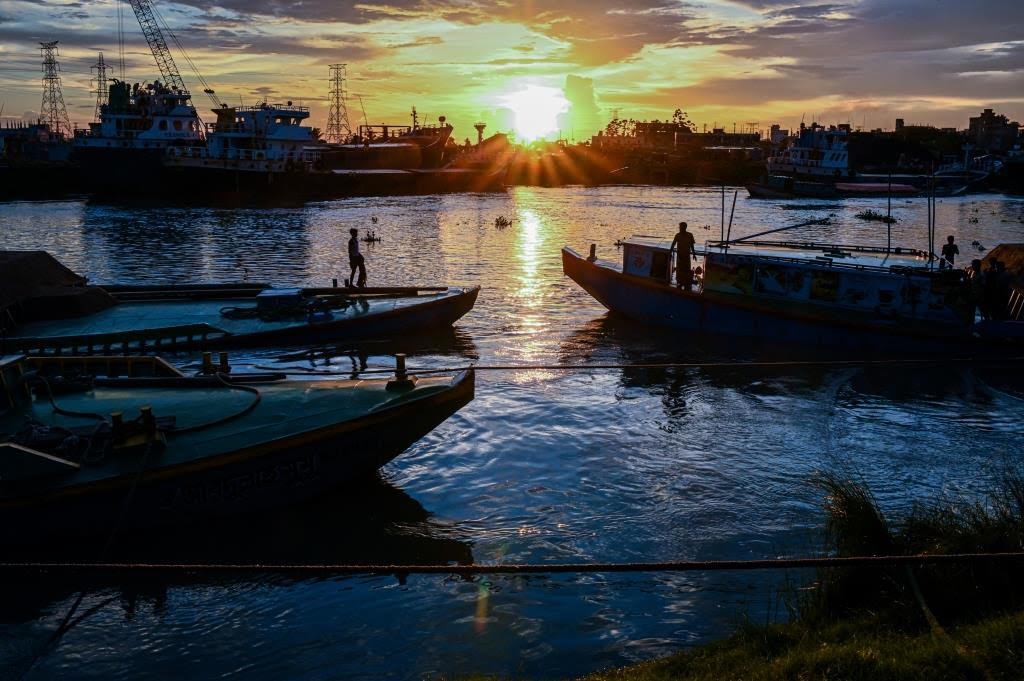
River Buri Ganga, lifeline of Dhaka, and the port at Gatboli
By Vikas Bajpai* 
Earlier this month I was in Dhaka to attend a one on one photography workshop with an extremely talented Bangladeshi photographer GMB Aakash. As I was set to leave for Dhaka a student of mine remarked – “Comrade, tussi abroad challe ho” (comrade, you are going abroad)? Nothing could have been more tragic for me than to feel like being ‘abroad’ in Bangladesh. I told my student friend – “I would just like to feel like being at home in Dhaka; like an overdue homecoming.”
My affliction here does not owe to any reason endogenous to me; it simply is for the reason that we are the same people either across our western border or the eastern border, united by a shared history extending over thousands of years. The borders albeit are only 75 years old and it is my belief that if people across the sub-continent could have their way, the borders, as a barrier to free intermingling of the people, would be gone sooner than later.
I need to admit here that Bangladesh did not disappoint me even in the least. Upon arrival as the immigration official at the airport saw my passport a smile crossed his face. “Welcome to Bangladesh Sir. You are from JNU! It’s a great university; at least the greatest in South Asia and you are in a great profession.” This was no coincidence, for on my return another officer at the immigration said much the same thing.
But this was not the first time that I earned plaudits from a Bangladeshi in Bangladesh for simply being part of the Jawaharlal Nehru University (JNU). There is a small village ‘Dawki’ on Indo-Bangladesh border in south-east Meghalaya where the Umngot river forms a lake on the Indian side before flowing across the border into Bangladesh. It is a picnic spot where the common people seemed to have sway over the paramilitary Border Guards right on the border, both in India and Bangladesh. I had been to the place in December 2017.
A rather modest nylon rope, stretched across the river to mark the border, seemed to bear the audacity of dividing thousands of years of our shared history into India and Bangladesh. But the people were equally intent, quite spontaneously rather than by design, upon mitigating the ‘audacity of the rope.’ Even as the hawkers on either side did brisk business by selling snacks to customers from either side, selfies were being clicked by picnickers from the two countries on either side of the ‘rope’, inside each other’s country.
It is there that I met a group of Bangladeshi students and some lawyers practicing in Bangladesh Supreme Court. Mere mention of being a professor at JNU earned me generous plaudits instantly along with an invite for a selfie in Bangladesh. The ‘rope’ was only a hapless witness to the will of the people.
I would let the plaudits rest here.
Before my arrival in Bangladesh, Aakash had asked me to come prepared with a wish list of what I would like to photograph. ‘People’ is all that I had in my mind. I told him that my interest was in the genre of photography where people would speak through my photographs, and so it was. 
We went almost exclusively to working class areas and among the workers during the workshop. They welcomed me with generous smiles and rarely declined a pose for the camera. Moreover, that I was from India elicited a measure of excitement and a lot of respect on their part – something, I believe, we in India need to learn from.
Here I have displayed some more impressions I have carried back with me. I just wish that these manage to nudge our opinions a little.
***
Opposite old Dhaka, across the Buri Ganga river there is this shipyard where old ships are refurbished and some smaller ones are forged anew from metal retrieved from breaking down old ships. I do not know the scale of it, but like India, Bangladesh is also a recipient of old ships from across the world to be broken down. 
The breaking down happens in Chittagong and the retrieved metal is then shipped to Dhaka by trawler boats and smaller ships where these labourers offload it. From what I saw, I can assure you that doing so is no mean task.
What I saw here were the feet that tirelessly bear the burden of this world, soiled even though they are; the hands that can hold up the sky, even though bonded into slavery of circumstances they are; burden off loaded to begin another round and the process goes on for at least eight hours a day; and a working woman, she steals a nap her mate keeps a strict vigil.
I met Anara Begom at Karwan Bazaar wholesale vegetable market, Dhaka. Anara’s husband was killed in Rawalpindi at the time of Bangladesh liberation war. She raised her children single handedly, and now that they are all married, she is left alone to fend for herself as her offspring can themselves manage only a hand to mouth existence.
Anara Begom
We found her tucked in a corner of Karwan Bazar sitting with an assortment of around a dozen pieces of vegetables on a mat waiting for a customer. All of her capital was worth no more than 10 to 15 takas, or so was her expectation. But who would buy this, one might wonder? As it was to be found, at Karwan Bazar there are layers within layers.
A headload worker
There are big wholesale traders, who supply the big and small retailers. In the transaction some vegetables fall off the sacks, or those that have started rotting in parts are discarded. Such vegetables are collected by people like Anara, washed, their decayed portions removed, and then sold to other poor people like her, of which there isn’t a dearth. Anara Begom thus manages to ward off the indignity of having to beg.
Then, there was a worker ferrying a headload of goods in the Karwan Bazar wholesale vegetable market; a worker enjoying a refreshing bath after the day’s hard work at Gabtoli cattle market in Dhaka; and a man and his machine (as I stood angling for this shot, I was incidentally reminded of Ritwik Ghatak’s 1958 film ‘Ajaantrik’).
Bangladesh is a land of mighty rivers. River Buri Ganga is the lifeline of Dhaka and the port at Gatboli is the busiest commercial port of the city handling major trade. Naturally then it is teeming with workers loading and unloading the ships. 
Nothing would exemplify better the adage -- ‘living by the sweat of the brow only to get browbeaten’ as these workers do. I captured lunch break at Gabtoli; Maimoona, who manages her tiny ‘dhaba’ (food stall) to provide cheapest possible food for the laborers at Gabtoli; an angry young man (I wonder, who will channelize his anger?); Rahimul and Khaleeda who ferry coal from the ships.
Maimoona, Rahimul, Khaleeda
Each basket of coal they ferry carries around 40 kg of coal which is to be offloaded at the depot that is around 100 meters from the ship. Each round trip earns them 3 takas and the count of the trips is kept by plastic tokens handed to them after each trip. Just calculate how many trips they would be making to earn a daily wage between 500 to 800 takas. It’s a sheer feat. Isn’t it humbling that they still managed a smile to make a great photograph. One can motice the kohl in Khaleeda’s eyes.
Then there was the proletarian Rambo, and a worker with flashy smile. You would have heard of descriptions like ‘Colgate smile’, ‘Binaca smile’ and ‘Cibaca smile’. His smile was twice as glorious as all three of them put together. Also, there was genial Hercules, Bilal Hossein, tall and muscular with broad shoulders on which rests the weight of many responsibilities.
He said that he toils hard so that his children can get all the education they need. I intervened just in time to prevent him from wiping out the beads of sweat on his countenance. The results are what they are. After the photograph was taken, Aakash asked the tea shop owner on site to open two one liter bottles of seven up for Bilal and his compatriots to quench their thirst.
As dusk cast its deep shadow over Gabtoli it was time to bid adieu.
---
*MD, MPH, PhD, Assistant Professor, Centre for Social Medicine and Community Health, Jawaharlal Nehru University New Delhi

Comments

TRENDING

Swami Vivekananda's views on caste and sexuality were 'painfully' regressive

By Bhaskar Sur* Swami Vivekananda now belongs more to the modern Hindu mythology than reality. It makes a daunting job to discover the real human being who knew unemployment, humiliation of losing a teaching job for 'incompetence', longed in vain for the bliss of a happy conjugal life only to suffer the consequent frustration.

The golden crop: How turmeric is transforming women's lives in tribal India

By Vikas Meshram*   When the lush green fields of turmeric sway in the tribal belt of southern Rajasthan, Madhya Pradesh, and Gujarat, it is not merely a spice crop — it is the golden glow of self-reliance. In villages where even basic spices once had to be bought from the market, the very soil today is yielding a prosperity that has transformed the lives of thousands of families. At the heart of this transformation is the initiative of Vaagdhara, which has linked turmeric with livelihoods, nutrition, and village self-governance — gram swaraj.

Buddhist shrines were 'massively destroyed' by Brahmanical rulers: Historian DN Jha

Nalanda mahavihara By Rajiv Shah  Prominent historian DN Jha, an expert in India's ancient and medieval past, in his new book , "Against the Grain: Notes on Identity, Intolerance and History", in a sharp critique of "Hindutva ideologues", who look at the ancient period of Indian history as "a golden age marked by social harmony, devoid of any religious violence", has said, "Demolition and desecration of rival religious establishments, and the appropriation of their idols, was not uncommon in India before the advent of Islam".

Authoritarian destruction of the public sphere in Ecuador: Trumpism in action?

By Pilar Troya FernĂ¡ndez  The situation in Ecuador under Daniel Noboa's government is one of authoritarianism advancing on several fronts simultaneously to consolidate neoliberalism and total submission to the US international agenda. These are not isolated measures, but rather a coordinated strategy that combines job insecurity, the dismantling of the welfare state, unrestricted access to mining, the continuation of oil exploitation without environmental considerations, the centralization of power through the financial suffocation of local governments, and the systematic criminalization of all forms of opposition and popular organization.

Echoes of Vietnam and Chile: The devastating cost of the I-A Axis in Iran

​ By Ram Puniyani  ​The recent joint military actions by Israel and the United States against Iran have been devastating. Like all wars, this conflict is brutal to its core, leaving a trail of human suffering in its wake. The stated pretext for this aggression—the brutality of the Ayatollah Khamenei regime and its nuclear ambitions—clashes sharply with the reality of the diplomatic landscape. Iran had expressed a willingness to remain at the negotiating table, signaling a readiness to concede points emerging from dialogue. 

False claim? What Venezuela is witnessing is not surrender but a tactical retreat

By Manolo De Los Santos  The early morning hours of January 3, 2026, marked an inflection point in Venezuela and Latin America’s centuries-long struggle for self-determination and independence. Operation Absolute Resolve, ordered by the Trump administration, constituted the most brutal and direct military assault on a sovereign state in the region in recent memory. In a shocking operation that left hundreds dead, President NicolĂ¡s Maduro and First Lady Cilia Flores were illegally kidnapped from Venezuelan soil and transported to the United States, where they now face fabricated charges in a New York federal detention facility. In the two months since this act of war, a torrent of speculation has emerged from so-called experts and pundits across the political spectrum. This has followed three main lines: One . The operation’s success indicated treason at the highest levels of the Bolivarian Revolution. Two . Acting President Delcy RodrĂ­guez and the remaining leadership have abandone...

The selective memory of a violent city: Uttam Nagar and the invisible victims of Delhi

By Sunil Kumar*  Hundreds of murders take place in Delhi every year, yet only a few incidents become topics of nationwide discussion. The question is: why does this happen? Today, the incident in Uttam Nagar has become the centre of national debate. A 26-year-old man, Tarun Kumar, was killed following a dispute that reportedly began after a balloon hit a small child. In several colonies of Delhi, slogans such as “Jai Shri Ram” and “Vande Mataram” are being raised while demanding the death penalty for Tarun’s killers. As a result, nearly 50,000 residents of Hastsal JJ Colony are now living in what resembles a state of confinement. 

The price of silence: Why Modi won’t follow Shastri, appeal for sacrifice

By Arundhati Dhuru, Sandeep Pandey*  ​In 1965, as India grappled with war and a crippling food crisis, Prime Minister Lal Bahadur Shastri faced a United States that used wheat shipments under the PL-480 agreement as a lever to dictate Indian foreign policy. Shastri’s response remains legendary: he appealed to the nation to skip one meal a day. Millions of middle-class households complied, choosing temporary hunger over the sacrifice of national dignity. Today, India faces a modern equivalent in the energy sector, yet the leadership’s response stands in stark contrast to that era of self-reliance.

Gujarat government urged to introduce heat-stress safety rules for construction workers

By A Representative   A representation submitted to Gujarat Labour, Skill Development and Employment Minister Kunvarji Bavaliya has urged the state government to introduce legally enforceable safety standards to protect construction workers from extreme heat and heatwaves, and to launch a financial assistance scheme for labourers affected by climate-related health risks.