 |
“The poetry of earth is never dead” – John Keats
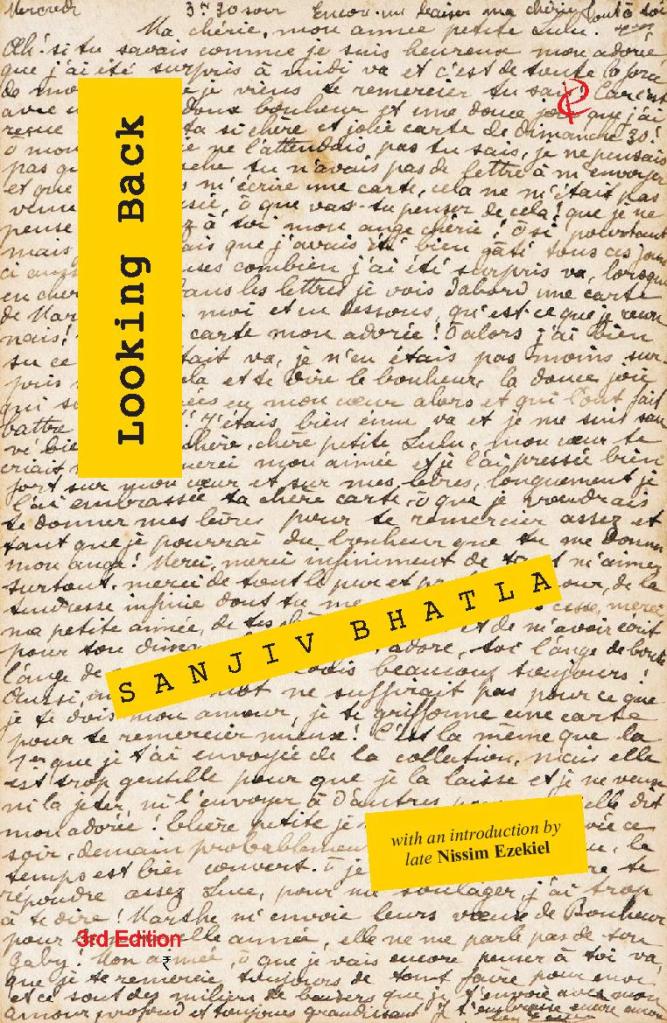
“Looking Back” is Sanjiv Bhatla’s maiden collection of poems. He has several authoritative and scholarly works on religious and spiritual subjects also to his credit. His poems are equally brilliant and bear out the finer sensibilities in him. His anthology was originally published by Orient Longman (now Orient Black Swan).It has now been brought in its new avatar by Crabwise Press. There are minor changes in the edition but the original flavor remains the same. In his brief but pithy introduction, Nissim Ezekiel describes Bhatla as a poet of “great promise ‘and is able to spot the subtle flashes of brilliance that only a great poet like him can decipher in the work of an emerging poet. He writes “…Lovers of serious and difficult poetry have much to brood over when they confront the subtle characters who appear in this book…they remain convincingly human in Sanjiv’s perception of them. He is not their Creator but their Companion, exemplary in his sympathy, even if mildly ironic…”
In ‘My Country Friend And I On A Train Journey’ we have the typical tale of the milkman portrayed with dry irony and wry humor. The ’Café Intellectual’ is a typical satire written in the poet’s characteristic style. Most poems of Bhatla are not fully evolved, using pregnant phrases, revealing partial truths but hinting at possibilities as thoughts are tossed about to germinate and sprout.
Bhatla’s clear-eyed attention and his sensitive mind bring each subject starkly into focus. The economy of words and clarity combined with deft phrasing, grace and wit create an immediacy that is surreal. For instance,
“Life here bustles with activity/ Busy men rushing about everywhere/ in passages and undergrounds; traffic/ tantrums in the sun”
Poetry has been one of the most ancient creative channels for man. With the birth of writing came the efflorescence of poetry. It became the vehicle of expression for all great men, philosophers, saints, savants and even kings.
Like in the case of most modern poets, Bhatla’s poetry is impatient with tradition, unwilling to tolerate any form of binding or control. Bhatla keeps innovating and therefore sheds conventions, abandons set forms, and is always ready to redefine paradigms. The poems demonstrate that in a world being rendered almost totally comprehensible, it is poetry which surprises us by its discoveries, its ever-lively sense of mystery of the universe, its attempt to restore the mysterious, to rehabilitate the sacred and to reiterate the abiding reverence for all life. Just sample this verse to get a peek into Bhatla’s craftsmanship:
“A cat now gapes, sitting/ atop a junked car-hulk lying/ in the backyard of a haunted/ house. Now I find it/ easier/ to develop a logic above pride”
Bhatla casts away the floridity of colonial Indian English verse and uses naturalized language to describe the colours, the heat, the skies, the light, the animals, the surroundings and the crowds in the Indian situation, and breathes Indianness in every poem. He handles complicated and messy subjects with a strong sense of formal order and emotional restraint. We can find meaning and vitality in the verse, “how personal dilemmas can so easily imply/human misery over a cup of coffee?” and “some unformed poem ceaselessly/turning in a poet’s mind, heedless/of the poet’s imploration, netting facts”.
Bhatla’s is a style (and temperament) that is understated, seeking to understand and learn, rather than preach. This is the mark of the liberal, and also perhaps of the poet. The liberal is attentive to the waywardness of social life; the poet, to the incongruities he can spot in human characters. There is an appealing hesitancy to the poems of Bhatla, which comes from a desire to interpret rather than judge.
“Outside, there stood a demon/ Stooping, raking a fire/ That glittered in his big eyes/ Just above the windowsill”
Bhatla’s bold attempt to pursue poetry may come as a strong riposte to those who believe “Poetry is dead, long live poetry!” All these critics miss the broader point. Poetry can’t meet its demise, any more than air or water can die, because poetry in the more expansive sense is not “poetry” in the narrow. Poetry is currency; it is permeative; and it is, thankfully, too big to die. By meaning that poetry is permeative, I would like to emphases that the poetic alchemy of Bhatla is always synthesizing: trying to relate each subject of observation to some other force, phenomenon, or abstract — to find the links between self and community, past and present, inspiration and its source.
One needs to immerse in Bhatla’s poems with great seriousness because the train of thoughts moves at an enormous velocity. Those who are familiar with Bhatla’s prose understand the intense philosophical vigour that permeates Bhatla’s writings. Professor Alastair Niven, who was then the Editor of Journal of Commonwealth Literature (in the late 1980s), wrote about this book: “I am happy to have encountered Sanjiv Bhatla’s immediate and often very touching poems: a series of gentle yet vivid vignettes.”
—
*Development expert
“Looking Back” is Sanjiv Bhatla’s maiden collection of poems. He has several authoritative and scholarly works on religious and spiritual subjects also to his credit. His poems are equally brilliant and bear out the finer sensibilities in him. His anthology was originally published by Orient Longman (now Orient Black Swan).It has now been brought in its new avatar by Crabwise Press. There are minor changes in the edition but the original flavor remains the same. In his brief but pithy introduction, Nissim Ezekiel describes Bhatla as a poet of “great promise ‘and is able to spot the subtle flashes of brilliance that only a great poet like him can decipher in the work of an emerging poet. He writes “…Lovers of serious and difficult poetry have much to brood over when they confront the subtle characters who appear in this book…they remain convincingly human in Sanjiv’s perception of them. He is not their Creator but their Companion, exemplary in his sympathy, even if mildly ironic…”
In ‘My Country Friend And I On A Train Journey’ we have the typical tale of the milkman portrayed with dry irony and wry humor. The ’Café Intellectual’ is a typical satire written in the poet’s characteristic style. Most poems of Bhatla are not fully evolved, using pregnant phrases, revealing partial truths but hinting at possibilities as thoughts are tossed about to germinate and sprout.
Bhatla’s clear-eyed attention and his sensitive mind bring each subject starkly into focus. The economy of words and clarity combined with deft phrasing, grace and wit create an immediacy that is surreal. For instance,
“Life here bustles with activity/ Busy men rushing about everywhere/ in passages and undergrounds; traffic/ tantrums in the sun”
Poetry has been one of the most ancient creative channels for man. With the birth of writing came the efflorescence of poetry. It became the vehicle of expression for all great men, philosophers, saints, savants and even kings.
Like in the case of most modern poets, Bhatla’s poetry is impatient with tradition, unwilling to tolerate any form of binding or control. Bhatla keeps innovating and therefore sheds conventions, abandons set forms, and is always ready to redefine paradigms. The poems demonstrate that in a world being rendered almost totally comprehensible, it is poetry which surprises us by its discoveries, its ever-lively sense of mystery of the universe, its attempt to restore the mysterious, to rehabilitate the sacred and to reiterate the abiding reverence for all life. Just sample this verse to get a peek into Bhatla’s craftsmanship:
“A cat now gapes, sitting/ atop a junked car-hulk lying/ in the backyard of a haunted/ house. Now I find it/ easier/ to develop a logic above pride”
Bhatla casts away the floridity of colonial Indian English verse and uses naturalized language to describe the colours, the heat, the skies, the light, the animals, the surroundings and the crowds in the Indian situation, and breathes Indianness in every poem. He handles complicated and messy subjects with a strong sense of formal order and emotional restraint. We can find meaning and vitality in the verse, “how personal dilemmas can so easily imply/human misery over a cup of coffee?” and “some unformed poem ceaselessly/turning in a poet’s mind, heedless/of the poet’s imploration, netting facts”.
Bhatla’s is a style (and temperament) that is understated, seeking to understand and learn, rather than preach. This is the mark of the liberal, and also perhaps of the poet. The liberal is attentive to the waywardness of social life; the poet, to the incongruities he can spot in human characters. There is an appealing hesitancy to the poems of Bhatla, which comes from a desire to interpret rather than judge.
“Outside, there stood a demon/ Stooping, raking a fire/ That glittered in his big eyes/ Just above the windowsill”
Bhatla’s bold attempt to pursue poetry may come as a strong riposte to those who believe “Poetry is dead, long live poetry!” All these critics miss the broader point. Poetry can’t meet its demise, any more than air or water can die, because poetry in the more expansive sense is not “poetry” in the narrow. Poetry is currency; it is permeative; and it is, thankfully, too big to die. By meaning that poetry is permeative, I would like to emphases that the poetic alchemy of Bhatla is always synthesizing: trying to relate each subject of observation to some other force, phenomenon, or abstract — to find the links between self and community, past and present, inspiration and its source.
One needs to immerse in Bhatla’s poems with great seriousness because the train of thoughts moves at an enormous velocity. Those who are familiar with Bhatla’s prose understand the intense philosophical vigour that permeates Bhatla’s writings. Professor Alastair Niven, who was then the Editor of Journal of Commonwealth Literature (in the late 1980s), wrote about this book: “I am happy to have encountered Sanjiv Bhatla’s immediate and often very touching poems: a series of gentle yet vivid vignettes.”
—
*Development expert
Comments