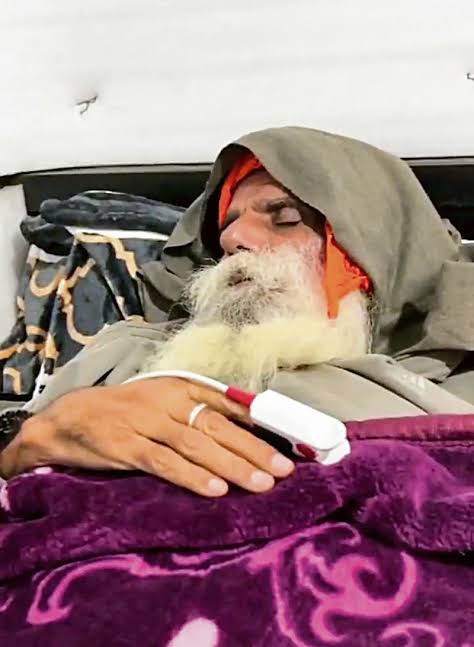
Dallewal's fast unto death: A landmark in the history of nonviolent resistance against injustice

By Prem Singh 
On 5 March 2025, one hundred days passed since Jagjit Singh Dallewal began his protest fast. Discussions continue on issues such as the Minimum Support Price (MSP) for crops, other demands put forth under the aegis of the Samyukt Kisan Morcha (non-political) and Kisan Mazdoor Morcha, negotiations with the government, and coordination with the Samyukt Kisan Morcha (SKM). Dallewal’s protest fast, too, continues. But if it stretches on much longer, there is a serious fear that it may turn into a maran vrat (fast unto death).
As a result of the farmers' protest at Delhi's Singhu border in 2020–21, the government withdrew the three agricultural laws. Since then, the yaksha prashn remains: How can the country’s vast agricultural sector survive the rapidly increasing corporatization of education, healthcare, and other service sectors, including public sector enterprises? Economists have yet to question the private capital being worshipped in corporate India—and how much of that capital is looted public wealth. It is hoped that economists like Professor Arun Kumar, who has extensively explained the scale of black money in the Indian economy, will also address this central issue. Whatever the case, a decisive point in the clash between farmers and corporate powers does not appear imminent.
However, regarding Jagjit Singh Dallewal's fast, which has now surpassed 100 days, it can be said with certainty that it has become a landmark in the history of nonviolent resistance against injustice. The significance of this fast increases when we consider that it has restored the credibility, dignity, and strength of protest fasts. I do not wish to mention here those fasts that are staged for self-promotion. Instead, I refer to the observation made by Abhimanyu Kohar, convener of the protest ongoing for over a year at the Khanauri border, who points out that while the media covered Anna Hazare’s 13-day fast in 2011 around the clock, they have devoted barely a fraction of that attention to Jagjit Singh Dallewal's long and determined fast.
In fact, the comparison is flawed from the outset. The truth was evident even then that Anna Hazare fasted for the media. The forces involved in that episode and their intentions were no secret. Its outcome was along expected lines: India’s national and social life fell further under the grip of the corporate-communal nexus.
Seriousness, dignity, and humility have always been maintained in Jagjit Singh Dallewal's satyagraha fast. Dallewal and the farmer leaders and supporters participating in the movement have refrained from turning the fasting site into a platform for speeches. This discipline has upheld the belief that the long-cherished value of “weighing one's words” has not been lost entirely in today’s cacophony. Needless to say, Jagjit Singh Dallewal prepared himself for this fast. Before beginning it, he completed certain worldly duties in order to detach himself. At the time, even some of his close colleagues did not fully realize that he was embarking on a maran vrat.
With Dallewal’s fast, there has indeed been a small revolution in the nonviolent mode of resistance—a single individual standing fearlessly against injustice through satyagraha, civil disobedience, and fasting. Mohandas Gandhi employed this method in India’s freedom movement, drawing inspiration from global traditions. Dr. Ram Manohar Lohia, describing Gandhi's nonviolent action as “the most revolutionary core of his teachings,” writes:
“The greatest revolution of our time is, therefore, a procedural revolution: removal of injustice through a mode of action characterized by justice. The question here is not so much the content of justice as the method to achieve it. Constitutional and orderly processes are often not enough. They are then transgressed by the use of weapons. In order that this should not happen, and that man should not ever get thrown around between ballot and bullet, this procedural revolution of civil disobedience has emerged. At the head of all revolutions of our time stands this revolution of satyagraha against weapons...”
(Marx, Gandhi, and Socialism, pp. xxxi–xxxii)
It is now accepted common sense that the three agricultural laws withdrawn by the government will eventually be reintroduced, in the same or an altered form. The government itself said, “The laws are being withdrawn, not repealed.” This outcome is inevitable due to the neoliberal consensus prevailing among the political and intellectual elite of the country. But this does not lessen the need for resistance, nor diminish its value. As long as even a single citizen of this country stands opposed to corporatization and in favor of freedom, self-reliance, and sovereignty, the need for resistance will remain.
Governments can fire bullets. They can rig elections. But citizens who disagree with government decisions have the option to offer resistance—even at the risk of their lives. This satyagraha fast by Jagjit Singh Dallewal is an open, nonviolent rebellion by him and his fellow farmers against the corporate dictates of the government. Lohia, at the end of his above statement, lamented that despite its moral value and righteousness, the nonviolent mode of resistance had “made only a faltering appearance to date.”
The protest fast and resistance at Khanauri border offer reassurance against this concern; they have resurrected the nonviolent mode of protest against injustice and infused new faith in its credibility, dignity, and strength.
---
The writer, associated with the socialist movement, is a former teacher at Delhi University and a former fellow of the Indian Institute of Advanced Study, Shimla

Comments

TRENDING

Swami Vivekananda's views on caste and sexuality were 'painfully' regressive

By Bhaskar Sur* Swami Vivekananda now belongs more to the modern Hindu mythology than reality. It makes a daunting job to discover the real human being who knew unemployment, humiliation of losing a teaching job for 'incompetence', longed in vain for the bliss of a happy conjugal life only to suffer the consequent frustration.

Was Netaji forced to alter face, die in obscurity in USSR in 1975? Was he so meek?

  By Rajiv Shah   This should sound almost hilarious. Not only did Subhas Chandra Bose not die in a plane crash in Taipei, nor was he the mysterious Gumnami Baba who reportedly passed away on 16 September 1985 in Ayodhya, but we are now told that he actually died in 1975—date unknown—“in oblivion” somewhere in the former Soviet Union. Which city? Moscow? No one seems to know.

Love letters in a lifelong war: Babusha Kohli’s resistance in verse

By Ravi Ranjan*  “War does not determine who is right—only who is left.” Bertrand Russell’s words echo hauntingly in our times, and few contemporary Hindi poets embody this truth as profoundly as Babusha Kohli. Emerging from Jabalpur, Madhya Pradesh, Kohli has carved a unique space in literature by weaving together tenderness, protest, and philosophy across poetry, prose, and cinema. Her work is not merely artistic expression—it is resistance, refuge, and a call for peace.

The golden crop: How turmeric is transforming women's lives in tribal India

By Vikas Meshram*   When the lush green fields of turmeric sway in the tribal belt of southern Rajasthan, Madhya Pradesh, and Gujarat, it is not merely a spice crop — it is the golden glow of self-reliance. In villages where even basic spices once had to be bought from the market, the very soil today is yielding a prosperity that has transformed the lives of thousands of families. At the heart of this transformation is the initiative of Vaagdhara, which has linked turmeric with livelihoods, nutrition, and village self-governance — gram swaraj.

Authoritarian destruction of the public sphere in Ecuador: Trumpism in action?

By Pilar Troya Fernández  The situation in Ecuador under Daniel Noboa's government is one of authoritarianism advancing on several fronts simultaneously to consolidate neoliberalism and total submission to the US international agenda. These are not isolated measures, but rather a coordinated strategy that combines job insecurity, the dismantling of the welfare state, unrestricted access to mining, the continuation of oil exploitation without environmental considerations, the centralization of power through the financial suffocation of local governments, and the systematic criminalization of all forms of opposition and popular organization.

Echoes of Vietnam and Chile: The devastating cost of the I-A Axis in Iran

​ By Ram Puniyani  ​The recent joint military actions by Israel and the United States against Iran have been devastating. Like all wars, this conflict is brutal to its core, leaving a trail of human suffering in its wake. The stated pretext for this aggression—the brutality of the Ayatollah Khamenei regime and its nuclear ambitions—clashes sharply with the reality of the diplomatic landscape. Iran had expressed a willingness to remain at the negotiating table, signaling a readiness to concede points emerging from dialogue. 

Buddhist shrines were 'massively destroyed' by Brahmanical rulers: Historian DN Jha

Nalanda mahavihara By Rajiv Shah  Prominent historian DN Jha, an expert in India's ancient and medieval past, in his new book , "Against the Grain: Notes on Identity, Intolerance and History", in a sharp critique of "Hindutva ideologues", who look at the ancient period of Indian history as "a golden age marked by social harmony, devoid of any religious violence", has said, "Demolition and desecration of rival religious establishments, and the appropriation of their idols, was not uncommon in India before the advent of Islam".

The price of silence: Why Modi won’t follow Shastri, appeal for sacrifice

By Arundhati Dhuru, Sandeep Pandey*  ​In 1965, as India grappled with war and a crippling food crisis, Prime Minister Lal Bahadur Shastri faced a United States that used wheat shipments under the PL-480 agreement as a lever to dictate Indian foreign policy. Shastri’s response remains legendary: he appealed to the nation to skip one meal a day. Millions of middle-class households complied, choosing temporary hunger over the sacrifice of national dignity. Today, India faces a modern equivalent in the energy sector, yet the leadership’s response stands in stark contrast to that era of self-reliance.

False claim? What Venezuela is witnessing is not surrender but a tactical retreat

By Manolo De Los Santos  The early morning hours of January 3, 2026, marked an inflection point in Venezuela and Latin America’s centuries-long struggle for self-determination and independence. Operation Absolute Resolve, ordered by the Trump administration, constituted the most brutal and direct military assault on a sovereign state in the region in recent memory. In a shocking operation that left hundreds dead, President Nicolás Maduro and First Lady Cilia Flores were illegally kidnapped from Venezuelan soil and transported to the United States, where they now face fabricated charges in a New York federal detention facility. In the two months since this act of war, a torrent of speculation has emerged from so-called experts and pundits across the political spectrum. This has followed three main lines: One . The operation’s success indicated treason at the highest levels of the Bolivarian Revolution. Two . Acting President Delcy Rodríguez and the remaining leadership have abandone...