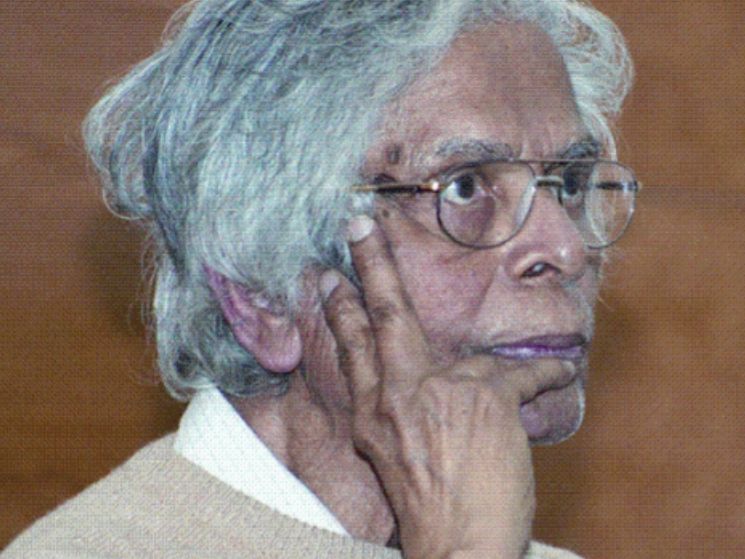
The evergreen Marxian socialist scholar and critic of Marxism, Paresh Chattopadhyay (PC) left us on January 14, 2023, in Montreal, Quebec, Canada, at age of 96.He was emeritus professor of political economy in the department of sociology at the University of Quebec, Montreal.
With in depth mastery of Marxism, PC made his readers think and reflect over what he wrote, with an independent bent of mind. His research penetrated boundaries almost unscaled, by any Marxist historian or economist. It is remarkable that Paresh , in the thick of the scenario of times when Marxism has been given a crippling blow by counter revolutionary forces or imperialism in the form of globalisation, penetrating the globe on an unparalleled scale, stuck to his task of shimmering spark of Marxism, with the solidity of a boulder.
Paresh Chattopadhyay should be revered for sheer single mindedness or relentless spirit. He unflinchingly stuck to the task as a Marxian socialist scholar and intellectual, to add to the treasury an understanding and clarification of what Marx and Engels, as revolutionists, considered imperative for the world’s proletariat to liberate itself and all the world’s oppressed, exploited, and dominated—the overthrow of capital and capitalism along with the state institutions capitalism had placed on this earth.
I commend PC’s deep insight into how bureaucracy crept in USSR in Lenin’s time itself. with exclusive power placed in the hands of the Bolshevik party and negation of democracy within Soviets. He illustrated a classical dictatorship of the proletariat was not established, as Marx professed.
During the last decade of his life PC tirelessly insisted that all of us interested in Marx’s Critique of Political Economy as a discipline must study the corresponding texts in the original languages and he tried to set an example, wherever possible, through his own use of Marx’s texts in the original languages.
Today’s generation should unhesitatingly study the works of Paresh Chattopadhyay to gain powerful insight into Marxian economy and politics, as well as Marxist activities to be able to critically analyse setbacks in the Communist Movement.
Writings and Works
As a young scholar and a State Doctorate in Economic Sciences (1964), University of Paris, a major influence was the French Marxian economist and historian, Charles Bettelheim (1913–2006), with whom PC had established a close relationship over a long period. Undoubtedly, PC was impressed by Bettelheim’s magnum opus, Class Struggles in the USSR, First Period: 1917-1923 (1974), Class Struggles in the USSR, Second Period: 1923-1930 (1977), Class Struggles in the USSR, Third Period: 1930–1941, Part One: The Dominated (1994), and Class Struggles in the USSR, Third Period: 1930–1941, Part Two: The Dominators (1996), especially the first two volumes. However, he disagreed with Bettelheim’s diagnosis made in a 1985 mimeograph in French that Marxian concepts were insufficient in analysing the Soviet economy because of the “new forms of capitalist relations” in Soviet type societies. By the 1980s, interpreting Soviet history in the context or telescope of what Marx understood as socialism, and using Marxian categories to grasp what had gone wrong, turned into PC’s objective as a Marxian socialist scholar. Based largely on a stream of his published research papers between 1981 and 1993, PC published his first major work analysing the Soviet economy within a Marxian theoretical framework, using Marx’s method and categories – The Marxian Concept of Capital and the Soviet Experience: Essay in the Critique of Political Economy (1994).PC reminds his readers that in his Afterword to the second German edition of Capital, Volume I, and Marx wrote: “In so far as this critique represents a class it can only represent that class whose historical mission/profession [Beruf] is to revolutionise the capitalist mode of production and, finally to abolish classes.” For capital, in Marx’s understanding, as PC reminds readers, is a specific social relation of production represented in stock, means of production, accumulated labour, and so on, at a particular phase of human history.
The chapters on “Socialism and Emancipation” and “The New Society: Towards a De-alienated World,” have powerful overtones of classical Marxian analysis. For instance, in PC explaining what Marx meant by “free individuals” in a “free society” in his conception of socialism—“individuals who are neither personally dependent as in different forms of slavery and serfdom, system[s] of caste and race servitude, and patriarchy, [and] not materially dependent as in capitalism,” this in a free society where there is “collective ownership of the means of production, and with no classes, no state and no pillars of oppression, exploitation, and alienation.” Or again, in PC’s exposition of Marx’s discerning of three broad stages in the evolution of the human society—one, wherein there is “subjective or personal dependence, “two, wherein there is “personal independence but objective or material dependence, “and three, in socialism as conceived by Marx, where there would be “free individuality with neither personal nor objective dependence. “The “appropriation of the ‘means of labour’ by the collective body of the freely associated individuals,” Marx expected, would take humanity towards a ‘reunion,’ which, once established, would complete the long transition from the society of “alienated, fragmented individuals” to one of de-alienated, “freely associated individuals.”.
By the 1980s, assessing Soviet history in the light of what Marx interpreted as socialism, and using Marxian parameters s to comprehend what had gone wrong, became PC’s exclusive goal as a Marxian socialist scholar. Based largely on a stream of his published research papers between 1981 and 1993, PC published his first major work analysing the Soviet economy within a Marxian theoretical framework, using Marx’s method and categories – The Marxian Concept of Capital and the Soviet Experience: Essay in the Critique of Political Economy (1994).
In this book, capital as social total capital was projected as a social relation of production and as the private property of a class, with the enlarged reproduction of the exploited wage labourers separated from the conditions of production. The accumulation of capital was the independent variable and the employment of labour the dependent variable. The Soviet economy, under the control of the “completely autonomized Party-State,” was galvanised by goal to surpass the advanced capitalist economies, mainly by quantitative intensifying of production, without taking imperative steps to revolutionise the methods of production. However such a mode of accumulation of capital reached its limit of absolute over accumulation of capital, i.e., not being able to match the productivity increases in Western capitalism, leading to a fall in the rate of profit and difficulty in increasing the total surplus value/total profit, which formed the basis of the regime’s collapse.PC confronts both the idea that the Soviet economy was socialist, and that the post-revolutionary society was neither capitalist nor socialist. The main proponent of this thesis was Paul Sweezy.
‘PC’s last book, Socialism in Marx’s Capital: Towards a De-alienated World (2021), makes a case for going beyond Marx’s critique of the Gotha Programme, by bringing in Capital and related work regarding political economy—the 1857–58 manuscripts, the Grundrisse, the 1959 Contribution to the Critique of Political Economy, and the 1881 last manuscript for volume two of Capital—into the discussion of socialism in Marx’s works.
Critique of Leninism or other Disciples of Marx
The principal theme of Chattopadhay was that Marx’s disciples converted his libertarian conception of socialism into a monopoly of Party-State affair – rule by a Communist party, not controlled by workers, with the means of production owned by the state, but “retaining the wage/salary system and commodity production.” PC argues that despite Lenin’s “original libertarian position,” close to Marx and Engels, in his State and Revolution, Lenin interpreted Marx wrongly on a few counts. Lenin confused socialism (calling it the first stage of communist society) with the period of revolutionary transformation when there is the need for a “dictatorship of the proletariat.As to Marxian socialism, conceived originally by Marx as “a society of free and associated producers without state, commodity production, and wage labour”.In Paresh Chattopadhaya’s view, Soviet society was completely devoid of human emancipatory character. and the Party-State replaced the dictatorship over the proletariat, the producers having been transformed into wage labourers. For PC, the wage-labour relationship was necessary and sufficient for the existence of capital and capitalism.
In three books – Marx's Associated Mode of Production: A Critique of Marxism (2016), Socialism and Commodity Production: Essay in Marx Revival (2018), and Socialism in Marx’s Capital: Towards a De-alienated World (2021). PC expressed as in 2016: “Marx’s liberating idea of a noble and humane society as the real alternative to the nightmare that capitalism has led to is more relevant than ever before.” Marx’s Associated Mode of Production is, again, about how Marx visualised the process of human liberation from bondage as freedom. Tragically, those who considered themselves his disciples distorted his texts.
For Marx and Engels, proletarian revolution was meant to be the work of the “immense majority in the interest of the immense majority,” wherein the proletariat, leading itself, was to first gain political power, then “expropriate the expropriators” by degrees, and assume the position of the ruling class, followed uninterruptedly by the “revolutionary transformation period.” Only at the end of this period, with the “disappearance of the capitalist class and with it the proletariat and the class rule altogether,” the revolution reaches its goal, inaugurating the Association of Free and Equal Individuals, this, a society “with no private ownership in the means of production and communication, no wage/salary system, no commodity-money relation and no state.”
The book, however, includes chapters on Marx’s 1844 Parisian manuscripts with its central theme of alienation and beyond alienation, Marx’s original examination of political economy in 1844–1847; a Marxian illustration of post-capitalist society; the dialectic of labour in the critique of political economy; how Marx perceived women’s labour under; Marx on the “global reach of capital” (“capital’s globalising tendency as its central characteristic”); crisis theory in Marx’s 1860s economic manuscripts; “market socialism” as a theoretical configuration; whether capitalist development is “a necessary precondition for the passage to the new society”; and Marx’s 1875 critical “marginal notes,” illustrating that Marx’s socialism was not even attempted in “twentieth-century socialism.” Overall, the book demonstrates that Marx’s (and Engels’s) ideas had been deliberately misinterpreted or distorted by those who “came to power under the banner of Marx, calling themselves communists,” this to “justify their own pursuit of political power.”
In Socialism and Commodity Production: Essay in Marx Revival (PC 2018), PC refuted the anti-Stalin left, including “some of the most knowledgeable and open-minded Western scholars, such as (E. H.) Carr, (Issac) Deutscher, and (Paul) Sweezy, (who) came to believe that Lenin rather than Marx was right in holding that proletarian revolution could occur first, not in advanced countries, but in countries which were comparatively backward. The state, he considered as “an apparatus of coercion and repression,” which would have no reason to exist in a socialist society. Bureaucracy, which he traced to the divorce of state and civil society, he classed as “a particular self-contained society within the state.” This whole superstructure of capitalist society was to be shattered in the process of the proletariat gaining power.
In the new society, according to Marx, “there will no longer be government or state power distinct from society itself.”PC underlined Marx’s anti-state position. The dictatorship of the proletariat in the political transition period, which will represent “the immense majority in the interest of the immense majority,” must be “the least repressive form of state.” Following the second Five Year Plan (1933–37), the rulers of the Soviet Union proclaimed the victory of socialism at the end of the period of proletarian dictatorship, but what was singularly absent was “the emancipation of the working classes” as interpreted in the Marxist criteria.. Readers of the book, Socialism and Commodity Production, however, will benefit from PC’s finesse in exposition of commodity production; commodity production and socialism in Marx’s followers; socialist accounting; anarchist collectivism; guild socialism; market socialism; and the “problematic” of the non-capitalist road to socialism.
PC’s last book, Socialism in Marx’s Capital: Towards a De-alienated World (2021), ignites a spark for going beyond Marx’s critique of the Gotha Programme, by bringing in Capital and related work regarding political economy—the 1857–58 manuscripts, the Grundrisse, the 1959 Contribution to the Critique of Political Economy, and the 1881 last manuscript for volume two of Capital—into the discussion of socialism in Marx’s works. In Capital as a critique of the “bourgeois science” of political economy and of capitalism, Marx considered capitalism as a transitional society, which by its own organism, from its internal contradiction simmers the eruption of socialism visualised as an association of free and equal individuals.
PC, in the Marxian conception of revolution, the revolutionary period came to be divided into three sub-periods, capitalism in the process of being dislodged , the transitional period—the time span of the transition to a classless society—during which it was imperative to establish a “dictatorship of the proletariat,” and the initial period of socialism. There was a realisation that even after the first sub-period, the counterrevolution, patronised by imperialism, would have to be, overpowered and liquidated lacking which, there would be a likelihood of failure, defeat, or betrayal.
Paresh in classically Marxist manner illustrated how after the first sub-period of the revolution, a tightly knit revolutionary party under non-proletarian elite leadership had come to power, expropriated the bourgeoisie and the landowners, and more or less centralised all the organs of production in the hands of the state. In his view the societies in the second sub-period of the revolution, therefore, could not be properly diagnosed, in the orthodox Marxist context, societies in transition to socialism.
Errors of PC
Professor Paresh Chattopadhyay no doubt diagnosed inconsistencies or flaws in the socialist countries, but in my view, expressed a highly idealistic or ecclectical analysis on denying dictatorship of the proletariat and the role of the Communist party as a vanguard.He completely obliterates the mass line methods adopted by the Bolshevik party and the Chinese Communist Party which strived to elevate mass participation and people’s struggles from below.Paresh fails to comprehend how it was imperative for even Stalin and Mao to undertake certain steps and without a revolutionary party playing a vanguard role, would completely dismantle any framework of proletarian power.
PC completely relegated the great advances in Socialist production through collectivisation in Russia, Great Leap Forward and Cultural Revolution in China,the reasons for the defeat of Fascist forces by USSR in World war 2,the democratic form of power contrived in the Soviets and Communes or how encirclement of imperialist countries or penetration of counter revolutionaries, made it all the more imperative for the vanguard party to exercise it’s power.
He failed to diagnose the symmetrical developments of the teachings of Marx, Lenin and Mao or how they were an integral part of each other.
PC erroneously diagnosed that state in was, not that of the proletariat (and the semi-proletarian poor peasantry) organised as the ruling class, after the revolutions Russia and China.
PC’s critique of Lenin’s Marxism doesn’t respect the fact that in the period, 1917–23, it was imperative for Lenin ,to keep the ball of socialist perspective rolling even as the impact of circumstances and conditions on the ground made him steer the revolution towards realising realistic objectives .Capitalist “development of underdevelopment” on a world scale (continuing in the present), force revolutionaries in semi-peripheral/peripheral countries like Russia, China, Cuba, etc., to pave the way in embarking the long road to socialism, beginning on the basis of poverty. It is unfair to dismiss this as “Don Quixotism,” as PC does. Many of the industrial workers were semi- worker, semi- peasant, but Lenin and his comrades left no stone unturned to raise the consciousness of the toiling classes for overthrowing capitalism. PC should have kept in mind obliterated the fact that in 1914, Lenin and Rosa Luxemburg denounced the Second International’s betrayal of international working-class solidarity.
In a well analysed piece recently in ‘Frontier Weekly’ by Bernard De Mello sums up Chattopadhaya’s great contribution to Marxism and flaws on analysis of Lenin. Still Bernard fails to portray the ecclectism of Paresh in completely rejecting Stalin and Mao. However laudable it as overtones of being over apologetic to trends that equate bureacratism to vanguard party concept, give no cutting edge to the Cultural revolution in China and does not distinguish between the Socialist and capitalist road . Marxist intellectuals should write a rational critique of Paresh Chattapodhaya ‘s writings ,projecting his failure to respect Marxism as a developing science and exposing his idealist critique of Leninism. In it’s absence readers may be swayed and fail into trap of classical Marxism being incoherently updated about modus operandi Marxism function s in the present scenario.
---
Harsh Thakor is freelance Journalist who has undertaken extensive research on History of Communism. Thanks information from Bernard De Mello and Monthly Review
Comments