
'Move on to slash rural jobs scheme': Govt of India 'suppresses' open discourse on NREGA

By A Representative 

The civil society group NREGA Sangharsh Morcha (NSM), which has completed its one month of its 100-day dharna at Jantar Mantar in Delhi, has claimed the authorities appear to be bent on refusing to allow any public discussion about the manner in which the premier rural jobs scheme is sought to be undermined by the Government of India.
In a statement, NSM said, “The Delhi police has made it quite clear that no public discussion about NREGA will be allowed beyond Jantar Mantar”, where the dharna is taking place. This, it noted, became clear when “students and activists were detained by the Delhi Police in the middle of a public discussion on NREGA at the Arts Faculty, Delhi University, for which permission was withdrawn on the day of the event.”
The event, organised by a student organisation called Collective, was a discussion on the right to work and NREGA in particular. Renowned economist Jean Dreze, Richa Singh of the Sangatin Kisan Mazdoor Sangathan, Uttar Pradesh and Somnath of the Jan Sangharsh Manch, Haryana, were slated to speak at the event.
“However, the event had just begun when it was abruptly stopped by the police and the organisers, speakers and other students were taken to the Maurice Nagar police station. Somnath, two students from Delhi University and a foreign student were detained by the police for over three hours”, the statement said.
According to NSM, “This comes a day after the workers were removed from Jantar Mantar despite having obtained prior permission to organise a protest. The workers were asked to vacate the protest site or be removed by force by police personnel in order to make way for an event organised by the Aam Aadmi Party(AAP).”
It added, earlier, “The workers’ right to protest was disrupted by a rally organised by BJP party workers who took over most of the protest site while all other demonstrations were pushed to the sidelines. The protestors were unable to procure mics and even had to bring their own carpets as they were made to settle down in a tiny space beyond the police barricades.”
According to NSM, “These actions on the part of law enforcement authorities will go down in the list of ever-increasing encroachments on the citizens’ right to protest and the right to ask questions of their elected government, a phenomenon all too common in our country today. They are gross violations of the right to freedom of speech and expression and the right to peaceful assembly enshrined in the Constitution.”
“Moreover”, it said, “Such an atmosphere of state surveillance and repression points to the unfortunate reality where the space for dissent is shrinking day by day and the idea of democracy itself is under threat.”
It noted, “The poor and the marginalized are being attacked in a comprehensive way on two simultaneous counts -- first, with social security rights like the Mahatma Gandhi National Rural Employment Guarantee Act (MGNREGA) being undermined and attacked through budget cuts and illegal imposition of technological interventions. Secondly, being attacked when they raise their voice against these measures in a democratic and peaceful manner.”
According too NSM, during the month-long protest, various workers delegations had made attempts to meet officials of the Ministry of Rural Development (MoRD) to present their grievances. “But not only were they repeatedly turned away, Union Minister (MoRD) Giriraj Singh also denied having received any NREGA-related complaints in Parliament.”
“Finally”, it said, “On 21 March 2023, a worker delegation from Jharkhand managed to meet MoRD Secretary Shailesh Kumar Singh and Joint Secretary Amit Kataria but they seemed non-committal about the issues presented to them.” Additionally, it added, “Workers from West Bengal whose wages are pending since December 2021 and have not been given any NREGA work through FY 2022-23, have also filed complaints with the National Human Rights Commission.”
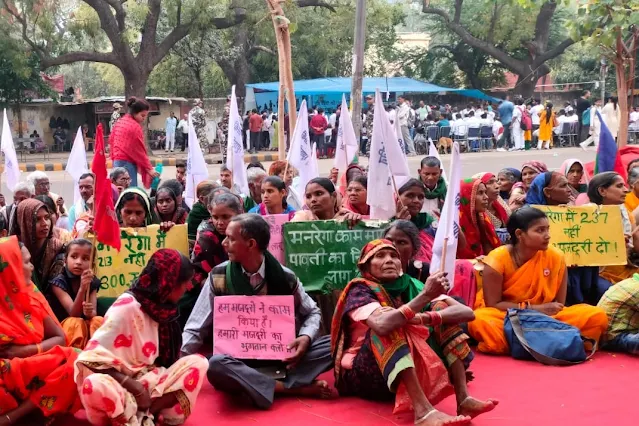
The demands put forward by NSM to the Government of of India include: 
  • removal of the National Mobile Monitoring Software (NMMS) App, which has become mandatory for "attendance" for the workers since January 1, 
  • reversal of the order dated 30 January, 2023 requiring all NREGA payments to be made via the Aadhar Based Payment System (ABPS), 
  • increase in the NREGA budget which has been drastically slashed, 
  • timely payment of wages and immediate release of wages that have been pending for over a year,
  • guaranteed provision of 200 work days annually, and 
  • increase wage-rate from INR 200 to INR 600 per diem.
Meanwhile, several NREGA workers testified at the dharna site as to how the ABPS system of payments was causing wreaking havoc in the villages, given more than 50% of NREGA workers’ bank accounts not being ABPS enabled. Workers were running from pillar to post to complete KYC formalities, often travelling for hours to link their Aadhaar with their job cards and bank accounts, it was stated.
Workers from Karnataka talked about village Hindalgi in Karnataka’s Belagum district, where none of the mates (supervisors under NREGA) have access to smartphones, making it impossible to mark attendance on the NMMS app. As a result, no work was carried out under NREGA in FY 2022-23, depriving many families of their sole source of income.
Workers from Uttar Pradesh raised concerns regarding the Centre’s discontinuation of NREGA funds to the state. They pointed out that if West Bengal funds have been halted due to allegations of corruption, there have been no such allegations in Uttar Pradesh. In spite of this, wages worth over Rs 200 crore owed to NREGA workers from Uttar Pradesh were pending as of 2 March 2023.
Rambeti, a 47-year old NREGA worker from Sitapur District, Uttar Pradesh told the dharna participants, “Because of the online attendance and the problems caused by it, our muster roll shows that we haven't worked, while we are working all seven days of the week and then we do not get paid. And with Aadhar being made mandatory, we are made to go from one office to another, to confirm our details, get KYC done repeatedly, and link Aadhaar with our job cards. But we continue to be told that our accounts are not ABPS-enabled.”
She claimed, she has not received her wages since January 2023 while many others have not been paid since October/ November of last year.
Madhav Maurya, a 36-year old from Hardoi district of Uttar Pradesh, added, “We have not been getting regular work for the past two years. We do not even get an unemployment allowance. When we do get some work, the wages are not cleared in time. It takes months to get the payment. They even make many deductions from the payment without giving any explanation.”

Comments

TRENDING

Grueling summer ahead: Cuttack’s alarming health trends and what they mean for Odisha

By Sudhansu R Das  The preparation to face the summer should begin early in Odisha. People in the state endure long, grueling summer months starting from mid-February and extending until the end of October. This prolonged heat adversely affects productivity, causes deaths and diseases, and impacts agriculture, tourism and the unorganized sector. The social, economic and cultural life of the state remains severely disrupted during the peak heat months.

Stronger India–Russia partnership highlights a missed energy breakthrough

By N.S. Venkataraman*  The recent visit of Russian President Vladimir Putin to India was widely publicized across several countries and has attracted significant global attention. The warmth with which Mr. Putin was received by Prime Minister Narendra Modi was particularly noted, prompting policy planners worldwide to examine the implications of this cordial relationship for the global economy and political climate. India–Russia relations have stood on a strong foundation for decades and have consistently withstood geopolitical shifts. This is in marked contrast to India’s ties with the United States, which have experienced fluctuations under different U.S. administrations.

From natural farming to fair prices: Young entrepreneurs show a new path

By Bharat Dogra   There have been frequent debates on agro-business companies not showing adequate concern for the livelihoods of small farmers. Farmers’ unions have often protested—generally with good reason—that while they do not receive fair returns despite high risks and hard work, corporate interests that merely process the crops produced by farmers earn disproportionately high profits. Hence, there is a growing demand for alternative models of agro-business development that demonstrate genuine commitment to protecting farmer livelihoods.

The Vande Mataram debate and the politics of manufactured controversy

By Vidya Bhushan Rawat*  The recent Vande Mataram debate in Parliament was never meant to foster genuine dialogue. Each political party spoke past the other, addressing its own constituency, ensuring that clips went viral rather than contributing to meaningful deliberation. The objective was clear: to construct a Hindutva narrative ahead of the Bengal elections. Predictably, the Lok Sabha will likely expunge the opposition’s “controversial” remarks while retaining blatant inaccuracies voiced by ministers and ruling-party members. The BJP has mastered the art of inserting distortions into parliamentary records to provide them with a veneer of historical legitimacy.

A comrade in culture and controversy: Yao Wenyuan’s revolutionary legacy

By Harsh Thakor*  This year marks two important anniversaries in Chinese revolutionary history—the 20th death anniversary of Yao Wenyuan, and the 50th anniversary of his seminal essay "On the Social Basis of the Lin Biao Anti-Party Clique". These milestones invite reflection on the man whose pen ignited the first sparks of the Great Proletarian Cultural Revolution and whose sharp ideological interventions left an indelible imprint on the political and cultural landscape of socialist China.

Why India must urgently strengthen its policies for an ageing population

By Bharat Dogra   A quiet but far-reaching demographic transformation is reshaping much of the world. As life expectancy rises and birth rates fall, societies are witnessing a rapid increase in the proportion of older people. This shift has profound implications for public policy, and the need to strengthen frameworks for healthy and secure ageing has never been more urgent. India is among the countries where these pressures will intensify most sharply in the coming decades.

The cost of being Indian: How inequality and market logic redefine rights

By Vikas Gupta   We, the people of India, are engaged in a daily tryst—read: struggle—for basic human rights. For the seemingly well-to-do, the wish list includes constant water supply, clean air, safe roads, punctual public transportation, and crime-free neighbourhoods. For those further down the ladder, the struggle is starker: food that fills the stomach, water that doesn’t sicken, medicines that don’t kill, houses that don’t flood, habitats at safe distances from polluted streams or garbage piles, and exploitation-free environments in the public institutions they are compelled to navigate.

Thota Sitaramaiah: An internal pillar of an underground organisation

By Harsh Thakor*  Thota Sitaramaiah was regarded within his circles as an example of the many individuals whose work in various underground movements remained largely unknown to the wider public. While some leaders become visible through organisational roles or media attention, many others contribute quietly, without public recognition. Sitaramaiah was considered one such figure. He passed away on December 8, 2025, at the age of 65.

Bangladesh alternative more vital for NE India than Kaladan project in Myanmar

By Mehjabin Bhanu*  There has been a recent surge in the number of Chin refugees entering Mizoram from the adjacent nation as a result of airstrikes by the Myanmar Army on ethnic insurgents and intense fighting along the border between India and Myanmar. Uncertainty has surrounded India's Kaladan Multimodal Transit Transport project, which uses Sittwe port in Myanmar, due to the recent outbreak of hostilities along the Mizoram-Myanmar border. Construction on the road portion of the Kaladan project, which runs from Paletwa in Myanmar to Zorinpui in Mizoram, was resumed thanks to the time of relative calm during the intermittent period. However, recent unrest has increased concerns about missing the revised commissioning goal dates. The project's goal is to link northeastern states with the rest of India via an alternate route, using the Sittwe port in Myanmar. In addition to this route, India can also connect the region with the rest of India through Assam by using the Chittagon...