It has been confirmed time and again that traditional knowledge of farmers and farmer communities has a lot to contribute much but despite this the authorities of various countries have often tried to impose technologies without trying to work with farmers in a spirit of learning together with each other. This has curbed creativity and the access of invaluable information best suited to local conditions in farm development programs.
One of the less known aspects of the green revolution in India is that one of the most senior scientists of India, one of the first and the youngest from India to get a doctorate from Cambridge, was firmly opposed to it. This scientist Dr. R.H. Richharia was at the time of the introduction of the green revolution the Director of the Central Rice Research Institute, Cuttack. He was clearly the most senior expert on the most important food crop at that time in India, and he firmly opposed the seeds of exotic varieties called high yielding varieties or HYVs in official jargon. In fact officials decided using the the words ‘high yielding’ only for these exotic varieties so that attention was entirely drawn away from any indigenous varieties that may be giving high productivity and may have other exceptional qualities. Dr. Richharia opposed this dangerous tendency aimed at ignoring traditional knowledge and immense diversity of very good varieties based on this. Instead he pleaded repeatedly for an alternative farm strategy based on indigenous rice varieties. He remained steadfast in his ideas till he was removed from his job (although he was later recalled by the Madhya Pradesh Government in the seventies to head the Madhya Pradesh Rice Research Institute).
In Madhya Pradesh (or MP, which at that time included Chattisgarh) Dr. Richharia's research revealed that several indigenous rice varieties gave high yields without the use of chemical fertilizers and pesticides. This information is provided in the following table:
Unfortunately, these traditional high-yielding varieties were not given official recognition. As Dr. Richharia noted, 'In fact in every rice growing locality, the growers themselves tell us which of their own varieties are high yielding to which they stick. But under the extension services, the definition of high yielding rice variety is different which necessarily involves a dwarfing gene and, therefore, growers' own high yielding varieties are not recognized which are estimated to be 8 or 9 percent in M.P."
Writing in the specific context of rice, India's most important food crop, Dr. Richharia said that the importance of traditional wisdom of farmers is tied up with the fact that different varieties are needed for different conditions. He wrote, "If we were to think of a single characteristic feature of the rice crop which yields food for millions, it cannot be anything else unless it be its variability in the form of thousands of its cultivars, spread in India and in other rice growing belts of the world.”
An important publication, written by Dr. R.H. Richharia in 1977 from which we will quote extensively was titled 'A strategy for rice production to ensure sustained growth in Madhya Pradesh.'
The first and foremost fact which this publication emphasized is the ready availability of several indigenous high yielding varieties with yields (obtained at much less expense) comparable to or greater than the exotic high yielding varieties. In view of the great significance of this finding, which is still not widely known and recognized, we quote from this document in detail.
"During 1975, nucleus seeds of 967 improved cultures under BD. (Baronda) series were sent out to different locations (Govt. seed multiplication farms and farmers' holdings) in 17 different districts, mostly tested under normal fertility with no plant protection measures applied. The result, obtained from eleven districts, only are presented in Appendices 1 to 5 of A.R.R.C. Note No. 9. The average of 121 entries works out to be 3984 kg/Ha of paddy grain or 2669 kg/ha. of rice. In terms of the definition of a high yielding variety in respect of yield 3705 kg/Ha, as accepted by the M.P. Agriculture Department, the improved material recommended here can be accepted as high yielding." Comparative high yields observed in some trials are also detailed in this publication including some extremely high yields.
Then this document goes on to separately describe the already identified indigenous high yielding varieties, early-maturing varieties, drought - resistant varieties, scented varieties, special flavor varieties etc.
"The surveys carried out so far have disclosed the existence of over 237 scented varieties, maintained by the growers in the state. Such scented varieties are Chinnor of Balaghat (village Kaidi), Dubraj of Sehawa Nagri and Kali Muchh of Dabra (Gwalior) are well known."
Dr. Richharia emphasized that wisdom of local farmers regarding diverse rice varieties should be utilized as the major resource for improving rice cultivation. He stated that rice farmers who possess intimate knowledge of their rice varieties should be involved in the research effort, "even to guide us with their inherent gift."
"A special advantage associated with indigenous high yielding rice germplasm identified for different tracts and situations, is that it possesses a good level of resistance to environmental stress and common diseases and pests, coupled with local preference for palatability."
Dr. Richharia wrote, "It may be of interest to record that during our survey in the Chhattisgarh area we came across rice growers in remote areas, maintaining a large collection of rice varieties, year after year, associated with local customs. This also explains how thousands of varieties are being descended down for centuries.”
Thus it is clear, as stated by this top rice scientist, that the potential to learn from the great traditional wisdom of a large number of farmers, which was in keeping with low costs of farming and protection of environment, has not been realized in the rush for exotic seeds grown with chemical fertilizers and pesticides and in the process the dependence on fossil fuels has also increased. Farming systems based on self-reliance and ‘swaraj’ make it more possible to learn from the wisdom of farmers to reduce costs and to protect environment while maintaining good productivity of healthier food.
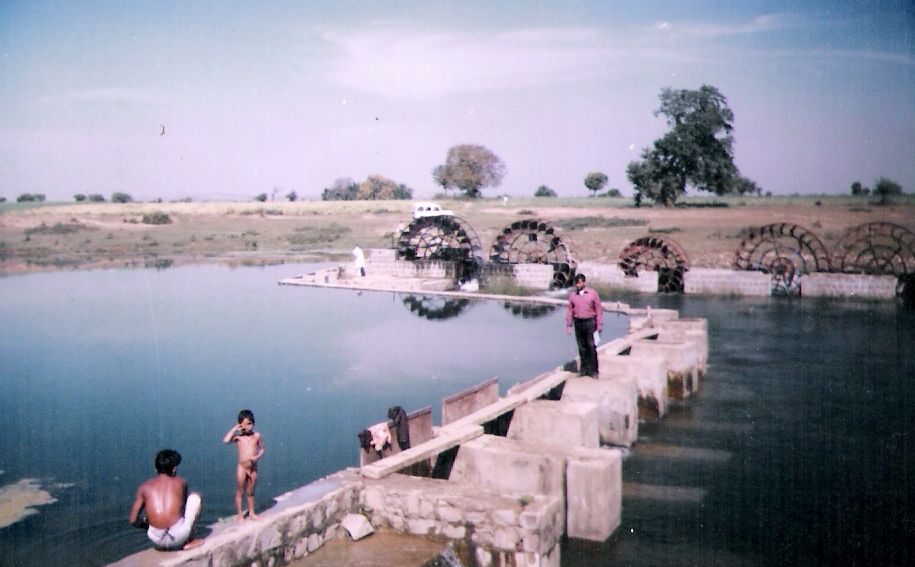
Another example of high creativity and innovativeness of farmers and farmer scientists that should be given here is Mangal Turbine whose potential has been repeatedly confirmed for India and certainly extends to many other countries. Its neglect has meant that a vast potential of reducing GHG emissions worldwide is being missed year after year.
The inventor of this device Mangal Singh grew up in a farmer family of Bundelkhand region in India. As a teenager he used to see farmers of his village Bhailoni Lodh (in Lalitpur district, UP) experiencing a lot of problems in arranging diesel to lift water from streams to irrigate their fields. This led him to the idea of innovating a device which could lift water from streams (or small rivers, canals, etc.) without diesel (or electricity). After a lot of experimentation, he succeeded and Mangal Turbine at work was first demonstrated in 1987. Mangal Singh was 40 years old at that time. Later it was patented as "Mangal Water Wheel Turbine Machine" (Patent No. 177190 dated 13-11-1997).
The great usefulness is entirely confirmed in government documents as well as reports of academic institutions. The Ministry of Rural Development, Government of India, appointed the Maithani Committee (2011—12) to look into various aspects of the Mangal Turbine. This committee has commented. “There are several variants of the Mangal Turbine but the standard device contains a water wheel of 2 meter diameter with 12 blades radially fixed to the rim. The shaft is coupled with a suitable gear box for stepping up of rotation to 1500-1800 rpm. The output shaft of the gear box is coupled on one end with a centrifugal pump for lifting water and the other end is mounted with a suitable pulley to operate any other machine like crusher, grinder etc. By using the energy of flowing water in a stream, Mangal Turbine enables lifting of water for irrigation/drinking purposes and also produces mechanical power that can be used for various other purposes…It is undoubtedly unparalleled in its simplicity and utility… Its benefits are multiple and multidimensional."
This invention is particularly in tune with the concept of swaraj and self-reliance of rural communities, as a joint report of the Indian Institute of Technology, Delhi, and a leading voluntary organization Vigyan Shikhsha Kendra says, "Most significant aspect is that the entire system designed by Mangal Singh is easily fabricated in the village itself, using available material and local workmanship… Mangal turbine would prove a boon for fulfilling the energy need of irrigation, agro processing etc. in the rural sector wherever low water head exists in the rivers/nallahs… "
Apart from being very helpful to farmers, agro-processing units and drinking water-supply projects, the great potential of reduction of greenhouse gas emissions is very important. It has been estimated that if one unit of Mangal Turbine (MT) runs for 11 hours in a day, then it saves 44 litres of diesel in a day (on the basis of use of 4 litre diesel per hour by 25 HP diesel pump). Again assuming irrigation by MT on 190 days in a year, a single unit of MT can save 8360 litres (44x190) in a typical year. Over a lifetime of 15 years one unit of MT can potentially save 125400 litres (8360x15). In terms of greenhouse gas emissions (using assumptions made in US Environment Protection Agency fact sheet) this works out to 335 tonnes. This estimate by Dr. Jai Shankar Singh is made on the basis of the assumption that one unit of MT will lift water from a stream which is equivalent to 25 HP diesel pump set and irrigate a command area of 50 ha. Reduction in diesel consumption and related GHG emissions can further increase significantly to the extent that the M.T. is used also (in addition to water lifting) for processing of various farm produce and other work.
Unfortunately the clear great potential could not be realized in India as some powerful persons started victimizing and harassing the inventor Mangal Singh. A brief review is provided by the government's own Maithani Committee Report --“Shri Mangal Singh was harassed and harmed in the process of implementation of the project.”Further this report said, "There is no case against ShriMangal Singh who needs to be compensated for the losses suffered...” Now there is very little time to be lost as Mangal Singh is already about 74 years old and his health has suffered in the course of harassment over long years. He should be provided extensive facilities for setting up several Mangal Turbine units in diverse suitable conditions and train a number of young technicians in setting up and maintaining Mangal Turbines.
The road map for the rapid spread of Mangal Turbine has been laid down by the Maithani Committee, which stated that this should be promoted and utilized by various relevant agencies of the Government be it Ministry of Rural Development, Ministry of Agriculture, Ministry of Panchayati Raj, Ministry of Water Resources Development, NABARD, Horticulture Board, Rajiv Gandhi. Drinking Water Mission, Department of Alternate Energy Sources, Department of Land Resources, DRDA’s, PRIs etc."In addition the potential of Mangal Turbine should be tapped also in other parts of the world wherever suitable conditions exist.
---
The writer is Honorary Convener, Campaign to Save Earth Now. His recent books include ‘Planet in Peril’, ‘Protecting Earth for Children’ 'Man over Machine' and ‘India’s Quest for Sustainable Farming and Healthy Food’
Comments