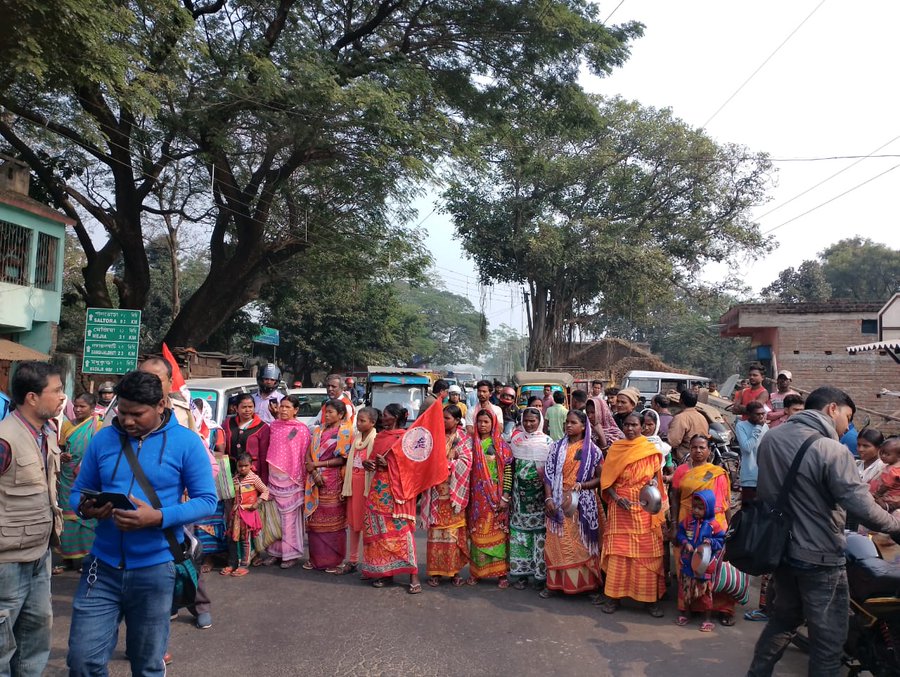
West Bengal farm workers protest Centre withholding Rs 7,500 crore MGNREGA budget

Counterview Desk 

Marking one year of the Government of India withholding the release of over Rs 7,500 crore MGNREGA funds to West Bengal, the civil rights network NREGA Sangarsh Morcha, in alliance with the Paschim Banga Khet Majoor Samity (PBKMS), held Black Day on December 27, with workers holding black flag demonstrations, thaala bajao, road blockade and public meetings.
Releasing a note on the occasion along with Status of MGNREGA Employment & Wages in West Bengal by Libtech, India and Fact Finding Investigating the Stoppage of MGNREGA Work and Wages, senior activists Anuradha Talwar, Jean Dreze, Nikhil Dey, Parul Saboo and Sanjay Sahni called it “one year of Injustice: one year of NREGA workers wage theft in West Bengal”.

Text:

MGNREGA workers in West Bengal have not been paid wages since 26th December 2021. Today, we mark one year of centre withholding the release of over Rs 7,500 crore MGNREGA funds to the state for ‘non-compliance of central government directives’ invoking the Section 27 of the Act. Out of this amount, the pending wages are touching a staggering gure of Rs.2,744 crore. According to the report, there is around Rs  3,891 crores of perceived loss in NREGA wages from pre-Covid years (average of 2018-19 and 2019-20) and Rs 6046 crores in comparison to post-Covid years (average of 2020-21 and 2021-22) The present stoppage of wages is irrational and leads to victimization of workers who have done their work honestly. It has also pushed poor workers on the brink of starvation.

Violation of Fundamental Rights and Legal Provisions:

Section 27 of the Act may appear to allow the central government to “order stoppage of release of funds to the Scheme” in some circumstances, but this provision cannot be read as a license to stop wage payments to workers who have already worked. These workers have an unconditional right to be paid within 15 days. That line in Section 27 was formulated at a time when the release of funds preceded NREGA work. Today, work comes rst, and then funds are effectively released when the central government pays the wages directly in workers’ accounts. Stopping the release of funds cannot be allowed, even under Section 27, when it has the e ect of depriving workers of their rightful wages.
Both the Central and State Governments are guilty of violating the fundamental Right to life of 3.4 crore registered workers across the state. Denial of work and wages is also in contravention to the Supreme Court’s judgement in the Swaraj Abhiyan case (writ petition 857/2015; full judgement). We understand from news reports that the Government of India (GoI) has stopped transfer of funds after discovering anomalies in the implementation of works under MGNREGA. By turning a blind eye to corruption, the State Government has ensured that funds meant for workers are siphoned o by political goons from the ruling party in the state. With Panchayat elections due in mid 2023, the Centre-State stand-off over NREGA funds is taking on political overtones. While the state asserts that all corrective measures have been taken, BJP at the Centre is however reluctant to release the money before the Panchayat elections. In this political slugfest the sufferers are workers who have been deprived of their wages for the past year.
We encourage that measures should be taken to tackle corruption and increase transparency. E orts should be made to ensure that social audits and grievance redressal mechanisms are e ective. But, the standards of audits and action taken on audit findings are largely unsatisfactory in the state and across the country. The State Employment Guarantee Council (SEGC) and Central Employment Guarantee Council (CEGC) do not exist for the past couple of years (click here for RTI reply). This not only makes a mockery out of transparency and anti corruption measures, but also shows how the GoI is using anti corruption as an excuse while itself violating the Act. Eliminating leakages and irregularities cannot be used as an excuse to undermine the demand driven nature of the Act. This is a continuation of the government’s assault on NREGA and has once again exposed the central government’s lack of commitment for NREGA workers’ rights.

In particular, we demand the following:

  1. Immediate release of MGNREGA funds by Central Government, with immediate starting of new works and issue of new job cards.
  2. The pending wages to the tune of Rs 2,744 crores for all MGNREGA workers need to be released immediately along with the delay compensation at the rate of 0.05% per day for the entire duration of the delay (as per Para 29 of Schedule II of the Act).
  3. Sanction and transfer of the 2022-23 Labour Budget.
  4. Action against anomalies and corruption in the scheme, and strengthening of social audits & grievance redressal mechanisms.
  5. The State Government must start a revolving fund of Rs.1000 crores from which immediate payment of NREGA wages can be done and to ensure timely payment of wages, in the event of future delays or complications in receiving money from the Central Government.
  6. All the documents pertaining to correspondence between the Central Government and the State Government on MGNREGA since 2019, including the reports of central team visits and action taken, should be made public.

Comments

TRENDING

From algorithms to exploitation: New report exposes plight of India's gig workers

By Jag Jivan   The recent report, "State of Finance in India Report 2024-25," released by a coalition including the Centre for Financial Accountability, Focus on the Global South, and other organizations, paints a stark picture of India's burgeoning digital economy, particularly highlighting the exploitation faced by gig workers on platform-based services. 

'Condonation of war crimes against women and children’: IPSN on Trump’s Gaza Board

By A Representative   The India-Palestine Solidarity Network (IPSN) has strongly condemned the announcement of a proposed “Board of Peace” for Gaza and Palestine by former US President Donald J. Trump, calling it an initiative that “condones war crimes against children and women” and “rubs salt in Palestinian wounds.”

India’s road to sustainability: Why alternative fuels matter beyond electric vehicles

By Suyash Gupta*  India’s worsening air quality makes the shift towards clean mobility urgent. However, while electric vehicles (EVs) are central to India’s strategy, they alone cannot address the country’s diverse pollution and energy challenges.

Gig workers hold online strike on republic day; nationwide protests planned on February 3

By A Representative   Gig and platform service workers across the country observed a nationwide online strike on Republic Day, responding to a call given by the Gig & Platform Service Workers Union (GIPSWU) to protest what it described as exploitation, insecurity and denial of basic worker rights in the platform economy. The union said women gig workers led the January 26 action by switching off their work apps as a mark of protest.

Jayanthi Natarajan "never stood by tribals' rights" in MNC Vedanta's move to mine Niyamigiri Hills in Odisha

By A Representative The Odisha Chapter of the Campaign for Survival and Dignity (CSD), which played a vital role in the struggle for the enactment of historic Forest Rights Act, 2006 has blamed former Union environment minister Jaynaynthi Natarjan for failing to play any vital role to defend the tribals' rights in the forest areas during her tenure under the former UPA government. Countering her recent statement that she rejected environmental clearance to Vendanta, the top UK-based NMC, despite tremendous pressure from her colleagues in Cabinet and huge criticism from industry, and the claim that her decision was “upheld by the Supreme Court”, the CSD said this is simply not true, and actually she "disrespected" FRA.

Stands 'exposed': Cavalier attitude towards rushed construction of Char Dham project

By Bharat Dogra*  The nation heaved a big sigh of relief when the 41 workers trapped in the under-construction Silkyara-Barkot tunnel (Uttarkashi district of Uttarakhand) were finally rescued on November 28 after a 17-day rescue effort. All those involved in the rescue effort deserve a big thanks of the entire country. The government deserves appreciation for providing all-round support.

Whither space for the marginalised in Kerala's privately-driven townships after landslides?

By Ipshita Basu, Sudheesh R.C.  In the early hours of July 30 2024, a landslide in the Wayanad district of Kerala state, India, killed 400 people. The Punjirimattom, Mundakkai, Vellarimala and Chooralmala villages in the Western Ghats mountain range turned into a dystopian rubble of uprooted trees and debris.

Fragmented opposition and identity politics shaping Tamil Nadu’s 2026 election battle

By Syed Ali Mujtaba*  Tamil Nadu is set to go to the polls in April 2026, and the political battle lines are beginning to take shape. Prime Minister Narendra Modi’s visit to the state on January 23, 2026, marked the formal launch of the Bharatiya Janata Party’s campaign against the ruling Dravida Munnetra Kazhagam (DMK). Addressing multiple public meetings, the Prime Minister accused the DMK government of corruption, criminality, and dynastic politics, and called for Tamil Nadu to be “freed from DMK’s chains.” PM Modi alleged that the DMK had turned Tamil Nadu into a drug-ridden state and betrayed public trust by governing through what he described as “Corruption, Mafia and Crime,” derisively terming it “CMC rule.” He claimed that despite making numerous promises, the DMK had failed to deliver meaningful development. He also targeted what he described as the party’s dynastic character, arguing that the government functioned primarily for the benefit of a single family a...

Over 40% of gig workers earn below ₹15,000 a month: Economic Survey

By A Representative   The Finance Minister, Nirmala Sitharaman, while reviewing the Economic Survey in Parliament on Tuesday, highlighted the rapid growth of gig and platform workers in India. According to the Survey, the number of gig workers has increased from 7.7 million to around 12 million, marking a growth of about 55 percent. Their share in the overall workforce is projected to rise from 2 percent to 6.7 percent, with gig workers expected to contribute approximately ₹2.35 lakh crore to the GDP by 2030. The Survey also noted that over 40 percent of gig workers earn less than ₹15,000 per month.