
How local NGO is using art, songs to teach children revive Sundarbans mangroves

By Sara Ahmed* 

Located in the low-lying islands in the Bay of Bengal, the Sundarbans straddle the border between India and Bangladesh and cover more than 1 million hectares, making them the world’s largest single contiguous mangrove swamp. A Ramsar site added to the UNESCO World Heritage list in 1987, they are home to a wide range of critically endangered fauna, including the Bengal tiger, the Ganges dolphin, river terrapin, the estuarine crocodile and the Indian python, along with approximately 428 species of birds, 120 fish, 42 mammal, 35 reptile and 8 amphibian species. Having adapted to the saline estuarine conditions, more than 60 plant species can be found there.
Historically, cyclones have posed a greater threat in the Bay of Bengal than they do in the Arabian sea, to India’s west. Between 1891 and 2018, there were 520 cyclones in the Bay of Bengal, compared to 126 in the Arabian Sea. On top of sucking up large amounts of greenhouse emissions, mangroves also act as the first line of defence against flooding and erosion by lowering waves and storm surges. Research has shown that mangrove swamps are capable of lessening the impacts of major storms and other natural phenomena, not only in the delta region but also in the nearby cities such as Kolkata.

Environmental degradation

Unfortunately, mangrove swamps have suffered significant degradation due to human encroachment, illegal logging, and seawater levels, which lead to increasing salinity of the surrounding areas. Approximately 40% of the mangrove cover in the Sundarbans has disappeared over the last 20 years.
While several initiatives have been undertaken to replant mangroves, especially on the inhabited islands, a range of natural and institutional vulnerabilities have left long stretches of riverbanks bare and nearby communities exposed to storms and other natural phenomena. Despite growing awareness, it was only after the deadly cyclones Aila (2009) and Amphan (2020) that communities realised the urgent need to restore an ecological balance and develop resilience. With the help of local activists, the communities have been able to achieve partial success, but they do require more encouragement and support to keep this going and inspire neighbouring communities to take it up as well.
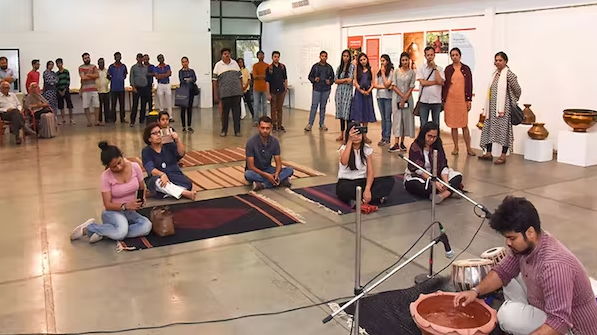
Water vrata exhibition of Living Waters Museum, 2018
It is at junctures like these where organisations like ours, the Living Waters Museum, play a crucial role in providing not only financial assistance but also leading capacity-building activities with youth. Established in 2017, we are a virtual repository exploring the multifaceted dimensions of water through the use of digital media, storytelling, music, theatre and other forms of art. At the forefront of such initiatives lies the project “Climate Wall”, a project created in association with US Consulate General Kolkata and led by Sukrit Sen, which helps students understand their environment and its challenges.
As part of the project, a physical climate wall teaches young leaders about the different species of mangroves and helps them develop effective strategies for collecting and growing them in nurseries. Once their roots are long enough to withstand the tidal forces, the seedlings are finally planted on the riverbeds. The virtual wall uses creative arts such as paintings, dance, poetry and music as mediums to raise climate awareness and encourage community members to get involved in local governing bodies for water management.

Building capacity

The project is based in the Sundarbans village of Hingalganj, at the border between India and Bangladesh. There we are currently working with a local organisation called “Breathing Roots” to help schoolchildren learn about the importance of mangroves as well as growing techniques so that they can withstand tidal pressures. We also discuss ways that students can take action to help mitigate climate impacts and understand how our own lifestyles can contribute to climate change. Workshops over the past year have involved media such as art, dance and poetry. The last stage of this project will include another round of tree planting to reinforce the surrounding areas against future cyclones.
Apart from these, one of the main outcomes of this project will include a Bhatiyali song, a genre of music believed to have originated with boatmen who would compose songs based on their long and lonely journeys and what they learned from their surroundings. Bhatiyali singers have thus been documenting climate change for much longer than conventional researchers, who coined the term climate change only in the late 1970s.
While this genre of music was long neglected by newer generations, the song being written will be composed and sung by our youth partners. The goal is that it will be able to serve as a local medium of interpretation and inspire future generations – they too have much to contribute to the scientific discourse of our current times.
The final outcomes of the “Climate Wall” project will be available toward mid-2023 on the Living Waters Museum portal.
---
*Adjunct faculty, humanities and social sciences, Indian Institute of Science Education and Research (IISER) Pune. Sukrit Sen of the Living Waters Museum helped contribute to this article. Source: The Conversations

Comments

TRENDING

From algorithms to exploitation: New report exposes plight of India's gig workers

By Jag Jivan   The recent report, "State of Finance in India Report 2024-25," released by a coalition including the Centre for Financial Accountability, Focus on the Global South, and other organizations, paints a stark picture of India's burgeoning digital economy, particularly highlighting the exploitation faced by gig workers on platform-based services. 

'Condonation of war crimes against women and children’: IPSN on Trump’s Gaza Board

By A Representative   The India-Palestine Solidarity Network (IPSN) has strongly condemned the announcement of a proposed “Board of Peace” for Gaza and Palestine by former US President Donald J. Trump, calling it an initiative that “condones war crimes against children and women” and “rubs salt in Palestinian wounds.”

India’s road to sustainability: Why alternative fuels matter beyond electric vehicles

By Suyash Gupta*  India’s worsening air quality makes the shift towards clean mobility urgent. However, while electric vehicles (EVs) are central to India’s strategy, they alone cannot address the country’s diverse pollution and energy challenges.

Gig workers hold online strike on republic day; nationwide protests planned on February 3

By A Representative   Gig and platform service workers across the country observed a nationwide online strike on Republic Day, responding to a call given by the Gig & Platform Service Workers Union (GIPSWU) to protest what it described as exploitation, insecurity and denial of basic worker rights in the platform economy. The union said women gig workers led the January 26 action by switching off their work apps as a mark of protest.

Jayanthi Natarajan "never stood by tribals' rights" in MNC Vedanta's move to mine Niyamigiri Hills in Odisha

By A Representative The Odisha Chapter of the Campaign for Survival and Dignity (CSD), which played a vital role in the struggle for the enactment of historic Forest Rights Act, 2006 has blamed former Union environment minister Jaynaynthi Natarjan for failing to play any vital role to defend the tribals' rights in the forest areas during her tenure under the former UPA government. Countering her recent statement that she rejected environmental clearance to Vendanta, the top UK-based NMC, despite tremendous pressure from her colleagues in Cabinet and huge criticism from industry, and the claim that her decision was “upheld by the Supreme Court”, the CSD said this is simply not true, and actually she "disrespected" FRA.

Stands 'exposed': Cavalier attitude towards rushed construction of Char Dham project

By Bharat Dogra*  The nation heaved a big sigh of relief when the 41 workers trapped in the under-construction Silkyara-Barkot tunnel (Uttarkashi district of Uttarakhand) were finally rescued on November 28 after a 17-day rescue effort. All those involved in the rescue effort deserve a big thanks of the entire country. The government deserves appreciation for providing all-round support.

Whither space for the marginalised in Kerala's privately-driven townships after landslides?

By Ipshita Basu, Sudheesh R.C.  In the early hours of July 30 2024, a landslide in the Wayanad district of Kerala state, India, killed 400 people. The Punjirimattom, Mundakkai, Vellarimala and Chooralmala villages in the Western Ghats mountain range turned into a dystopian rubble of uprooted trees and debris.

Fragmented opposition and identity politics shaping Tamil Nadu’s 2026 election battle

By Syed Ali Mujtaba*  Tamil Nadu is set to go to the polls in April 2026, and the political battle lines are beginning to take shape. Prime Minister Narendra Modi’s visit to the state on January 23, 2026, marked the formal launch of the Bharatiya Janata Party’s campaign against the ruling Dravida Munnetra Kazhagam (DMK). Addressing multiple public meetings, the Prime Minister accused the DMK government of corruption, criminality, and dynastic politics, and called for Tamil Nadu to be “freed from DMK’s chains.” PM Modi alleged that the DMK had turned Tamil Nadu into a drug-ridden state and betrayed public trust by governing through what he described as “Corruption, Mafia and Crime,” derisively terming it “CMC rule.” He claimed that despite making numerous promises, the DMK had failed to deliver meaningful development. He also targeted what he described as the party’s dynastic character, arguing that the government functioned primarily for the benefit of a single family a...

Over 40% of gig workers earn below ₹15,000 a month: Economic Survey

By A Representative   The Finance Minister, Nirmala Sitharaman, while reviewing the Economic Survey in Parliament on Tuesday, highlighted the rapid growth of gig and platform workers in India. According to the Survey, the number of gig workers has increased from 7.7 million to around 12 million, marking a growth of about 55 percent. Their share in the overall workforce is projected to rise from 2 percent to 6.7 percent, with gig workers expected to contribute approximately ₹2.35 lakh crore to the GDP by 2030. The Survey also noted that over 40 percent of gig workers earn less than ₹15,000 per month.