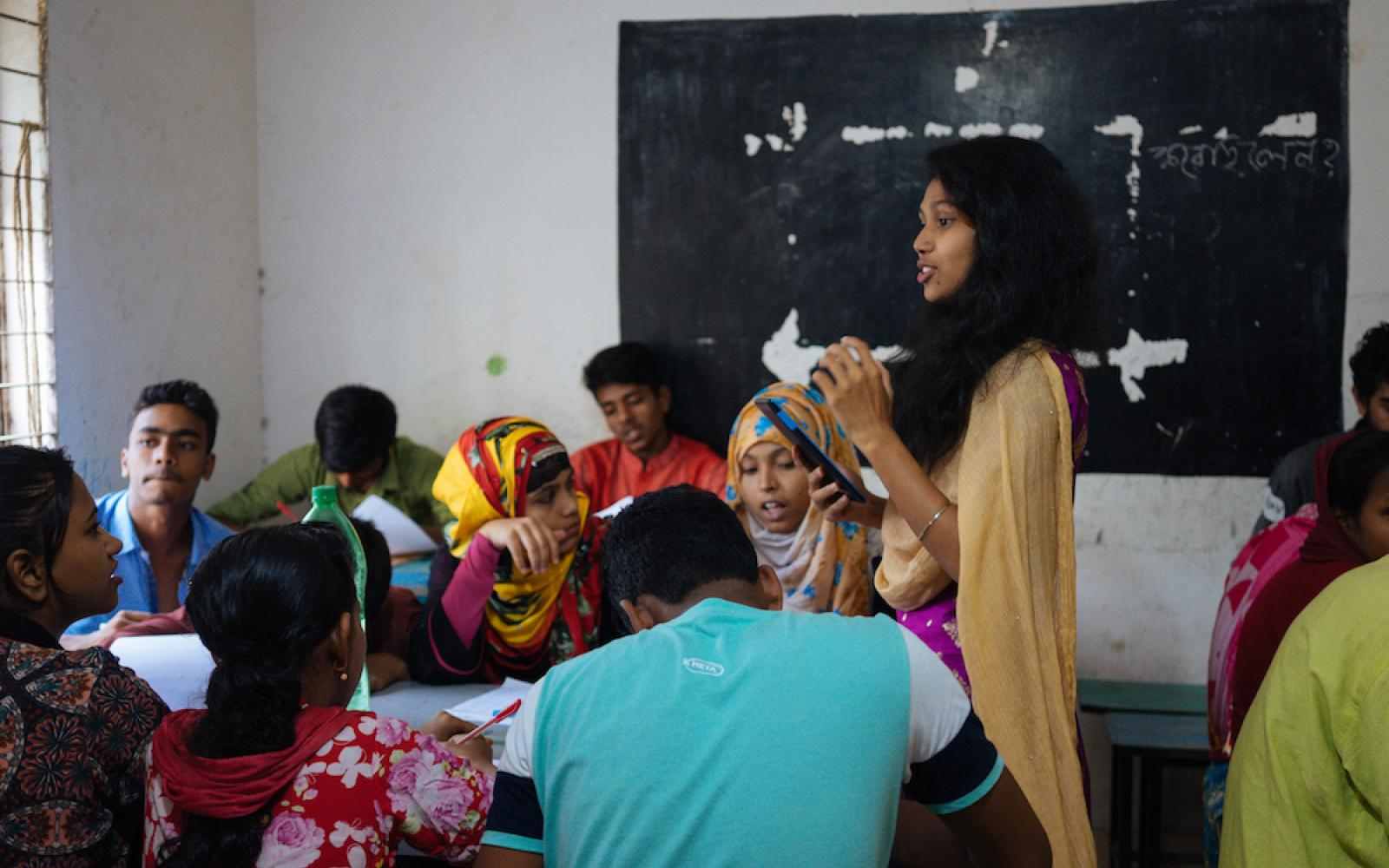
Among the many pressing issues our country is facing, gender inequality, especially while discussing equitable access to education, remains significant. Encouraging the promotion of gender equality and deliberating on the need of the hour, #IMPRI Gender Impact Studies Center (GISC), IMPRI Impact and Policy Research Institute, New Delhi celebrated the National Girl Child Day through its #WebPolicyTalk under the series The State of Gender Equality– #GenderGaps with Ms Puja Marwaha on Rescripting the Gender Narrative: Ensuring Girls’ Secondary Education.
Our moderator, Prof. Vibhuti Patel, Visiting Professor at IMPRI and a Former Professor at the Tata Institute of Social Sciences (TISS), Mumbai, started the event with a brief introduction to the topic. She exclaimed that the outbreak of Coronavirus disease severely impacted each and every sector of society, education is one of them. The nationwide lockdowns imposed in 200 countries affected more than 1.5 billion students globally and hampered their access to quality education, disrupting SDG-4.
Girls with disabilities, in conflict-stricken areas or in the poorest regions of the country are the ones facing the biggest brunt of the entire situation- they are first at disadvantage with their gender and then with COVID-19 restricting the fulfilment of the Right to Education. According to United Nations Educational, Scientific and Cultural Organization (UNESCO) 2020, the report on the Global Monitoring of School Closures by COVID-19 shows that in conflict-stricken areas, many girls will not be able to read a simple sentence in the coming future. Such concerns call for gender-inclusive planning, where the emphasis is given to equitable and gender-responsive education during the planning of emergency preparedness and response to recovery. Besides this, Prof Patel mentioned the strengthening of gender-responsive distance education as almost 40% of the education will be online. The private, public and non-governmental organizations have also demanded at least 10% of the budget to develop the existing education infrastructure. Not only the macro-level planning but also micro-level interventions and understanding of the ground reality are important to understand the theme better. She hands over the floor to our speaker by introducing her.
Dropout and Enrolment Rates for Women
Our speaker, Puja Marwaha, Chief Executive – Child Rights and You (CRY), fuelled her passion for child rights into becoming a full-fledged part of the social sector in 1994. She also serves on the board for VANI – Voluntary Action Network India – in an endeavour to strengthen public mobilization for social causes. Highlighting the significance of National Girl Child Day, claimed that girls’ education has the power of changing the gender narrative in India. Although there have been improvements in the reduction of gender gaps, the long-standing socio-cultural barriers and myths surrounding women and their role in society vis-a-vis men are some of the primary reasons which lead to differential access to basic services and rights.Narrowing down the focus of her discussion to gender equality in higher-secondary education, she mentions the United Nations Fund for Population Activities (UNFPA) definition of gender equality and explains it as the equal enjoyment of status, entitlements, opportunities and respect by all the genders in the society, along with their power to choose for themselves and take advantage of those decisions with no restrictions with respect to their gender. With so many initiatives on both national and global levels, like the SDGs, National Education Policy (NEP), etc., the development of women and their education is gaining impetus as education is central to human development and feeds into other goals of poverty reduction, health and economic development.
She expressed how our efforts should be in sync with the government to bridge the gaps within the education sector, like strengthening safety measures within schools, provision of gender inclusion funds and many others incorporated within the NEP. Ms Marwaha talks about a McKinsey study that states that the potential to improve our GDP by 2025, if equal education opportunities are provided for girls, is 770 billion dollars in India. She explains how the role of education is beyond learning outcomes, especially for women confronted with multiple marginalizations because of their gender. Thus, proper access and affordability of education especially for women from vulnerable groups encourage them to create their own agency in terms of marriage, fertility and other prospects of life. Ms Marwaha pointed out the need for adequate resourcing to the existing policies in the field of education, without which they are of no good.
She expressed how our efforts should be in sync with the government to bridge the gaps within the education sector, like strengthening safety measures within schools, provision of gender inclusion funds and many others incorporated within the NEP. Ms Marwaha talks about a McKinsey study that states that the potential to improve our GDP by 2025, if equal education opportunities are provided for girls, is 770 billion dollars in India. She explains how the role of education is beyond learning outcomes, especially for women confronted with multiple marginalizations because of their gender. Thus, proper access and affordability of education especially for women from vulnerable groups encourage them to create their own agency in terms of marriage, fertility and other prospects of life. Ms Marwaha pointed out the need for adequate resourcing to the existing policies in the field of education, without which they are of no good.
Although these policies helped in ensuring better enrollment rates at elementary levels, the cause of concern is the dropout rates and children completing their education at school levels. The gross enrolment ratio at upper-primary levels is 90.46, dropping down to 77.8 at secondary levels and finally deteriorating to 52.4 at higher secondary levels as here education becomes a paid well. Prof. talks about the importance of delivering life skills to children and hence moulding the curriculum as such that on one end, we work at schools to ensure girls stay and study there, while, on the other end, working with girls’ families to make sure that they are allocating the necessary resources.
The dropout rates at the secondary level are again dramatic because girls are ‘forced out’ of schools due to early child marriage, early motherhood and other domestic activities with which the women in India are associated. The COVID-19 pandemic has further exacerbated the existing challenges- child marriages, sexual exploitation, domestic violence etc. Besides this, the blind rush towards online education has increased the statistics for online porn with India being one of the sources as we are less secure on these fronts than other countries. The problem of the digital divide has also diverted our attention by further intensifying the problem of inequality within our society. While children from Indian households having no electricity, internet or digital devices are missing out on their education altogether, women in households who do possess these resources fall last in the line of getting access to it.
The dropout rates at the secondary level are again dramatic because girls are ‘forced out’ of schools due to early child marriage, early motherhood and other domestic activities with which the women in India are associated. The COVID-19 pandemic has further exacerbated the existing challenges- child marriages, sexual exploitation, domestic violence etc. Besides this, the blind rush towards online education has increased the statistics for online porn with India being one of the sources as we are less secure on these fronts than other countries. The problem of the digital divide has also diverted our attention by further intensifying the problem of inequality within our society. While children from Indian households having no electricity, internet or digital devices are missing out on their education altogether, women in households who do possess these resources fall last in the line of getting access to it.
She explains the gender divide within digital infrastructure via statistics depicting that only 33 women have access to the internet against 67 men and in rural India specifically, only 28 women have access to the internet in comparison to 72 men. While concluding, Ms Marwaha talked about the inverse relationship between girls’ safety and dropout rates because of the fear instilled within society. To curb this, there is a need for collective action by everyone involved to change the attitude of both, men and women, towards gender and their access to not only education but also other entitlements as a part of humanity, just like men. At last, meaningful allocation of resources at every level is integral to supporting and encouraging girls in their endeavours with education.
Impact of COVID-19
The first discussant for the session, Dr Frances Vaidya, President, Inner Wheel Club of Bombay Filmcity and the Associate Professor at Gandhi Shikshan Bhavan’s Smt Surajba College of Education, Mumbai gave her regards to the gathering for the National Girl Child Day and began her discussion with a UNICEF study between August-September, 2020. The study stated that about 50% of secondary class students and around 33% of students of elementary levels felt that their mental and socio-emotional health had been poor or very poor since May, 2020; students belonging to tribal and migrant families were hit worse. Dr Vaidya highlighted a number of problems faced by girls on various fronts- household chores, cost, distance, safety, male teachers, cultural beliefs, etc.- that always overtake their willingness and ability to go to school and get an education. She highlighted the existing situation by pointing out how the existing gaps in the education spheres have been deepened by the pandemic as parents and children do not want to go back to school. According to the data presented by the Education Ministry in the Parliament, 30 million students did not possess any digital device during the pandemic. Studies have also revealed how many young girls have become pregnant due to isolation at home with other male members of the family, further deteriorating their ability to gain knowledge.
Learning from Experience
Our second discussant, Dr Meena Prakash Kute, Principal, SSR College of Education, Silvassa and Ex Registrar, SNDT Women’s University, Mumbai, shared her heart-wrenching experience from belonging to a poor family and being married at a young age, which brought a spark to the discussion. While she was suffering through the many disadvantages brought upon her, Dr Kute was determined to change this situation and showed her perseverance by educating herself. She firmly believes that if we have the will, nothing is impossible. Reiterating Prof. Patel’s point, she encountered her being forced out of school due to early marriage and other cultural factors. However, Dr Kute worked hard even after living in an abusive household, she was determined to change the situation and mindset of her family; she used to give tuition along with manage the domestic chores. She appreciated the social reformers who worked towards educating women and highlighted their famous sayings- no nation can progress without women’s education; the hands which rock the cradle, rule the world. Dr Kute talks about a survey in Dhangadwada where, out of hundred families, 60 lost the only earning member of the household, who was a male, due to alcoholism or other bad practices. Having encountered a similar experience herself, she was empathetic towards these families and especially towards the status of women’s education.She very well pointed out that if in the 21st century, we are facing inequalities in terms of gender, women are still expected to confine to the domestic boundaries and boys are still prioritised over girls when it comes to resource allocation within families, then where are we with the development. Even after laying out so many schemes and scholarships, girls belonging to remote areas are not intimated about it, leaving them disadvantaged. She believes that if we really want to create an impact and improve the condition of girls’ education, we have to trace the rural areas and other under-developed districts to make them aware of these incentives and their optimal utilization. When people living in these districts will see educated women coming together to promote education, it will definitely sensitize them towards the same. In the end, she brought to light that the adverse circumstances in India, exploit the girl child in so many ways that it becomes tough for them to achieve their dreams. The situations have to be improved, the mentality needs to be changed and constant efforts need to be put in when considering women’s education.
Conclusion
After discussing the issue in great detail, our moderator, Prof. Patel, led the talk by taking up questions from the chatbox. While discussing one of the questions, Dr Kute as well as Ms Marwaha conveyed the pressing need for education to protect the girl child from child marriage. They believe that education should not be pursued with the sole aim of earning/employment but should be seen as a skill that empowers them to say ‘no’ to something as evil as child marriage; it should be seen as a resource that facilitates the lifecycle of a girl child and gives them the agency to choose for themselves. We should be working with not only the women but the parents, the siblings, the police, the priests and the entire society to create awareness and change their attitudes by making them realize the multi-dimensional impact an educated woman can create not just for the family but for the society on whole.---
Acknowledgement: Diya Goswami, research intern at IMPRI
Comments