 |
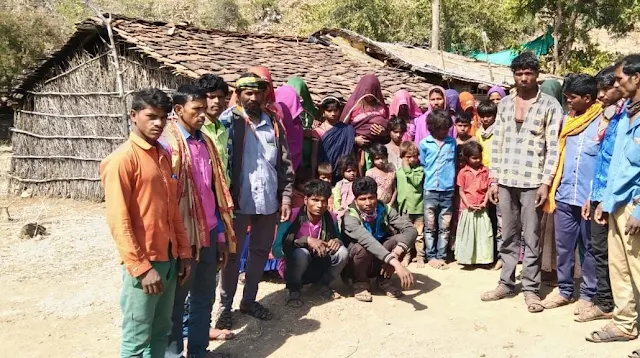
| Adivasis freed of bondage by JADS team |
Bringing to light the case of alleged gangrape of a 16-year-old Adivasi girl by labour two contractors, the Madhya Pradesh-based advocacy group Jagrit Adivasi Dalit Sangathan (JADS) has said, it reveals the unhindered sexual exploitation and violence faced by adivasi women, forced to migrate for work.
Despite this, JADS regrets in a media communique, the government refuses to act on numerous atrocities against Adivasi workers facing bonded labour, exploitation and sexual violence. Worse, even the adivasi demand for prosecution of the guilty contractors and factory owners is summarily ignored.
Text:
Last week, over a hundred Adivasis of Siwni village in Barwani returned from Satara, Maharashtra after being trapped in bonded labour for over three months. Upon their return, on February 17, workers went to file police complaints when one of the workers. A 16-year-old Adivasi girl reported that contractors in Satara gangraped her multiple times during the time they were in bondage.The harrowing experience of the minor has revealed the extent of sexual violence and exploitation faced by Adivasi women as they are forced to migrate for work, and find themselves in bonded labour. These workers were given debts by contractors, employed by sugar factories in the form of an ‘advance’, in exchange for which, they were taken to Bhuinj village in Satara, where they were forced to work for 13-16 hours a day.
In November, when the 16-year old had gone out to fetch water at around 4 in the morning, two contractors kidnapped her, and raped her multiple times, with another accomplice. At the time, the girl was 4 months pregnant, and suffered a miscarriage. Her clothes were drenched in blood due to the miscarriage when she returned, and the men threatened to kill her and her family members if she tried to complain about this.
Despite losing blood for 6 days straight, she and other workers were forcibly made to work continuously. Being in a foreign place, intimidated by the clout of the local contractors and fearful for their lives, the workers were unable to file a complaint at the local police station.
In the month of January, during Sankranti holiday, the same contractors once again kidnapped the girl late at night, and raped her. The other workers kept asking the contractors to bring her back, and finally decided to walk up to the local police station to file a complaint.
Upon reaching the police station, they found that the contractors were already present with the girl, whom they had threatened into giving a false statement in the favour of the contractors. Despite this, the workers tried to file a complaint, but the local police threatened to throw the workers in the lock up and sent them away instead.
It was then, that the workers informed the activists of Jagrit Adivasi Dalit Sangathan (JADS) of their ordeals, who raised this issue with local police and administration in Barwani, which subsequently led to the release and safe return of all workers back to Barwani.
Despite the horrors faced by the girl, she along with her family members and other workers, upon their return, are now demanding that Barwani administration and police file an FIR against the contractors for committing gang rape and forcing the workers into bonded labour, and arrest them immediately.
Working in sugarcane harvesting, women have to work alongside men for up to 16 hours a day, while looking after children. The workers, who are indebted to the contractors, are brought to an unknown place by the contractor, and thus are completely dependent on the him, making them unable to report atrocities like rape to the local police.
Similarly, in the nearby district of Khargone, Adivasi workers who had gone to Belagavi for sugarcane harvesting work, three women and three minor girls were repeatedly raped by contractors.
Upon their return to Khargone in December 2021, the women and other workers immediately tried to file a complaint with Khargone police, but it was only after almost a month, in January 2022 that the police filed an FIR against rape, while refusing to file a case on bonded labour. No action has been taken in the matter so far.
Adivasi women along with being forced to work as bonded labour, also face sexual violence and harassment; the inaction of administration and state government only serves to provide the contractors and factory owners a free hand to exploit women and Adivasi workers.
Thousands of young Adivasi couples from Adivasi districts of western Madhya Pradesh are forced to migrate with their children to Gujarat, Maharashtra and Karnataka for sugarcane harvesting work.
Thousands of Adivasi couples from western Madhya Pradesh migrate to Gujarat, Maharashtra and Karnataka for sugarcane harvesting
Contractors working for sugar factories offer debts of Rs 30,000-40,000, in exchange of which, they are promised that they only need to work for three months, after which not only would the debt be repaid, but they would be taking home a good amount of money as well. On reaching these fields, they are immediately put to work, their work beginning at the break of dawn and going on until the evening. Thereafter, they are made to load sugarcane on to vehicles, a task that often finishes only by 1-2 am at night.
While living in makeshift plastic tents forced to toil 13-16 hours or more, every day for 3 to 6 months, the workers are neither given any wages, nor told the valuation of the work done by them – the time for which the workers will have to work and the money they are to receive, are all decided unilaterally by these contractors, upon whom the workers are usually dependent to reach back home to their village.Around 250-300 workers from Barwani have recently returned after being freed from Bonded Labour in Maharashtra and Karnataka.
Now they are demanding that the contractors and factory owners responsible for subjecting them to bonded labour, sexual violence and exploitation be prosecuted and arrested. Sections 370, 374 of the IPC, the Bonded Labour System (Abolition) Act, Inter-State Migrant Workmen Act and the Prevention of Atrocities Act define these offences as cognizable ones, and it is the responsibility of the government and administration to ensure prosecution as per law.
However, the police and administration have not taken any action on these complaints. Failing to do so will only further allow guilty contractors and factory owners to continue the trafficking, entrapment of Adivasi workers into bondage and further sexual exploitation and violence upon Adivasi women.
While living in makeshift plastic tents forced to toil 13-16 hours or more, every day for 3 to 6 months, the workers are neither given any wages, nor told the valuation of the work done by them – the time for which the workers will have to work and the money they are to receive, are all decided unilaterally by these contractors, upon whom the workers are usually dependent to reach back home to their village.Around 250-300 workers from Barwani have recently returned after being freed from Bonded Labour in Maharashtra and Karnataka.
Now they are demanding that the contractors and factory owners responsible for subjecting them to bonded labour, sexual violence and exploitation be prosecuted and arrested. Sections 370, 374 of the IPC, the Bonded Labour System (Abolition) Act, Inter-State Migrant Workmen Act and the Prevention of Atrocities Act define these offences as cognizable ones, and it is the responsibility of the government and administration to ensure prosecution as per law.
However, the police and administration have not taken any action on these complaints. Failing to do so will only further allow guilty contractors and factory owners to continue the trafficking, entrapment of Adivasi workers into bondage and further sexual exploitation and violence upon Adivasi women.
Comments
Post a Comment
NOTE: Hateful, abusive comments won't be published. -- Editor