 |
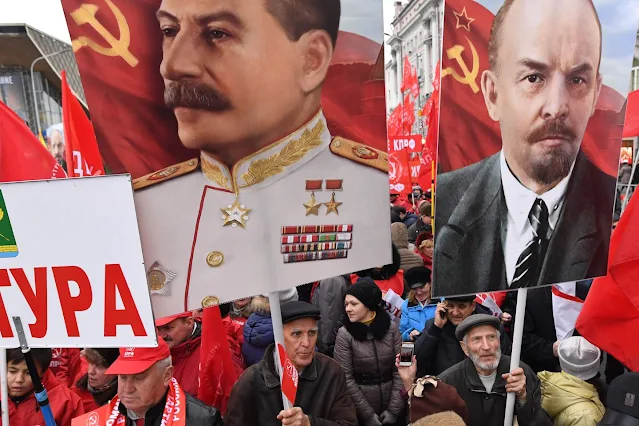
| Moscow rally on 100th anniversary of Nov 7, 1917 Bolshevik revolution |
Even as the world observed the 30th anniversary of the fall of the Union of Soviet Socialist Republic (USSR) in December 2021-end, the earth shaking event has been sought to be seen by many a liberal historian as final blow to communism and its ideological failure. No doubt, the collapse did create a huge psychological dent in the minds of the people around the world who believed in progressiveness of communism or Marxism.
However, there is a need to look at it a different level. The collapse also destroyed whatever the USSR claimed to have achieved by giving power to the working class between 1917 and 1956: workers owing means of production, no unemployment, literacy to all, universal healthcare unheard of even in western countries, and so on.
The USSR industrialized at a rate four times quicker than any western power during this period, a fact recognised by intellectuals like EH Carr, Alan Taylor, Anne Loiuse Strong, George Bernard Shaw and Sydney Beatrice Webb. More recently, writers like Grover Furr, Raymond Lotta, Vijay Singh, Joma Sison, Joseph Ball, Gonzalo and Bruce Franklin took a similar view.
These writers have vividly recounted how the USSR overcame hazardous obstacles to take people’s welfare to new heights. Carr also delves into the conspiracy of the colonial powers to topple USSR and why it was imperative for Lenin and Stalin to take certain steps.
Raymond Lotta, considered as one of the topmost revolutionary intellectuals, points towards, what went wrong. According to him, “By 1934, Stalin and several others in leadership felt it was time to consolidate the political and social gains of the revolution. The new proletarian state was facing extreme and difficult objective conditions. War was looming. There was no prior historical experience for dealing with the magnitude of the situation. Adjustments were called for."
"But", he continues, "Mistakes were made in how this dire necessity was dealt with. On the basis of the transformations in ownership that had gone on, there was a push for greater discipline and stepped-up production in the factories. But the development of the productive forces came to be seen as the guarantee of socialism. Leadership relied less on the conscious activism and initiative of the masses."
He adds," The radical social and cultural experimentation of the 1920s and early 1930s was reined in – and things got consolidated in a way that strengthened more traditional relations. Socialism in the Soviet Union had to be defended. But the Soviet leadership tended to see the defense of the Soviet Union as being one and the same as the interests of the world revolution without any contradiction – and thus increasingly promoted national patriotism instead of proletarian internationalism.”
Citing Mao Zedong, Lotta criticises Stalin in the following words: “He relied on purges and police actions to solve problems -- rather than mobilizing the masses to take up the burning political and ideological questions on the overall direction of society."
He adds, "Mao was critical of Stalin’s approach and pointed out that Stalin had a tendency to mix up two fundamentally different types of contradictions: the contradiction between the people and the enemy, and contradictions among the people themselves. Repression, which should only have been directed against enemies, was used against people who were not enemies but merely were making mistakes or expressing disagreements with the policy of the government.”
Yet, the fact is, major errors or violations of the Marxist practice occurred during the Stalin era from the 1930s. Innocent party members perished in the purges. Democracy was suppressed, leading to bureaucratism. Agriculture was neglected by giving too much emphasis on industry. Collectivization was undertaken by force.
A strata of a privileged class of party members was created with wage differentials imposed and a class of technicians created. The Soviets failed to function independently and were made subordinate to the Communist Party. Harsh treatment was meted out to poets, artists and writers not conforming with the system, with dissent not given voice.
Even scientists like Lysenko were not spared by Stalin. No doubt, USSR won the war against the German Nazis led by Hitler. The Soviet victory at Stalingrad was arguably the greatest turning point in the last century. But the violations helped foreign spies infiltrate USSR and the Communist Party.
After 1956, Khrushchev introduced the profit motive concept, undermining Stalin’s socialist practice. The economy was sought to be decentralised. Managerial structures were re-introduced within factories. In 1964 Khrushchev was ousted and Brezhnev, who attempted to reverse whatever Khrushchev did, though with little success.
Gorbachev, through perestroika and glasnost from 1985, gave USSR a totally different shape. He virtually dismantled Stalin’s socialist legacy, even though welfare measures such as full employment, literacy, healthcare facilities, sports facilities and child care were allowed to continue.
A strata of a privileged class of party members was created with wage differentials imposed and a class of technicians created. The Soviets failed to function independently and were made subordinate to the Communist Party. Harsh treatment was meted out to poets, artists and writers not conforming with the system, with dissent not given voice.
Even scientists like Lysenko were not spared by Stalin. No doubt, USSR won the war against the German Nazis led by Hitler. The Soviet victory at Stalingrad was arguably the greatest turning point in the last century. But the violations helped foreign spies infiltrate USSR and the Communist Party.
 |
| Courtesy: Bloomberg |
Gorbachev, through perestroika and glasnost from 1985, gave USSR a totally different shape. He virtually dismantled Stalin’s socialist legacy, even though welfare measures such as full employment, literacy, healthcare facilities, sports facilities and child care were allowed to continue.
Mao Zedong evaluated that Stalin was 70% correct and 30% wrong. Mao was particularly critical of Stalin's abuse of democratic centralism
The collapse had another root. At the international level, it was Stalin who first displayed big brother treatment towards Eastern European countries and China, which was continued later. After 1956 USSR advocated peaceful co-existence.It invaded Czechoslovakia in 1968, supported emergency in India in 1975, invaded Afghanistan in 1982, and also supported martial law in Poland in 1982. Through Comecon it virtually treated East European countries as satellites.
Though it appeared to become less supportive of national liberation struggles, it did sustain resistance to apartheid in South Africa, supported the Palestinian liberation struggle against Israel, supported Cuba and anti-colonial movement of Angola. It gave full support to Vietnam in the war against America.
Chairman Mao evaluated that Stalin was 70% correct and 30% wrong. Mao was particularly critical of Stalin's abuse of democratic centralism, neglecting superstructure and inability to involve democratic movements from below.
George Thomson believes Stalin dealt with opponents only through the medium of police terror, and failed to encourage democratic initiative of the people. The Red Paper publication “How Capitalism was restored in the USSR” is a classic in illustrating how USSR morally turned capitalist with the party turning into a new class.
Today, Russia appears to have turned into another imperialist country, even though it challenges the hegemony of superpower America. It has suppressed Islamic movements, exhibiting chauvinism. Internally unemployment and inflation have reached sky high levels.
The result is, many Russians have begun to feel that conditions were better when it was formally USSR. They have begun rating Lenin and Stalin quite high, as suggested by recent rallies in the country.
---
*Freelance journalist based in Mumbai
Chairman Mao evaluated that Stalin was 70% correct and 30% wrong. Mao was particularly critical of Stalin's abuse of democratic centralism, neglecting superstructure and inability to involve democratic movements from below.
George Thomson believes Stalin dealt with opponents only through the medium of police terror, and failed to encourage democratic initiative of the people. The Red Paper publication “How Capitalism was restored in the USSR” is a classic in illustrating how USSR morally turned capitalist with the party turning into a new class.
Today, Russia appears to have turned into another imperialist country, even though it challenges the hegemony of superpower America. It has suppressed Islamic movements, exhibiting chauvinism. Internally unemployment and inflation have reached sky high levels.
The result is, many Russians have begun to feel that conditions were better when it was formally USSR. They have begun rating Lenin and Stalin quite high, as suggested by recent rallies in the country.
---
*Freelance journalist based in Mumbai
Comments