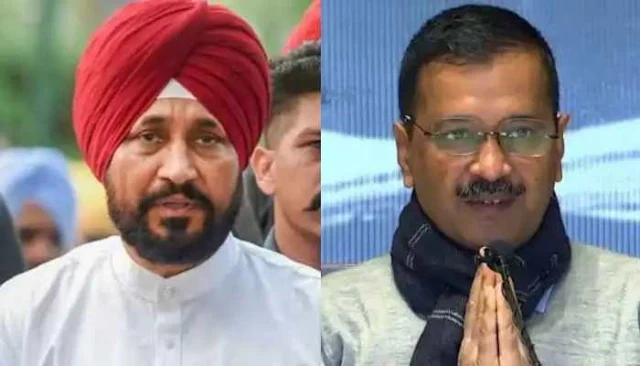
On January 20, Delhi Chief Minister Arvind Kejriwal called Punjab Chief Minister Charanjit Singh Channi a dishonest man, and emphasized that Channi should not be viewed as a common man. That is, the patent of the common man lies with Kejriwal alone, and in this respect, honesty as well.
Kejriwal made this statement in a quick response to the Enforcement Directorate's (ED's) raid on Channi's nephew's house. Since then, a series of allegations and counter-allegations have been going on between the two leaders, which may continue till the last day of the Punjab Assembly elections.
Kejriwal's comment was followed by Aam Aadmi Party's chief ministerial candidate Bhagwant Singh Mann who stated that he himself cannot be a candidate from a reserved seat, so Channi should show the courage to give up his reserved seat and contest from his general seat.
If a leader like former Chief Minister Captain Amarinder Singh, or current deputy Chief Minister Sukhjinder Singh Randhawa, had been the face of the Chief Minister from the Congress side, Kejriwal would have avoided calling them dishonest straightaway, even if had labelling the remaining Congress party as dishonest.
Had similar ED raids taken place for the leaders of Shiromani Akali Dal or the leaders of the newly formed Punjab Lok Congress, even then Kejriwal would have avoided calling them dishonest. Had there been a Congress chief ministerial candidate other than Channi, Bhagwant Singh Mann also might not have challenged Channi, who comes from Dalit society of Punjab, to contest against him from the Dhuri constituency.
Hearing Kejriwal's statement, I was reminded of the anti-corruption movement organized under the aegis of India Against Corruption (IAC); and Bhagwant Singh Mann's statement reminded me of the earlier Youth for Equality campaign.
Everyone knows that the platform of the anti-corruption movement was used attacking the 'dishonest' Prime Minister Manmohan Singh, his government and the party, and praising the honest Vikas Purush, Narendra Modi. When some 'dishonest' elements raised the issue of 'honest' Kejriwal took nine lakh rupees when he was in government service.
It was learnt that he had gone abroad at government expenses; that on his return he had to work regularly for three years in his office; and that for not doing so, Rs 9 lakh had to be deposited by him in the department.
Courtesy progressive and secular civil society, the market price of Kejriwal's 'honesty' in those days was skyrocketing. The civil society attacked like a lion those who brought this case against him to light. The civil society barbed that the Congress, which was drowned deep in dishonesty, has discovered this case against Kejriwal.
Kejriwal cited the plea that the post he held in his office could have earned crores. That is, why would he spoil his integrity for a meagre amount of nine lakhs! He deliberately sent the amount directly to 'dishonest' Prime Minister Manmohan Singh by a check, and not deposited the same in the concerned department. He was lauded by his supporters on this befitting act!
Similarly, some 'ungrateful' elements raised some legal questions on the money received by the anti-corruption movement and Aam Aadmi Party, which arose from the ashes of that very movement, from domestic and foreign sources.
Kejriwal and Manish Sisodia participated in a campaign launched in favour of merit against reservation
Then, the civil society dismissed it as the handiwork of the dishonest Congress. However, when Anna Hazare said that public donations received from people should be accounted for, Kejriwal directly said that he had earned nothing in life except honesty.
On hearing his emotional utterances, the civil society began to swing in the intoxication of Kejriwal’s and its own honesty. For a detailed account of the honesty discourse of Kejriwal and civil society supporting each other, see my book ‘Bhrashtachar Virodh: Vibhram Aur Yatharth’ (Vani Prakashan, Delhi, 2014).
People might have remembered the Youth for Equality campaign. As part of that campaign against the provision/policy of reservation, a strong demonstration was held at Delhi's Jantar Mantar. Kejriwal and Manish Sisodia had participated in that demonstration. In fact, the campaign launched in favour of merit against reservation was nurtured by these two gentlemen.
A lot of water has flown in the Ganges since then. It is not without reason that Kejriwal can openly call Channi a dishonest man; and Bhagwant Singh Mann can openly raise the issue of Channi's merit in the election battle. Kejriwal has been empowered to do so by the progressive and secular civil society of India.
I do not say that Channi is an honest politician; yet the fact is, the ED, as is the practice, has tried to defame him by raiding his nephew's house at the behest of the Centre. Channi may be a mixture of dishonesty and honesty like most other people and leaders of the country. His relatives would also have taken undue advantage of his position.
The country's treasury and all the assets are kept in the hands of the leaders. Therefore, their dishonesty can also be proportional. The common man may have to be contented by stealing a simple amount of nine lakhs.
Suffice to say, while summarising the comment that Kejriwal is honest, recognized by progressive and secular civil society, he can retain the right to openly call anyone, at any time, dishonest. Channi may have been active in Punjab politics for a long time, and even though he might have tried to maintain utmost honesty in his public life, he can be called a dishonest man by a so-called champion of honesty.
---
Former Delhi University teacher, fellow at the Indian Institute of Advanced Study, Shimla
People might have remembered the Youth for Equality campaign. As part of that campaign against the provision/policy of reservation, a strong demonstration was held at Delhi's Jantar Mantar. Kejriwal and Manish Sisodia had participated in that demonstration. In fact, the campaign launched in favour of merit against reservation was nurtured by these two gentlemen.
A lot of water has flown in the Ganges since then. It is not without reason that Kejriwal can openly call Channi a dishonest man; and Bhagwant Singh Mann can openly raise the issue of Channi's merit in the election battle. Kejriwal has been empowered to do so by the progressive and secular civil society of India.
I do not say that Channi is an honest politician; yet the fact is, the ED, as is the practice, has tried to defame him by raiding his nephew's house at the behest of the Centre. Channi may be a mixture of dishonesty and honesty like most other people and leaders of the country. His relatives would also have taken undue advantage of his position.
The country's treasury and all the assets are kept in the hands of the leaders. Therefore, their dishonesty can also be proportional. The common man may have to be contented by stealing a simple amount of nine lakhs.
Suffice to say, while summarising the comment that Kejriwal is honest, recognized by progressive and secular civil society, he can retain the right to openly call anyone, at any time, dishonest. Channi may have been active in Punjab politics for a long time, and even though he might have tried to maintain utmost honesty in his public life, he can be called a dishonest man by a so-called champion of honesty.
---
Former Delhi University teacher, fellow at the Indian Institute of Advanced Study, Shimla
Comments