
Budget is for all, every aam aadmi (common man) expects something from the Union Budget. The upcoming Budget 2022, of the Modi 2.0 government to be presented by Finance Minister Nirmala Sitharaman on February 1 would come against the backdrop of gradual recovery taking place after the economy was severely hit by the Covid-19 pandemic. However, the impact of the third wave is yet to be assessed in terms of its impact, as the number of active Covid cases were about 2.2 million as on January 25.
The Covid-19 pandemic has had profound impact on the economy as millions of people lost their livelihoods and slipped into poverty trap. This has created a formidable crisis and challenge on how to provide livelihood to those who have lost jobs. The efforts made by the government provided a palliative rather than making employment focused development approach.
The country has witnessed a reasonably good growth rate. It recorded growth of 4 percent in 2019-20, lower growth rate due to the pandemic; increased to 7.3 percent in 2020-21, and it is expected to grow 9.2 percent in 2021-22. However, this growth has not translated into employment growth.
It is argued that the economy is experiencing a K shaped recovery, meaning that certain sectors of the economy are witnessing a higher growth and faster recovery, particularly large industries and technology and IT based industries, while a large part of micro small and medium enterprises (MSMEs) are stagnating or are not doing well, thereby resulting in an uneven economic recovery across different sectors. The major source of employment creation are the MSMEs but they are fraught with several problems, both from demand and supply sides.
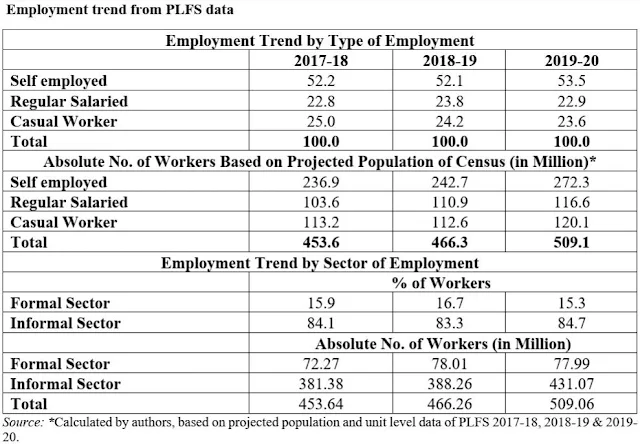
The evidence from the Periodic Labour Force Survey (PLFS) results clearly show that employment has declined during 2018-19 to 2019-20 among regular and casual workers. Though the share of casual workers, the most disadvantaged class, has declined consistently during this period, in absolute terms, the number of casual workers in the economy has increased significantly.
Typically, for the casual workers neither duration of employment nor income is certain. Regular employment has either declined or remained constant in percentage terms; however, in absolute terms the net increase was less (5.7 million) in 2019-20 over 2018-19 as compared to increment (7.3 million) in 2018-19 over 2017-18.
Some improvement has been experienced in the case of self-employment category in 2019-20 which appears to be retrogression effect from casual to self-employment, as people could not find foothold even in the casual form of employment. This fact has been supported by the Centre for Monitoring Indian Economy (CMIE), which reports that the employment rate has been falling. It fell from 41.6 percent in 2017-18 to 40.1 pe cent in 2018-19 and further fell to 39.4 percent in 2019-20.
The unemployment rate as per the CMIE data was 7.9 percent in December 2021. Urban unemployment rate reported a higher rate (9.3 percent) than rural unemployment (7.3 percent). The informalization is also increasing, which is an indicator of precarious form of employment that is unprotected by any social security measures.
The percentage share of informal sector has been rising, while formal sector has declined during 2017-18 to 2019-20. The increase of informal workers from 381.4 million in 2017-18 to 431.1 million in 2018-19 is whopping.
Another important feature emerging from the Labour Bureau survey data is rising vacancy in the organized sector. It reveals that the estimated number of total vacancies increased by more than twice in the second quarter and reached 4.3 lakh as compared to 1.9 lakh in the first quarter. More than 12 percent of the embellishments under the coverage of the survey has reported that these vacancies were not filled as they don’t feel the need to do so.
 More than 65 percent of the establishments have reported reasons for such huge vacancy other than resignations and retirement, which could be Covid-19, lockdown, lack of required skilled manpower etc. Though the survey also revealed that nearly 2 lakh new employment has been generated in the second quarter of FY 2021-22 in the organized sector, this is like a penny in the wholesome.
Another important feature emerging from the Labour Bureau survey data is rising vacancy in the organized sector. It reveals that the estimated number of total vacancies increased by more than twice in the second quarter and reached 4.3 lakh as compared to 1.9 lakh in the first quarter. More than 12 percent of the embellishments under the coverage of the survey has reported that these vacancies were not filled as they don’t feel the need to do so.
The Labour Bureau under the Ministry of Labour & Employment recently launched its second report of the Quarterly Employment Survey (QES) on January 10 for the second quarter of 2021-22. The Bureau conducts establishment-based sample survey of employment in the country using a sample frame of the 6th Economic Census, of the establishments having 10 and above workers from nine important economic sectors -- manufacturing, construction, trade, transport, education, health, accommodation & restaurants, IT /BPOs, and financial services -- which constitute a majority of the total employment in the non-farm sector.
Employment has been treated as a byproduct of the growth process rather than giving it a major focus. Employment in the formal sector is getting more and more scarce, and even the vacancies are not being filled up. Large industry with high capital intensity have limited capacity to create employment and SMEs are under great stress for expanding employment.
Clearly, raising investment and savings rate are critical for achieving higher economic growth. However, it has been noticed that private capital has either stagnated or is shying away from making investment, and without that growth cannot be stimulated.
However, higher growth does not automatically translate into employment. So what if we have created huge economic and social infrastructure? These are the outputs which are tangible. But what are the results of having these infrastructures unless these are transformed into real outcome in terms of employment and bettering the lives of people? Evidently, outputs and outcomes are being misconstrued.
---
*Kumar Shrivastav is with Labour Bureau, Chandigarh and Ishwar Chandra Awasthi is with Institute for Human Development (IHD), New Delhi
Employment has been treated as a byproduct of the growth process rather than giving it a major focus. Employment in the formal sector is getting more and more scarce, and even the vacancies are not being filled up. Large industry with high capital intensity have limited capacity to create employment and SMEs are under great stress for expanding employment.
Clearly, raising investment and savings rate are critical for achieving higher economic growth. However, it has been noticed that private capital has either stagnated or is shying away from making investment, and without that growth cannot be stimulated.
However, higher growth does not automatically translate into employment. So what if we have created huge economic and social infrastructure? These are the outputs which are tangible. But what are the results of having these infrastructures unless these are transformed into real outcome in terms of employment and bettering the lives of people? Evidently, outputs and outcomes are being misconstrued.
---
*Kumar Shrivastav is with Labour Bureau, Chandigarh and Ishwar Chandra Awasthi is with Institute for Human Development (IHD), New Delhi
Comments