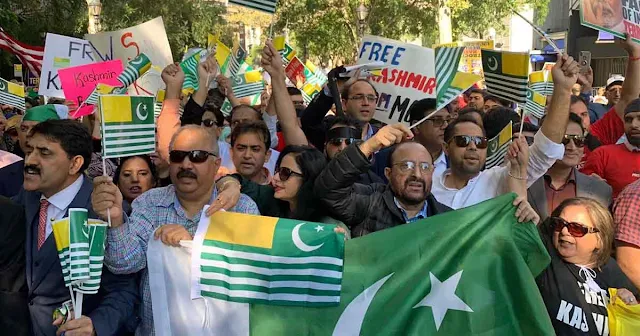
Pro-Pak Kashmiri diaspora group terribly annoyed with US' 'leave-it-alone stance'

By A Representative 

A Pakistan-backed Kashmiri diaspora group based in the US is terribly perturbed. Calling itself World Kashmir Awareness Forum, its general secretary Dr Ghulam Nabi Fai, a controversial figure who was sentenced to two years’ prison for working as an agent of the Pakistan government in the US without disclosing his affiliation, has sharply criticised the US administration for maintaining a "largely leave-it-alone posture" towards the Kashmiri problem.
Speaking at a Islamic union conference in Istanbul, Dr Fai said, the US posture as that of other western powers have failed to stop hostilities on Kashmir with the conflict remaining "unresolved", leading to a "colossal waste of an arms race" between India and Pakistan, with the alleged potential of putting at stake the fate of "1.5 billion people of South Asia which is one fifth of total human race." The conference where he spoke was organised, among others, by the Pakistan Centre for Aerospace and Security Studies (CASS).
Suggesting how the US has changed its stance, Dr Fai said, in 1947-48, it championed the stand that the future status of Kashmir must be ascertained in accordance with the wishes and aspirations of the people of the territory while sponsoring of the resolution #47 which was adopted by the UN Security Council on April 21, 1948.
He claimed, there was now a "misplaced focus of the world powers including the US on the wrong-headed talk about the 'sanctity' of the line of control in Kashmir", adding, "It is forgotten that this line continues to exist only because the international agreements which had been concluded between India and Pakistan, with the full support of the US."
Calling the line of control "temporary" pending the demilitarization of Jammu and Kashmir, and advocating the holding of a plebiscite under "impartial" observers to determine its future, he insisted, "Any kind of agreement procured to that end, whether by the US or under its influence, will not only not endure; it will invite resentment and revolt against whichever leadership in Kashmir will sponsor or subscribe to it."
Dr Fai wondered, “What should be the procedure for putting the Kashmir dispute on the road to a settlement? For the US to do so by itself would be to arouse undue suspicion as though it has its own axe to grind. The better way would be that US asks the Secretary General of the United Nations, with the concurrence of the Security Council, to engage itself."

Comments

TRENDING

Grueling summer ahead: Cuttack’s alarming health trends and what they mean for Odisha

By Sudhansu R Das  The preparation to face the summer should begin early in Odisha. People in the state endure long, grueling summer months starting from mid-February and extending until the end of October. This prolonged heat adversely affects productivity, causes deaths and diseases, and impacts agriculture, tourism and the unorganized sector. The social, economic and cultural life of the state remains severely disrupted during the peak heat months.

Stronger India–Russia partnership highlights a missed energy breakthrough

By N.S. Venkataraman*  The recent visit of Russian President Vladimir Putin to India was widely publicized across several countries and has attracted significant global attention. The warmth with which Mr. Putin was received by Prime Minister Narendra Modi was particularly noted, prompting policy planners worldwide to examine the implications of this cordial relationship for the global economy and political climate. India–Russia relations have stood on a strong foundation for decades and have consistently withstood geopolitical shifts. This is in marked contrast to India’s ties with the United States, which have experienced fluctuations under different U.S. administrations.

From natural farming to fair prices: Young entrepreneurs show a new path

By Bharat Dogra   There have been frequent debates on agro-business companies not showing adequate concern for the livelihoods of small farmers. Farmers’ unions have often protested—generally with good reason—that while they do not receive fair returns despite high risks and hard work, corporate interests that merely process the crops produced by farmers earn disproportionately high profits. Hence, there is a growing demand for alternative models of agro-business development that demonstrate genuine commitment to protecting farmer livelihoods.

The Vande Mataram debate and the politics of manufactured controversy

By Vidya Bhushan Rawat*  The recent Vande Mataram debate in Parliament was never meant to foster genuine dialogue. Each political party spoke past the other, addressing its own constituency, ensuring that clips went viral rather than contributing to meaningful deliberation. The objective was clear: to construct a Hindutva narrative ahead of the Bengal elections. Predictably, the Lok Sabha will likely expunge the opposition’s “controversial” remarks while retaining blatant inaccuracies voiced by ministers and ruling-party members. The BJP has mastered the art of inserting distortions into parliamentary records to provide them with a veneer of historical legitimacy.

A comrade in culture and controversy: Yao Wenyuan’s revolutionary legacy

By Harsh Thakor*  This year marks two important anniversaries in Chinese revolutionary history—the 20th death anniversary of Yao Wenyuan, and the 50th anniversary of his seminal essay "On the Social Basis of the Lin Biao Anti-Party Clique". These milestones invite reflection on the man whose pen ignited the first sparks of the Great Proletarian Cultural Revolution and whose sharp ideological interventions left an indelible imprint on the political and cultural landscape of socialist China.

The cost of being Indian: How inequality and market logic redefine rights

By Vikas Gupta   We, the people of India, are engaged in a daily tryst—read: struggle—for basic human rights. For the seemingly well-to-do, the wish list includes constant water supply, clean air, safe roads, punctual public transportation, and crime-free neighbourhoods. For those further down the ladder, the struggle is starker: food that fills the stomach, water that doesn’t sicken, medicines that don’t kill, houses that don’t flood, habitats at safe distances from polluted streams or garbage piles, and exploitation-free environments in the public institutions they are compelled to navigate.

Why India must urgently strengthen its policies for an ageing population

By Bharat Dogra   A quiet but far-reaching demographic transformation is reshaping much of the world. As life expectancy rises and birth rates fall, societies are witnessing a rapid increase in the proportion of older people. This shift has profound implications for public policy, and the need to strengthen frameworks for healthy and secure ageing has never been more urgent. India is among the countries where these pressures will intensify most sharply in the coming decades.

Thota Sitaramaiah: An internal pillar of an underground organisation

By Harsh Thakor*  Thota Sitaramaiah was regarded within his circles as an example of the many individuals whose work in various underground movements remained largely unknown to the wider public. While some leaders become visible through organisational roles or media attention, many others contribute quietly, without public recognition. Sitaramaiah was considered one such figure. He passed away on December 8, 2025, at the age of 65.

Proposals for Babri Masjid, Ram Temple spark fears of polarisation before West Bengal polls

By A Representative   A political debate has emerged in West Bengal following recent announcements about plans for new religious structures in Murshidabad district, including a proposed mosque to be named Babri Masjid and a separate announcement by a BJP leader regarding the construction of a Ram temple in another location within Behrampur.