 |
| RSS leaders in 1939 |
India’s history of anti-British struggle is glorious, with flowering youths accepting gallows, facing bullets, spurning a so-called comfortable life, women gathering on the streets and many boycotting promising jobs offered to them. Their one and only aim? To free India from the British stranglehold.
Almost 200 years of British captivity resulted in immense economic plunder, inexplicable repression and pauperisation of the Indian people. During this period, each and every sensible person and organisation tried her and his bit to free the nation. They dreamt of a free India.
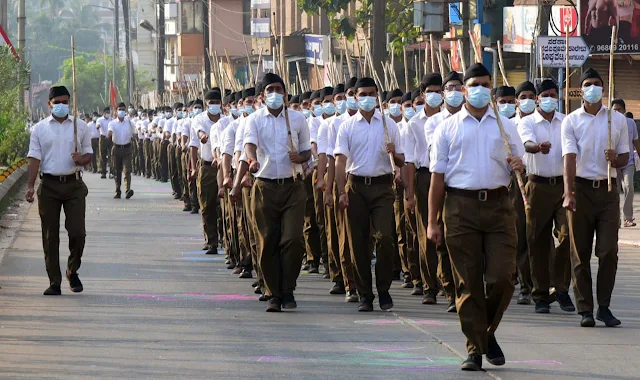
More than 70 years have passed since India gained its freedom on August 15, 1947, and so many changes are visible in Indian politics. The year 2014 celebrated the victory of Indian Prime Minister Narendra Modi who came to power with a thumping majority. Critics and political analysts see his ascension to the chair of Prime Minister due to his strong association with the Rashtriya Swayamsevak Sangh (RSS), a far-right extremist fringe Hindu outfit.
RSS is said to be the parent organisation of BJP, the political party to which Narendra Modi belongs. RSS and BJP leaders are often seen championing themselves as true nationalists and patriots. Their every activity is touched by the concept of ‘nationalism’. But history tells us something else about them.
People belonging to this outfit, wearing badges of nationalism, actually betrayed the Indian freedom movement. There are countless examples in this regard which expose the dubious role of RSS during the Indian freedom struggle.
At a time when the entire nation stood united against the British imperialists to realise their dream of making India free of British hold, RSS not only opposed the Indian freedom movements but announced its allegiance to the Britishers calling the anti-British freedom fighters reactionary as well as non-patriotic.
Before killing innocent people under the pretext of teaching them a lesson on nationalism, they should ask themselves why their forefathers maintained a distance from taking part in freedom movements.
A prominent biographer of Hedgewar writes: “After establishing Sangh, Doctor Saheb in his speeches used to talk only of Hindu organization. Direct comment on Government used to be almost nil” (Bhishikar, CP [1994]. “Sangh Vriksh ke Beej: Dr. Keshav Rao Hedgewar”, New Delhi: Suruchi Prakashan).
Hedgewar directly rejected the urges of the Congress under the leadership of Gandhiji to fight the Britishers. He was of the view that…
“the Hindu culture is the life-breath of Hindustan. It is therefore clear that if Hindustan is to be protected, we first nourish the Hindu culture. If the Hindu culture perishes in Hindustan itself, and if the Hindu society ceases to exist, it will hardly be appropriate to refer to the mere geographical entity that remains as Hindustan. Mere geographical lumps do not make a nation. Unfortunately, the Congress organization has given no thought to protecting the Hindu Dharma and Hindu culture. The organization keeps its eyes closed to the daily onslaughts by outsiders on the Hindu society” (“Religious Dimensions of Indian Nationalism: A Study of RSS” by Shamsul Islam).
Repeated utterings of the words “Hindustan and Hindu Dharma and Hindu culture” speak for themselves. He was more interested in making this nation a Hindu Rastra than revolting against the Britishers.
More than 70 years have passed since India gained its freedom on August 15, 1947, and so many changes are visible in Indian politics. The year 2014 celebrated the victory of Indian Prime Minister Narendra Modi who came to power with a thumping majority. Critics and political analysts see his ascension to the chair of Prime Minister due to his strong association with the Rashtriya Swayamsevak Sangh (RSS), a far-right extremist fringe Hindu outfit.
RSS is said to be the parent organisation of BJP, the political party to which Narendra Modi belongs. RSS and BJP leaders are often seen championing themselves as true nationalists and patriots. Their every activity is touched by the concept of ‘nationalism’. But history tells us something else about them.
People belonging to this outfit, wearing badges of nationalism, actually betrayed the Indian freedom movement. There are countless examples in this regard which expose the dubious role of RSS during the Indian freedom struggle.
At a time when the entire nation stood united against the British imperialists to realise their dream of making India free of British hold, RSS not only opposed the Indian freedom movements but announced its allegiance to the Britishers calling the anti-British freedom fighters reactionary as well as non-patriotic.
Before killing innocent people under the pretext of teaching them a lesson on nationalism, they should ask themselves why their forefathers maintained a distance from taking part in freedom movements.
RSS’ objectives
RSS was founded in 1925 by Keshav Baliram Hedgewar, a doctor in the city of Nagpur, British India. After founding RSS, Hedgewar kept this outfit away from participating in any anti-British movements. He never wanted to face the wrath of the Britishers for that could have posed a serious threat to the existence of the outfit.A prominent biographer of Hedgewar writes: “After establishing Sangh, Doctor Saheb in his speeches used to talk only of Hindu organization. Direct comment on Government used to be almost nil” (Bhishikar, CP [1994]. “Sangh Vriksh ke Beej: Dr. Keshav Rao Hedgewar”, New Delhi: Suruchi Prakashan).
Hedgewar directly rejected the urges of the Congress under the leadership of Gandhiji to fight the Britishers. He was of the view that…
“the Hindu culture is the life-breath of Hindustan. It is therefore clear that if Hindustan is to be protected, we first nourish the Hindu culture. If the Hindu culture perishes in Hindustan itself, and if the Hindu society ceases to exist, it will hardly be appropriate to refer to the mere geographical entity that remains as Hindustan. Mere geographical lumps do not make a nation. Unfortunately, the Congress organization has given no thought to protecting the Hindu Dharma and Hindu culture. The organization keeps its eyes closed to the daily onslaughts by outsiders on the Hindu society” (“Religious Dimensions of Indian Nationalism: A Study of RSS” by Shamsul Islam).
Repeated utterings of the words “Hindustan and Hindu Dharma and Hindu culture” speak for themselves. He was more interested in making this nation a Hindu Rastra than revolting against the Britishers.
RSS leaders
MS Golwalkar took over the leadership of RSS after Hedgewar passed away. He outrightly amplified his and RSS’ views on nationalism by saying, “Hindus, don’t waste your energy fighting the British. Save your energy to fight our internal enemies that are Muslims, Christians, and Communists.”He actively supported Hindu nationalism born out of the extremist Hindutva concept that sought to see the non-Hindus in India as second class citizens. He explained his version of Hindu Nationalism in his book ‘We Or Our Nationhood Defined’ in this way:
“…foreign races in Hindustan must either adopt the Hindu culture and language, must learn to respect and hold in reverence Hindu religion, must entertain no idea but those of the glorification of the Hindu race and culture, i.e. of the Hindu nation and must lose their separate existence to merge in the country, wholly subordinated to the Hindu Nation, claiming nothing, deserving no privileges, far less any preferential treatment not even citizen’s rights.”
This extract from his book bears testimony to the fact that how much hatred he used to hold for those who don’t profess Hinduism.
 At a time, when the entire world branded Hitler as the worst enemy of humankind, M.S. Golwalkar showered words of praise saying, “Germany shocked the world by her purging the country of the Semitic races – the Jews.” The RSS kept itself away from taking part in Quit India Movement in 1942. It not only mocked and opposed those participating in this mass struggle but urged the British government to resist the movement as soon as possible with an iron fist.
Dr Syama Prasad Mookerjee was a prominent Right-Wing firebrand who is often shown by the ruling BJP as an avowed worshipper of Mother India. He wrote a letter dated July 26, 1942, to the British Governor of Bengal, as the deputy chief minister in the Muslim League ministry of Bengal in which he said:
“Let me now refer to the situation that may be created in the province as a result of any widespread movement launched by the Congress. Anybody, who during the war, plans to stir up mass feeling, resulting in internal disturbances or insecurity, must be resisted by any Government that may function for the time being.”
VD Savarkar began his political career as a revolutionary who advocated for an inclusive India free of any sort of discrimination. But I feel that his mind underwent severe psychological transformation while he was in Cellular Jail in 1911. He wrote five consecutive petitions to the British government asking for forgiveness and his immediate release from the jail.
He assured that once released, he would withdraw himself from taking part in any sort of activity or movement that might pose a serious threat to the existence of the British rule in India. After he was released, he took over the leadership of Hindu Mahasabha. He played an active role in the formation of RSS. Hedgewar took advice from Savarkar before establishing RSS.
Savarkar too distanced himself and his organisation from Indian Freedom Movements. After a meeting with Savarkar, Lord Linlithgow, the then viceroy of India wrote to the then Secretary of State for India:
“The situation, he (Savarkar) said, was that his Majesty’s government must now turn to the Hindus and work with their support… Our interests were now the same and we must, therefore, work together… Our interests are solely so closely bound together, the essential thing is for Hinduism and Great Britain to be friends and the old antagonism was no longer necessary.”
‘Organiser‘, the English-language organ of RSS on August 14, 1947 while showing disrespect to the Tricolour wrote:
“The people who have come to power by the kick of fate may give in our hands the Tricolour but it never be respected and owned by Hindus. The word three is in itself an evil, and a flag having three colours will certainly produce a very bad psychological effect and is injurious to a country.”
The RSS, now projecting itself as an organisation of the nationalists and patriots, thus has an infamous past of betraying the revered freedom fighters. I strongly feel that it is very shameful, that with the rise of the BJP to power at centre, RSS is seen as a patriotic organisation.
Prominent rationalists from M M Kalburgi to Gauri Lankesh were murdered brutally because people carrying ideology similar to the RSS felt that they had insulted their religion. This too again speaks for itself. RSS along with other outfits that bear almost the same sort of ideology want to muzzle voices of dissent and most importantly have vowed to silence those voices that always advocate for rationalism.
---
*Graduate in English literature from the University of Kalyani; interests include politics, national and international affairs, gender based violence and women's issues
“…foreign races in Hindustan must either adopt the Hindu culture and language, must learn to respect and hold in reverence Hindu religion, must entertain no idea but those of the glorification of the Hindu race and culture, i.e. of the Hindu nation and must lose their separate existence to merge in the country, wholly subordinated to the Hindu Nation, claiming nothing, deserving no privileges, far less any preferential treatment not even citizen’s rights.”
This extract from his book bears testimony to the fact that how much hatred he used to hold for those who don’t profess Hinduism.
At a time, when the entire world branded Hitler as the worst enemy of humankind, M.S. Golwalkar showered words of praise saying, “Germany shocked the world by her purging the country of the Semitic races – the Jews.” The RSS kept itself away from taking part in Quit India Movement in 1942. It not only mocked and opposed those participating in this mass struggle but urged the British government to resist the movement as soon as possible with an iron fist.Dr Syama Prasad Mookerjee was a prominent Right-Wing firebrand who is often shown by the ruling BJP as an avowed worshipper of Mother India. He wrote a letter dated July 26, 1942, to the British Governor of Bengal, as the deputy chief minister in the Muslim League ministry of Bengal in which he said:
“Let me now refer to the situation that may be created in the province as a result of any widespread movement launched by the Congress. Anybody, who during the war, plans to stir up mass feeling, resulting in internal disturbances or insecurity, must be resisted by any Government that may function for the time being.”
VD Savarkar began his political career as a revolutionary who advocated for an inclusive India free of any sort of discrimination. But I feel that his mind underwent severe psychological transformation while he was in Cellular Jail in 1911. He wrote five consecutive petitions to the British government asking for forgiveness and his immediate release from the jail.
He assured that once released, he would withdraw himself from taking part in any sort of activity or movement that might pose a serious threat to the existence of the British rule in India. After he was released, he took over the leadership of Hindu Mahasabha. He played an active role in the formation of RSS. Hedgewar took advice from Savarkar before establishing RSS.
Savarkar too distanced himself and his organisation from Indian Freedom Movements. After a meeting with Savarkar, Lord Linlithgow, the then viceroy of India wrote to the then Secretary of State for India:
“The situation, he (Savarkar) said, was that his Majesty’s government must now turn to the Hindus and work with their support… Our interests were now the same and we must, therefore, work together… Our interests are solely so closely bound together, the essential thing is for Hinduism and Great Britain to be friends and the old antagonism was no longer necessary.”
Dishonoring Tricolour
Top leaders of RSS may go to various events to unfurl the Tricolour to demonstrate their nationalism. I am of the opinion that the RSS always denigrated and disrespected the Tricolour. Golwalkar used to say that it is the saffron flag that is the national flag of Hindustan and not the Tricolour.‘Organiser‘, the English-language organ of RSS on August 14, 1947 while showing disrespect to the Tricolour wrote:
“The people who have come to power by the kick of fate may give in our hands the Tricolour but it never be respected and owned by Hindus. The word three is in itself an evil, and a flag having three colours will certainly produce a very bad psychological effect and is injurious to a country.”
The RSS, now projecting itself as an organisation of the nationalists and patriots, thus has an infamous past of betraying the revered freedom fighters. I strongly feel that it is very shameful, that with the rise of the BJP to power at centre, RSS is seen as a patriotic organisation.
Prominent rationalists from M M Kalburgi to Gauri Lankesh were murdered brutally because people carrying ideology similar to the RSS felt that they had insulted their religion. This too again speaks for itself. RSS along with other outfits that bear almost the same sort of ideology want to muzzle voices of dissent and most importantly have vowed to silence those voices that always advocate for rationalism.
---
*Graduate in English literature from the University of Kalyani; interests include politics, national and international affairs, gender based violence and women's issues
Comments
Post a Comment
NOTE: Hateful, abusive comments won't be published. -- Editor