Nagas being subjected to untold trauma, 'heavy' mental burden: Global rights group

Counterview Desk 

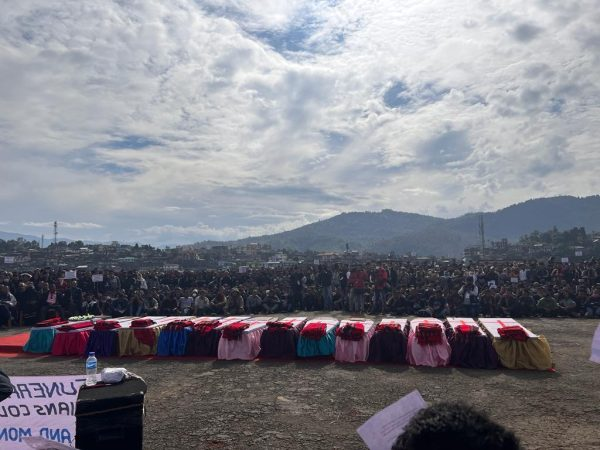
The International League of Peoples' Struggle (ILPS), with presence in 40 countries, even as strongly condemning the "murder" of 15 coal miners and injuring 11 more by the Indian army in Mon district, Nagaland, has said it is "joining" its network, Naga Peoples Movement for Human Rights (NPMHR), adding, it supports the Naga peoples, the people of India’s north east and all lovers of peace and freedom in calling for the immediate repeal of the Armed Forces Special Powers Act (AFSPA), 1958.
Releasing a statement by NPMHR, it said, AFSPA is sought to be implemented by the Government of India in Northeast States allegedly enabling Indian army’s "massacre of indigenous peoples and citizens with impunity." Calling for justice for all the "victims" of the Indian government, it has floated an online petition to repeal AFSPA to seek international solidarity.

NPMHR statement:

Ever since military aggression and occupation of the Naga homeland in 1954, civilians and common Naga people have been the target of the Indian army and the para-military forces. Armed with Draconian and inhuman legal immunity by the Indian Parliament, the Government of India continues unabated to kill civilians and common people at any time and at any place of its conveniences. Our women folks were stripped of all human dignity by the armed forces of the world’s largest Democracy, India.
They are being raped, tortured, made to give birth publicly with no more human dignity left and are being subjected to live lives of untold trauma and heavy mental burdens. The Indian State does not spare any of its armed tools and occupational instruments to extinguish the Naga spirit of human dignity and spirit of equal human brotherhood. The world is prevented from knowing these ceaseless state-sponsored crimes against the Naga people and against humanity.
The reign of the Indian State-sponsored terrorism and war waged on civilian population is yet again showcased when the best-trained Indian elite forces butchered a group of humble people returning to their homes in a truck from their work places. The well-trained Indian army personnel engaged their most sophisticated firearms to kill them as if the simple, humble and bread-earning villagers were diseased and had to be culled.
Are the lives of the Naga people less than the lives of other fellow human beings? This evil act of the Indian government through its military forces once again reveals its true intent of owning our land after exterminating our Naga people.
Our people at all times seek to live in peace with all other people. Our history tells that we have never waged war on any people even in the days of old. We are being denied to live lives of dignity, to exercise our rights and are now being driven to live in fear. The Government of India, time and again, wages war against our Naga people. The actions of the Indian State upon our people are no less than the erstwhile apartheid. No power on earth had ever succeeded in subduing our Naga spirit.
We, the Naga Peoples’ Movement for Human Rights (NPMHR), resolutely condemn the genocide committed upon the humble working-civilian villagers. We squarely hold the Government of India with all its draconian and fascist laws responsible for letting loose their dogs of war to maul to shreds the innocent villagers of Oting who have committed no crime whatsoever except commitment to humbly earn their livelihood with dignity and honor. Even at this moment when we are making this Statement, the Indian military and paramilitary forces are still engaged in their mayhem of killing the civilians in Mon Town.
Our anguish is unspeakable at this moment of grief. Our hearts go to the families of the slain innocent villagers. The NPMHR stands with them all and shall walk with them through thick and thin.

Comments

TRENDING

Whither space for the marginalised in Kerala's privately-driven townships after landslides?

By Ipshita Basu, Sudheesh R.C.  In the early hours of July 30 2024, a landslide in the Wayanad district of Kerala state, India, killed 400 people. The Punjirimattom, Mundakkai, Vellarimala and Chooralmala villages in the Western Ghats mountain range turned into a dystopian rubble of uprooted trees and debris.

From algorithms to exploitation: New report exposes plight of India's gig workers

By Jag Jivan   The recent report, "State of Finance in India Report 2024-25," released by a coalition including the Centre for Financial Accountability, Focus on the Global South, and other organizations, paints a stark picture of India's burgeoning digital economy, particularly highlighting the exploitation faced by gig workers on platform-based services. 

Gig workers hold online strike on republic day; nationwide protests planned on February 3

By A Representative   Gig and platform service workers across the country observed a nationwide online strike on Republic Day, responding to a call given by the Gig & Platform Service Workers Union (GIPSWU) to protest what it described as exploitation, insecurity and denial of basic worker rights in the platform economy. The union said women gig workers led the January 26 action by switching off their work apps as a mark of protest.

'Condonation of war crimes against women and children’: IPSN on Trump’s Gaza Board

By A Representative   The India-Palestine Solidarity Network (IPSN) has strongly condemned the announcement of a proposed “Board of Peace” for Gaza and Palestine by former US President Donald J. Trump, calling it an initiative that “condones war crimes against children and women” and “rubs salt in Palestinian wounds.”

India’s road to sustainability: Why alternative fuels matter beyond electric vehicles

By Suyash Gupta*  India’s worsening air quality makes the shift towards clean mobility urgent. However, while electric vehicles (EVs) are central to India’s strategy, they alone cannot address the country’s diverse pollution and energy challenges.

With infant mortality rate of 5, better than US, guarantee to live is 'alive' in Kerala

By Nabil Abdul Majeed, Nitheesh Narayanan   In 1945, two years prior to India's independence, the current Chief Minister of Kerala, Pinarayi Vijayan, was born into a working-class family in northern Kerala. He was his mother’s fourteenth child; of the thirteen siblings born before him, only two survived. His mother was an agricultural labourer and his father a toddy tapper. They belonged to a downtrodden caste, deemed untouchable under the Indian caste system.

Jayanthi Natarajan "never stood by tribals' rights" in MNC Vedanta's move to mine Niyamigiri Hills in Odisha

By A Representative The Odisha Chapter of the Campaign for Survival and Dignity (CSD), which played a vital role in the struggle for the enactment of historic Forest Rights Act, 2006 has blamed former Union environment minister Jaynaynthi Natarjan for failing to play any vital role to defend the tribals' rights in the forest areas during her tenure under the former UPA government. Countering her recent statement that she rejected environmental clearance to Vendanta, the top UK-based NMC, despite tremendous pressure from her colleagues in Cabinet and huge criticism from industry, and the claim that her decision was “upheld by the Supreme Court”, the CSD said this is simply not true, and actually she "disrespected" FRA.

Stands 'exposed': Cavalier attitude towards rushed construction of Char Dham project

By Bharat Dogra*  The nation heaved a big sigh of relief when the 41 workers trapped in the under-construction Silkyara-Barkot tunnel (Uttarkashi district of Uttarakhand) were finally rescued on November 28 after a 17-day rescue effort. All those involved in the rescue effort deserve a big thanks of the entire country. The government deserves appreciation for providing all-round support.

Over 40% of gig workers earn below ₹15,000 a month: Economic Survey

By A Representative   The Finance Minister, Nirmala Sitharaman, while reviewing the Economic Survey in Parliament on Tuesday, highlighted the rapid growth of gig and platform workers in India. According to the Survey, the number of gig workers has increased from 7.7 million to around 12 million, marking a growth of about 55 percent. Their share in the overall workforce is projected to rise from 2 percent to 6.7 percent, with gig workers expected to contribute approximately ₹2.35 lakh crore to the GDP by 2030. The Survey also noted that over 40 percent of gig workers earn less than ₹15,000 per month.