The issue is not privacy -- it has never been. Millenials of all stripes today willingly sign-off most of their personal life fully well knowing that Big Tech is openly hoovering up their messages and posts. Mining every word and search term for valuable insights into users' behaviour leads to targeted advertising, ergo -- profits -- but the likes of Gen-Z, etc., couldn’t care less, shrugging away with a so-what when confronted with this ultra-personal intrusion. Indeed as the quip goes, youth is wasted on the young.
The issue is not overreaching of grounds-level authority. In India that fact is often a given -- a resigned cliche. Citizens with even limited arm’s length experience with law-and-order enforcement have few illusions on the demonstrated coercive ability of police/customs officials/immigration officials when a citizen is under-duress to demand, implicitly insinuate terrible outcomes, or otherwise tire you out and get (un)willing access to your phones, message apps and computers.
US based digital forensics firm Arsenal Consulting has found how incriminating letters were planted in Rona Wilson’s laptop to implicate him and 15 others in the Bhima-Koregaon case. In the same case Pegasus spyware was used to install malware in defense lawyer Nihalsing Rathod’s phone.
The issue is not NSO or Israel. The privacy busting “products" that the former sells is not much different in spirit from Rafale or Raytheon’s wares. Governments are the buyers of arms -- ostensibly -- to protect their citizens from external aggression and NSO’s Pegasus when used against the terribly-cliched “terrorists” serves a similar purpose of attempting to protect residents from malicious harm.
Indeed NSO seems to be doing exactly what every arms-dealer does -- asks for an end-user certificate that has the buyer assuring that the usage would be restricted to legitimate targets, for example, “terrorists”. So, if arms dealers and manufacturers may continue to be in business under the auspices of their host countries, the NSO or for that matter Israel -- as detestable to you this business might be -- is not the problem.
The issue is not even evident brazenness of the Indian government to use a large sum of tax payer money, in what had been an opaque manner, to procure this tool. It has been known since day one when the NSO indicated that its customers are only governments - a fact that many among us did not miss when in July 2020, a related court ruling was made public in California.
The issue is not -- though all this is admittedly infuriating -- that the GoI deployed it against both now-known 161 civilian and still-unpublished unknown number of terrorist targets and that they did this spying without any pretence of "due process”. That is, they did all this without going to any judicial authority to secure a specific warrant - a feature of constitutionally protected checks and balances -- by justifying to an adversarial court why surveillance was necessary in a specific case -- using the principle of probable cause.
Neither is the issue that when confronted by a global expose - they resorted to feckless stonewalling, issuing non-denials and in the process curtailing democratic parliamentary debate. Nopes. None of this really is terribly surprising in India. Indeed the previous UPA government admitted to snooping on 7500 phones and 300 email accounts per month as late in 2013. Nevertheless, Pegasus would demonstrably cap the long democratic slide India has had since 1951.
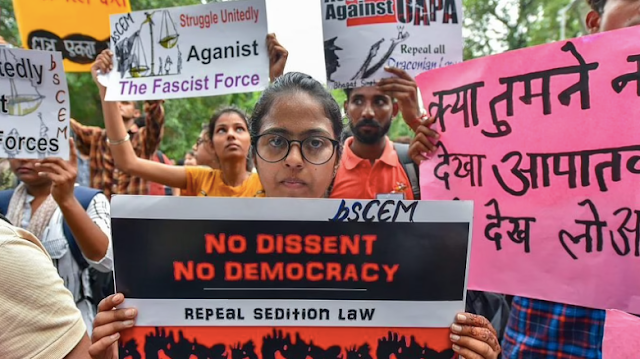
The issue is simply the chilling effect on free speech which even the SC is forced to admit. When you know that your government has abrogated to itself the unchecked power and authority to actively target citizens it deems enemy of the state -- vocal or otherwise -- basically searching for kompromat, an understandable over-reaction is to become acutely self-conscious of every aspect of your own private life.
When you know that your spending habits, your private texts with your partner, your debts, your trip to Bangkok or Amsterdam, your off-colour political jokes -- let alone a tweet against government policy -- any opinion which is simply your right to hold and speak/ text/ message even in private closed groups is being surveilled that could later be used to wreck your personal life, your career or aspirations -- you’d change your behaviour.
That exactly is the goal. The government is quietly delighted that the public at-large is now aware of their snooping on the public-at-large. That signal itself is the message. Self-censorship of any criticism against the government is the real objective.
This is the illiberal goal that this government seeks -- preemptive control of their dissidents, critics and wannabe irritants. Have you wondered why it is that so few people -- business leaders, entertainment celebrities and others with large platform -- have chosen not to speak up over the past few years? The government seems to have leverage from the skeleton-cupboard of everyone.
This is the illiberal goal that this government seeks -- preemptive control of their dissidents, critics and wannabe irritants. Have you wondered why it is that so few people -- business leaders, entertainment celebrities and others with large platform -- have chosen not to speak up over the past few years? The government seems to have leverage from the skeleton-cupboard of everyone.
Why is it that so few people -- business leaders, entertainment celebrities, others with large platform -- choose not to speak up over the past few years?
Once outspoken leaders have had an often sudden change-of-heart, some becoming cringe-inducing craven yes-people to the ruling regime. In a truly Kafkaesque twist, initial nominees to the farcical SC committee set up to investigate the Pegasus affair -- possibly knowing that they had kompromat-on-tap to offer via Pegasus snooping and would be miserably silenced -- wisely refused to, completing a self-fulfilling loop.
With endless news cycles, and media circuses around easier stories such as an actor with a few grams of charas or a cricket captain not issuing a denunciation, a mass uprising around this most foundational assault on Article 19 remains in the distance. If history is any indication, the SC committee will be thwarted at every step, subject to delays and obfuscation.
They will end up issuing a toothless un-categorical report, likely on a Friday afternoon before a long festive weekend at the start of a parliamentary recess and just before the new Chief Justice is onboarded. Still, such investigative journalism often leads to elite defection -- a pre-requisite for radical change.
The free speech has to be protected from due-process-free government intrusion. Dragnet surveillance has to be opposed. The use of surveillance technology on any resident by any government authority should pass through case-by-case judicial oversight -- securing a magistrate’s warrant every time before deploying to use without exception.
Aggregate numbers under surveillance should be available periodically as parliamentary reports. RTI queries should respond fully to requests for warrants from magistrates once the case is adjudicated or not brought to trial. Use of taxpayer funds should always be transparent and subject to independent audit.
With endless news cycles, and media circuses around easier stories such as an actor with a few grams of charas or a cricket captain not issuing a denunciation, a mass uprising around this most foundational assault on Article 19 remains in the distance. If history is any indication, the SC committee will be thwarted at every step, subject to delays and obfuscation.
They will end up issuing a toothless un-categorical report, likely on a Friday afternoon before a long festive weekend at the start of a parliamentary recess and just before the new Chief Justice is onboarded. Still, such investigative journalism often leads to elite defection -- a pre-requisite for radical change.
The free speech has to be protected from due-process-free government intrusion. Dragnet surveillance has to be opposed. The use of surveillance technology on any resident by any government authority should pass through case-by-case judicial oversight -- securing a magistrate’s warrant every time before deploying to use without exception.
Aggregate numbers under surveillance should be available periodically as parliamentary reports. RTI queries should respond fully to requests for warrants from magistrates once the case is adjudicated or not brought to trial. Use of taxpayer funds should always be transparent and subject to independent audit.
We will support laws that allow protection to whistleblowers who expose government overreach -- it is no surprise that since 2017 when Pegasus was deployed, no insider came out to speak up -- against such brazen constitutional undercutting.
Article 19 is the bedrock of a healthy society -- people freely able to speak their mind, even when their opinions might go against the majoritarian view or contrarian to establishment is key to overall progress.
---
*Venkatesh Narayanan is Mumbai based software technology management professional; Sandeep Pandey is General Secretary of Socialist Party (India) and Magsaysay award winning activist-scholar
---
*Venkatesh Narayanan is Mumbai based software technology management professional; Sandeep Pandey is General Secretary of Socialist Party (India) and Magsaysay award winning activist-scholar
Comments
Post a Comment
NOTE: Hateful, abusive comments won't be published. -- Editor