Appearances can be deceptive. So can be Covid Appropriate Behaviour (CAB). An anecdote illustrates this well known cliché. A man who is very particular about hygiene decides to eat out. After a rather long search, he spots a restaurant which has a spotlessly clean exterior and he walks in.
A waiter in spotlessly clean attire ushers him to a spotlessly clean table. The waiter takes out a pair of spotlessly clean silver tongs from the pocket of his spotlessly clean jacket and with it takes out a spotlessly clean menu card from his other pocket. After going through it the fastidious customer is about to hand it back to the waiter who tells him to throw it away in the nearby waste bin.
The waiter informs that the hotel management is very particular about hygiene and even the menu cards are disposable to prevent cross contamination. The customer is thoroughly impressed now and pats himself on the back on his choice of restaurant. He orders cutlets.
The waiter brings them in a spotlessly clean silver casserole, takes out the spotlessly clean tongs from his pocket, picks up the cutlets and puts them on a spotlessly clean plate. The customer muses on the efforts made to ensure zero transmission of any infection in this spotlessly clean hygienic restaurant.
While munching on his cutlet he noticed a peculiar thing. All the waiters were dressed in spotlessly clean white jackets and black trousers.What intrigued him was that the uniform had a white string hanging over the front flap of the black trousers.
When the waiter brought his bill he enquired about this fascinating aspect of the waiters’ attire. The waiter replied, “Sir, as I told you the management is stickler for hygiene. They want to ensure that even when we go to the washroom we do not use our fingers."
A waiter in spotlessly clean attire ushers him to a spotlessly clean table. The waiter takes out a pair of spotlessly clean silver tongs from the pocket of his spotlessly clean jacket and with it takes out a spotlessly clean menu card from his other pocket. After going through it the fastidious customer is about to hand it back to the waiter who tells him to throw it away in the nearby waste bin.
The waiter informs that the hotel management is very particular about hygiene and even the menu cards are disposable to prevent cross contamination. The customer is thoroughly impressed now and pats himself on the back on his choice of restaurant. He orders cutlets.
The waiter brings them in a spotlessly clean silver casserole, takes out the spotlessly clean tongs from his pocket, picks up the cutlets and puts them on a spotlessly clean plate. The customer muses on the efforts made to ensure zero transmission of any infection in this spotlessly clean hygienic restaurant.
While munching on his cutlet he noticed a peculiar thing. All the waiters were dressed in spotlessly clean white jackets and black trousers.What intrigued him was that the uniform had a white string hanging over the front flap of the black trousers.
When the waiter brought his bill he enquired about this fascinating aspect of the waiters’ attire. The waiter replied, “Sir, as I told you the management is stickler for hygiene. They want to ensure that even when we go to the washroom we do not use our fingers."
We use this white string to pull down the zipper!
The customer was impressed by this attention to details. Just as he got up and was leaving, a thought came to him and he asked the waiter, “I get the string to pull down the zipper part, but after that how do you proceed?” “I cannot say about the others, but as for me I use these tongs,” the waiter replied pulling out the spotlessly clean silver tongs from the pocket of his spotlessly clean jacket!
The above anecdote can also be used to explain the principle of “Hazard Analysis and Critical Control Points” or HACCP, a method in food hygiene to make a flow diagram of food from the farm to the plate between which there may be many a slip. After critically examining the process at each step in the flow diagram, “hazard analysis” identifies the hazardous practices, or the “critical control points.” HACCP method has been increasingly applied for critical appraisal of hygienic measures beyond the food industry.
The term “appropriate technology” is one of the principles of health care with a goal to attain Health for All at the Alma-Ata conference in 1978 endorsed by the World Health Organisation (WHO). Appropriate technology has been defined as technology that is scientifically sound, adaptable to local needs and acceptable to the people. It may be worthwhile to examine CAB under the lens of science, HACCP and “Appropriate Technology.”
CAB advocates three practices; use of masks, physical distancing and hand-washing. Wearing of masks has been a bone of contention since the onset of the pandemic. Initially even the great Anthony Fauci, who claims that if you attack him you are attacking science, flip flopped on the need for the common citizen to wear masks, first saying there is no good reason for them to wear masks, then advocating it and subsequently going to the other extreme of recommending double masking.
While few “convenient studies,” mostly observational, including a recent messy meta-analysis published in BMJ, conclude they reduce transmission, two rigorous randomized trials found none to modest reduction in transmission of the virus.
The customer was impressed by this attention to details. Just as he got up and was leaving, a thought came to him and he asked the waiter, “I get the string to pull down the zipper part, but after that how do you proceed?” “I cannot say about the others, but as for me I use these tongs,” the waiter replied pulling out the spotlessly clean silver tongs from the pocket of his spotlessly clean jacket!
The above anecdote can also be used to explain the principle of “Hazard Analysis and Critical Control Points” or HACCP, a method in food hygiene to make a flow diagram of food from the farm to the plate between which there may be many a slip. After critically examining the process at each step in the flow diagram, “hazard analysis” identifies the hazardous practices, or the “critical control points.” HACCP method has been increasingly applied for critical appraisal of hygienic measures beyond the food industry.
The term “appropriate technology” is one of the principles of health care with a goal to attain Health for All at the Alma-Ata conference in 1978 endorsed by the World Health Organisation (WHO). Appropriate technology has been defined as technology that is scientifically sound, adaptable to local needs and acceptable to the people. It may be worthwhile to examine CAB under the lens of science, HACCP and “Appropriate Technology.”
CAB advocates three practices; use of masks, physical distancing and hand-washing. Wearing of masks has been a bone of contention since the onset of the pandemic. Initially even the great Anthony Fauci, who claims that if you attack him you are attacking science, flip flopped on the need for the common citizen to wear masks, first saying there is no good reason for them to wear masks, then advocating it and subsequently going to the other extreme of recommending double masking.
While few “convenient studies,” mostly observational, including a recent messy meta-analysis published in BMJ, conclude they reduce transmission, two rigorous randomized trials found none to modest reduction in transmission of the virus.
These modest findings were under study conditions where participants are under observation and a sort of population placebo effect known as the Hawthorne effect comes into play. Being study participants, they would tend to use the masks more properly than practiced by the common citizen under normal conditions.
Viruses are very small particles, many times tinier than the pores of a mask, surgical or cloth. Even a high school student would know that masks would not work as filters for any virus. Therefore the advocacy for masks hinges on spread of droplets carrying the virus. These droplets are thrown out during speaking, coughing or sneezing. Let us do HACCP analysis on use of masks by the common citizen.
It is common tendency to pull down the mask while speaking, and then pull it up. The purpose of mitigating spread of droplets while speaking, when more droplets are expelled, gets defeated. Similarly when a group of people enter a restaurant all masked up, for eating they have to pull down their masks (in some places in the West there are mandates that one should pull up their masks between bites!). Good food increases salivation and speaking while eating with family and friends ejects “lethal” droplets full of virus!
Viruses are very small particles, many times tinier than the pores of a mask, surgical or cloth. Even a high school student would know that masks would not work as filters for any virus. Therefore the advocacy for masks hinges on spread of droplets carrying the virus. These droplets are thrown out during speaking, coughing or sneezing. Let us do HACCP analysis on use of masks by the common citizen.
It is common tendency to pull down the mask while speaking, and then pull it up. The purpose of mitigating spread of droplets while speaking, when more droplets are expelled, gets defeated. Similarly when a group of people enter a restaurant all masked up, for eating they have to pull down their masks (in some places in the West there are mandates that one should pull up their masks between bites!). Good food increases salivation and speaking while eating with family and friends ejects “lethal” droplets full of virus!
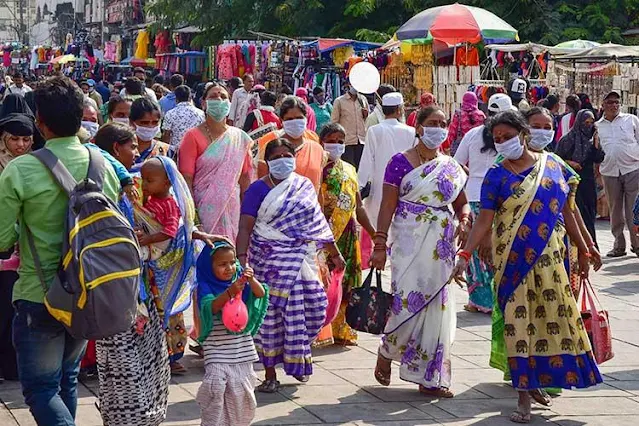
Physical distancing is not appropriate technology for a country with high population density where homes and public transport are crowded
After leaving the restaurant all don their masks as they enter the street outwardly observing Covid Appropriate Behaviour! Transmission, if any, has already occurred indoors. So by the principles of HACCP, masks would have little impact on mitigation of transmission of the virus, until one masters the technique of withholding one’s breath, and observe “maun vrath”! Common sense without fancy trials should also guide policy.
What about mask being “appropriate technology” for hot humid conditions in the country. Surprisingly, no one is studying the harm which masks can cause if used improperly. In hot humid conditions, they get wet with sweat and saliva within hours and the common citizen cannot afford the frequent change which is required to prevent infections with perhaps more lethal pathogens. Fungus including mucor can thrive on moist masks.
Being close to the nose the organisms growing on these soiled masks can easily reach the sinuses and potentially cause life threatening infections. It raises the question whether the high rate of mucormycosis in the country in the second wave occurred due to improper use of soiled masks in addition to underlying diabetes and use of steroids.
Similarly the practice of physical distancing is not “appropriate technology” for a country with high population density where homes, public transport, and even airplanes are crowded. The last practice of frequent hand washing may be the only one which may be feasible by citizens and policy makers alike – the former may keep washing their hands with soap and water, the latter have already “washed their hands off” accountability as they can blame the citizen for not observing CAB in case of any surge!
---
*Professor & Head, Community Medicine, Clinical Epidemiologist; Editor-in-Chief, Medical Journal Dr DY Patil Vidyapeeth, Pune
What about mask being “appropriate technology” for hot humid conditions in the country. Surprisingly, no one is studying the harm which masks can cause if used improperly. In hot humid conditions, they get wet with sweat and saliva within hours and the common citizen cannot afford the frequent change which is required to prevent infections with perhaps more lethal pathogens. Fungus including mucor can thrive on moist masks.
Being close to the nose the organisms growing on these soiled masks can easily reach the sinuses and potentially cause life threatening infections. It raises the question whether the high rate of mucormycosis in the country in the second wave occurred due to improper use of soiled masks in addition to underlying diabetes and use of steroids.
Similarly the practice of physical distancing is not “appropriate technology” for a country with high population density where homes, public transport, and even airplanes are crowded. The last practice of frequent hand washing may be the only one which may be feasible by citizens and policy makers alike – the former may keep washing their hands with soap and water, the latter have already “washed their hands off” accountability as they can blame the citizen for not observing CAB in case of any surge!
---
*Professor & Head, Community Medicine, Clinical Epidemiologist; Editor-in-Chief, Medical Journal Dr DY Patil Vidyapeeth, Pune
Comments