
The farmers’ protest movement has brought into sharp focus that India consists of two countries. One is the mighty sprawling urban India where all of us fortunate live spoilt by consumerism and wanting more and more at the cost of others.
The other is the weak scattered rural population who are waiting still since 1947 independence to survive poverty, hunger, malnutrition, unemployment and basic education and health facilities. In 73 years of independence the rural population has been denied even the ultimate basic necessity of clean drinking water – why bother for more.
For the first time the rural population has risen against the insensitive government in the form of village farmers protesting the one-sided farm laws and telling the rulers to mind their own business. The farmers are telling the government that they toil and till the land with their sweat and thus feed the vast population of this country and the least one could do is to step stating that the farm laws are for their benefit.
They insist: Don’t call us Khalistanis or terrorists because if we stop farming you will not survive. You have no tears for the more than 3,00,000 farmers that have committed suicide over the years and more than 130 farmers have died during this recent ongoing protest but you shed a lot of tears for the earning fall of your dear Corporates or for sliding GDP.
Our Father of the Nation warned us in 1948 with these prophetic words:
“Recall the face of the poorest and the weakest man [woman] whom you may have seen, and ask yourself, if the step you contemplate is going to be of any use to him [her]. Will he [she] gain anything by it? Will it restore him [her] to a control over his [her] own life and destiny? In other words, will it lead to swaraj [freedom] for the hungry and spiritually starving millions?”
Merely placing flowers in Rajghat on his birthday and martyrdom day was not Mahatma’s message. He was Mahatma for and of the poor and deprived. Ironically, we are ready to lower taxes and give tax breaks to the urban population and the rich community but not increased subsidies to the toiling farmers. Compare this with other countries who promote farming not kill it.
The migrant crisis during this Coronavirus and continuous lockdown has shown us the underbelly of our pseudo-development model. Globalisation and so-called liberalization has benefitted a few at the top and the vast majority at the bottom of the pile have waited patiently for the promised trickle-down effect which never came in the last thirty years.
Vast technological progress has not resulted in equitable distribution of wealth; rather it has converted a human being into a number to be manipulated, shadowed and controlled by a heartless technology. This globalization has reduced the vast majority as a statistical entity whose only purpose in life is to serve the fortunate and powerful few. This is slavery of the worst kind since the slave is brain-washed to feel that he is serving a noble purpose.
It would be pertinent to remember in these turbulent times what Mahatma Gandhi had suggested in the 1940s for making the rural India as the centerpiece of planning and growth:
“I am convinced that if India is to attain true freedom and through India the world also, then sooner or later the fact must be recognized that people will have to live in villages, not in towns, in huts, not in palaces.
“My idea of Village Swaraj is that it is a complete Republic, independent of its neighbours for its own vital wants, and yet interdependent for many others in which dependence is a necessity. Thus every village’s first concern will be to grow its own food crops and cotton for its cloth. It should have a reserve for its cattle, recreation and playground for adults and children. Then if more land is available, it will grow useful money crops. The village will maintain a village theatre, school and public hall. It will have its own waterworks ensuring clean water supply. This can be done through controlled wells or tanks. Education will be compulsory up to the final basic course. As far as possible every activity will be conducted on the co-operative basis.
“No one under it should suffer for want of food and clothing. We should be ashamed of resting or having a square meal so long as there is one able-bodied man or woman without work or food.”
The wide gulf existing between the urban and rural population even after 73 years of independence proves that we are more concerned for our city population than our simple living uneducated rural human beings. It explains how quick we are ready to spend crores over new Parliament building, bullet train, smart cities, modernizing airports, etc. but would rather not divert any budgetary support to build schools, hospitals, provide drinking water and electricity to villages in India.
Much has been made of village electrification in India proclaiming that almost all Indian villages have been electrified. Of course electric poles may have been erected and wires stretched but there is no current flowing through them.
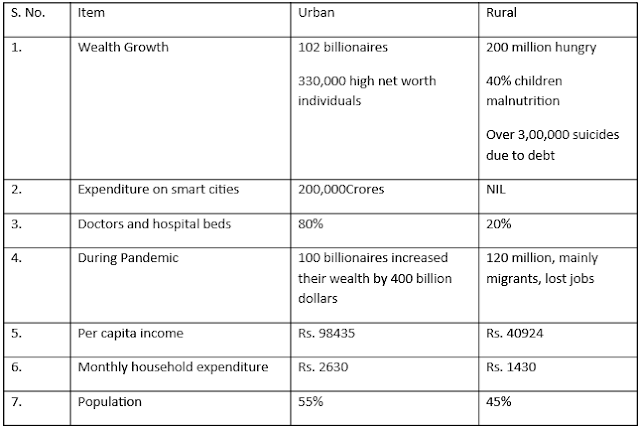
The disparity between urban and rural development has been sharply focused by Avay Shukla in a revealing article entitled ‘The Day Bharat came calling on India’ as given below:
 Through the decentralization of power and the investment emphasis on the rural sector, we can invert the existing pyramid so that the poor, deprived and neglected become the prime concern of ours and real development indices relate to the well-being of this section of society. It is of no consequence if the rich get richer; it is important that the bottom is offered a life of purpose and happiness. The equality and equity will not then remain merely a slogan.
Rural India is crying for help and the farmers’ agitation is a result of this neglect. The test of real leadership is that it hears these complaints and acts according to the will of the population which it is supposed to represent. The silence from this Government is deafening.
---
*Convener, Jharkhand Nagrik Prayas
For the first time the rural population has risen against the insensitive government in the form of village farmers protesting the one-sided farm laws and telling the rulers to mind their own business. The farmers are telling the government that they toil and till the land with their sweat and thus feed the vast population of this country and the least one could do is to step stating that the farm laws are for their benefit.
They insist: Don’t call us Khalistanis or terrorists because if we stop farming you will not survive. You have no tears for the more than 3,00,000 farmers that have committed suicide over the years and more than 130 farmers have died during this recent ongoing protest but you shed a lot of tears for the earning fall of your dear Corporates or for sliding GDP.
Our Father of the Nation warned us in 1948 with these prophetic words:
“Recall the face of the poorest and the weakest man [woman] whom you may have seen, and ask yourself, if the step you contemplate is going to be of any use to him [her]. Will he [she] gain anything by it? Will it restore him [her] to a control over his [her] own life and destiny? In other words, will it lead to swaraj [freedom] for the hungry and spiritually starving millions?”
Merely placing flowers in Rajghat on his birthday and martyrdom day was not Mahatma’s message. He was Mahatma for and of the poor and deprived. Ironically, we are ready to lower taxes and give tax breaks to the urban population and the rich community but not increased subsidies to the toiling farmers. Compare this with other countries who promote farming not kill it.
 |
| Government subsidy in agriculture sector 2019 |
Vast technological progress has not resulted in equitable distribution of wealth; rather it has converted a human being into a number to be manipulated, shadowed and controlled by a heartless technology. This globalization has reduced the vast majority as a statistical entity whose only purpose in life is to serve the fortunate and powerful few. This is slavery of the worst kind since the slave is brain-washed to feel that he is serving a noble purpose.
It would be pertinent to remember in these turbulent times what Mahatma Gandhi had suggested in the 1940s for making the rural India as the centerpiece of planning and growth:
“I am convinced that if India is to attain true freedom and through India the world also, then sooner or later the fact must be recognized that people will have to live in villages, not in towns, in huts, not in palaces.
“My idea of Village Swaraj is that it is a complete Republic, independent of its neighbours for its own vital wants, and yet interdependent for many others in which dependence is a necessity. Thus every village’s first concern will be to grow its own food crops and cotton for its cloth. It should have a reserve for its cattle, recreation and playground for adults and children. Then if more land is available, it will grow useful money crops. The village will maintain a village theatre, school and public hall. It will have its own waterworks ensuring clean water supply. This can be done through controlled wells or tanks. Education will be compulsory up to the final basic course. As far as possible every activity will be conducted on the co-operative basis.
“No one under it should suffer for want of food and clothing. We should be ashamed of resting or having a square meal so long as there is one able-bodied man or woman without work or food.”
The wide gulf existing between the urban and rural population even after 73 years of independence proves that we are more concerned for our city population than our simple living uneducated rural human beings. It explains how quick we are ready to spend crores over new Parliament building, bullet train, smart cities, modernizing airports, etc. but would rather not divert any budgetary support to build schools, hospitals, provide drinking water and electricity to villages in India.
Much has been made of village electrification in India proclaiming that almost all Indian villages have been electrified. Of course electric poles may have been erected and wires stretched but there is no current flowing through them.
The disparity between urban and rural development has been sharply focused by Avay Shukla in a revealing article entitled ‘The Day Bharat came calling on India’ as given below:

Rural India is crying for help and the farmers’ agitation is a result of this neglect. The test of real leadership is that it hears these complaints and acts according to the will of the population which it is supposed to represent. The silence from this Government is deafening.
---
*Convener, Jharkhand Nagrik Prayas
Comments