
ONGC, State Bank of India 'stakeholders' in junta-supported Myanmar-China pipelines

By Henrieke Butijn* 

Some banks are comfortable financing atrocities, as is clear with the financiers that are bankrolling the fossil fuel giants that run the Myanmar-China pipelines. The Myanmar junta, who began an illegal attempted coup in February 2021, receives revenue from oil and gas projects and profits from the Myanma Oil and Gas Enterprise (MOGE) shares in projects.
MOGE is a state agency illegally under military control. The oil & gas sector has earned the Myanmar junta 800 million US dollars in April to July 2022 alone, according to the junta’s own figures. A significant portion of these earnings are from the Shwe gas project and connected Myanmar-China oil and gas pipelines. These projects are run by fossil fuel giants linked to banks covered by the Banking on Climate Chaos report which was published last week.
A junta that has killed over 3,200 people and arrested over 21,000 more since its illegal coup attempt unsurprisingly uses violence to protect the funding that enables its international crimes.
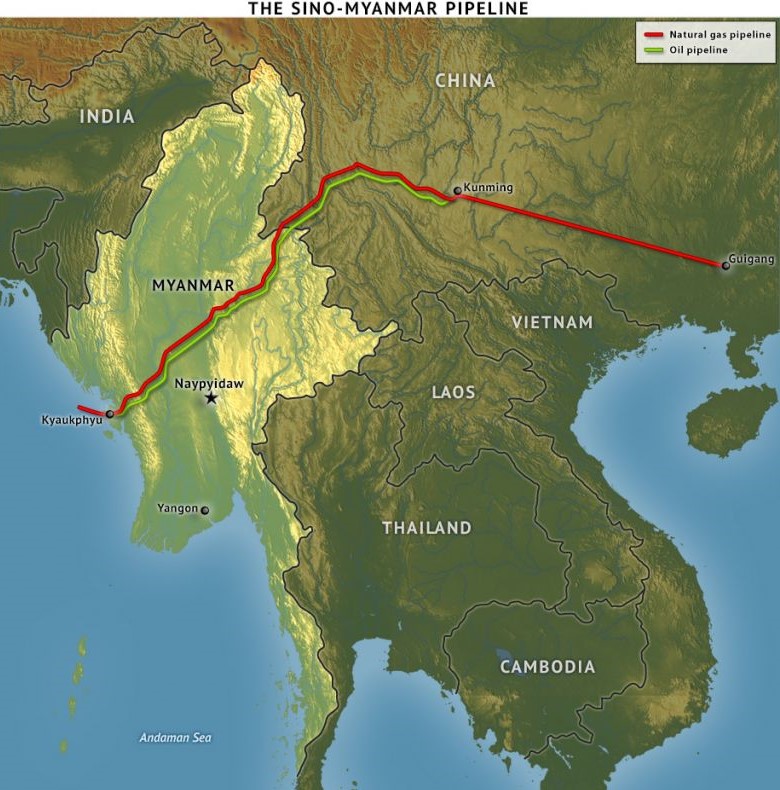
A Banking on Climate Chaos frontline story by Rainforest Action Network, BankTrack, and local partners follows the Myanmar-China oil and gas pipelines which start in Rakhine State (southwest Myanmar) and transverses the country’s heartland to enter Yunnan, China, from northeastern Shan State.
It shows people, who were displaced by the junta, in the path of this pipeline and land soured by pipeline construction, practically destroying farming that sustained communities for generations.
The study reports on entire villages in fear of pipeline explosions and environmental destruction. Military installations monitor farmers everyday, and just last year, the military laid landmines near the pipelines -- making people risk death daily for walking on their own lands.
At its coastal southern hub of another pipeline, on Ma-De Island, the pipeline resulted in land confiscation that affected the majority of residents. Fearing repression by the former military regime, many remained silent. The Myanmar China Pipeline Watch Committee (MCPWC) reports that this pipeline project caused environmental damage in 21 townships. “We know who is to blame for destroying the lives of people in the path of these pipelines", it said.
Among the main shareholders of the Myanmar-China pipelines are CNPC, POSCO, Oil & Natural Gas Corporation (ONGC) and KOGAS, bankrolling the military junta’s atrocities. In 2022 alone, these four companies together received nearly US$ 7.3 billion in corporate finance, with CNPC receiving the most with US$ 6.7 billion.
Their biggest and most recent financiers are ICBC, Bank of China, Agricultural Bank of China, KB Financial, UBS, Citi, State Bank of India, SMBC and BNP Paribas.
Construction of the pipelines began during Myanmar's military-controlled political and economic reforms, which ended when the military began its illegal attempted coup. Since then, the junta has waged a nationwide campaign of terror, backed by the flow of funds from the Myanmar-China pipelines, and other oil and gas projects.
Brave people are speaking out against the pipeline and how it destroys their way of life; ecologically and politically. They are showing undeniable proof of how the fossil fuel giants and the military junta profits off of their loss of life and lands that banks cannot ignore. 
The story shows a video of the pipeline threatening food sovereignty, people terrified for their lives, and a military attempting to control people for the sake of pipelines and to keep the blood money flowing.
The OECD Guidelines for multinational enterprises and the UN Guiding Principles on Business and Human Rights both clearly set out that international investors, including banks, have a responsibility to use their leverage to ensure their clients act to prevent or mitigate human rights abuses. 
Big financiers must consider that investing in or financing fossil fuel companies that military juntas rely on for funding violence is not worth whatever the financial gain.
---
Climate campaigner & researcher, BankTrack. Source: BankTrack email alert

Comments

TRENDING

Grueling summer ahead: Cuttack’s alarming health trends and what they mean for Odisha

By Sudhansu R Das  The preparation to face the summer should begin early in Odisha. People in the state endure long, grueling summer months starting from mid-February and extending until the end of October. This prolonged heat adversely affects productivity, causes deaths and diseases, and impacts agriculture, tourism and the unorganized sector. The social, economic and cultural life of the state remains severely disrupted during the peak heat months.

Stronger India–Russia partnership highlights a missed energy breakthrough

By N.S. Venkataraman*  The recent visit of Russian President Vladimir Putin to India was widely publicized across several countries and has attracted significant global attention. The warmth with which Mr. Putin was received by Prime Minister Narendra Modi was particularly noted, prompting policy planners worldwide to examine the implications of this cordial relationship for the global economy and political climate. India–Russia relations have stood on a strong foundation for decades and have consistently withstood geopolitical shifts. This is in marked contrast to India’s ties with the United States, which have experienced fluctuations under different U.S. administrations.

From natural farming to fair prices: Young entrepreneurs show a new path

By Bharat Dogra   There have been frequent debates on agro-business companies not showing adequate concern for the livelihoods of small farmers. Farmers’ unions have often protested—generally with good reason—that while they do not receive fair returns despite high risks and hard work, corporate interests that merely process the crops produced by farmers earn disproportionately high profits. Hence, there is a growing demand for alternative models of agro-business development that demonstrate genuine commitment to protecting farmer livelihoods.

The Vande Mataram debate and the politics of manufactured controversy

By Vidya Bhushan Rawat*  The recent Vande Mataram debate in Parliament was never meant to foster genuine dialogue. Each political party spoke past the other, addressing its own constituency, ensuring that clips went viral rather than contributing to meaningful deliberation. The objective was clear: to construct a Hindutva narrative ahead of the Bengal elections. Predictably, the Lok Sabha will likely expunge the opposition’s “controversial” remarks while retaining blatant inaccuracies voiced by ministers and ruling-party members. The BJP has mastered the art of inserting distortions into parliamentary records to provide them with a veneer of historical legitimacy.

A comrade in culture and controversy: Yao Wenyuan’s revolutionary legacy

By Harsh Thakor*  This year marks two important anniversaries in Chinese revolutionary history—the 20th death anniversary of Yao Wenyuan, and the 50th anniversary of his seminal essay "On the Social Basis of the Lin Biao Anti-Party Clique". These milestones invite reflection on the man whose pen ignited the first sparks of the Great Proletarian Cultural Revolution and whose sharp ideological interventions left an indelible imprint on the political and cultural landscape of socialist China.

Why India must urgently strengthen its policies for an ageing population

By Bharat Dogra   A quiet but far-reaching demographic transformation is reshaping much of the world. As life expectancy rises and birth rates fall, societies are witnessing a rapid increase in the proportion of older people. This shift has profound implications for public policy, and the need to strengthen frameworks for healthy and secure ageing has never been more urgent. India is among the countries where these pressures will intensify most sharply in the coming decades.

Thota Sitaramaiah: An internal pillar of an underground organisation

By Harsh Thakor*  Thota Sitaramaiah was regarded within his circles as an example of the many individuals whose work in various underground movements remained largely unknown to the wider public. While some leaders become visible through organisational roles or media attention, many others contribute quietly, without public recognition. Sitaramaiah was considered one such figure. He passed away on December 8, 2025, at the age of 65.

School job scam and the future of university degree holders in West Bengal

By Harasankar Adhikari  The school recruitment controversy in West Bengal has emerged as one of the most serious governance challenges in recent years, raising concerns about transparency, institutional accountability, and the broader impact on society. Allegations that school jobs were obtained through irregular means have led to prolonged legal scrutiny, involving both the Calcutta High Court and the Supreme Court of India. In one instance, a panel for high school teacher recruitment was ultimately cancelled after several years of service, following extended judicial proceedings and debate.

New RTI draft rules inspired by citizen-unfriendly, overtly bureaucratic approach

By Venkatesh Nayak* The Department of Personnel and Training , Government of India has invited comments on a new set of Draft Rules (available in English only) to implement The Right to Information Act, 2005 . The RTI Rules were last amended in 2012 after a long period of consultation with various stakeholders. The Government’s move to put the draft RTI Rules out for people’s comments and suggestions for change is a welcome continuation of the tradition of public consultation. Positive aspects of the Draft RTI Rules While 60-65% of the Draft RTI Rules repeat the content of the 2012 RTI Rules, some new aspects deserve appreciation as they clarify the manner of implementation of key provisions of the RTI Act. These are: Provisions for dealing with non-compliance of the orders and directives of the Central Information Commission (CIC) by public authorities- this was missing in the 2012 RTI Rules. Non-compliance is increasingly becoming a major problem- two of my non-compliance cases are...