
Survey: Gujarat tops in 'supporting' digital surveillance to curb opposition, protests

By Rajiv Shah 

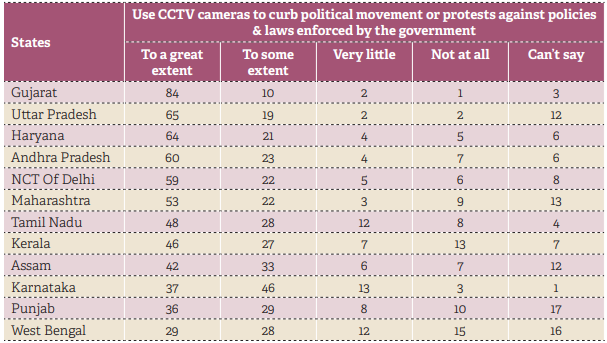
In a surprise revelation, which may send shock wave among those who consider agitations as a democratic right and believe this right is being eroded by the powers-that-be, nearly 95 percent of the respondents in a recent survey in Gujarat have justified the government’s use of CCTV as a means to control political movements of all sorts.
The highest in India, this is followed by two-thirds of the respondents from Uttar Pradesh and Haryana (65% and 64% respectively) completely supporting CCTV use for clamping down on protests. The result comes amidst sharp increase in mobile surveillance and drones by the police in the recent past in these States.
Says the report, “A State-wise analysis revealed that in Andhra Pradesh and Gujarat, more than 85 percent believed that the use of CCTVs by the police in their areas has increased”, adding, “More than two out of three respondents from Gujarat reported a significant increase in the use of mobile surveillance and drone technologies by the police in their localities in the past 4-5 years.”
The survey, carried out by Delhi-based non-profits Common Cause and Lokniti – Centre for the Study of Developing Societies (CSDS), and titled “Status of Policing in India Report 2023 Surveillance and the Question of Privacy” (SPIR 2023), also reveals that, in sharp contrast, respondents from West Bengal, Punjab and Karnataka “were not as enthusiastic in their support.”
“Only one-third of the respondents (29%) from Bengal completely justified the use of surveillance footage to curb dissent. The number is slightly higher in Punjab (36%) and Karnataka (37%)”, it notes.
Seeking to explore public opinions and experiences regarding digital surveillance, SPIR 2023 has been prepared against the backdrop of “recent developments, such as the Supreme Court's recognition of the right to privacy and discussions surrounding data protection, have intensified debates around privacy and surveillance”, the report claims.
It has also been prepared in context of recent concerns regarding “allegations of illegal government surveillance using the Pegasus spyware and the enactment of the Criminal Procedure (Identification) Act, 2022, which grants police the power to collect biometric information from suspects and detainees”, it adds.
In order to prepare the report, Common Cause, in collaboration with the Lokniti Programme of CSDS, conducted a face-to-face survey with 9,779 individuals across 12 Indian States and UTs to understand perceptions around digital surveillance. At the same time, the organisers conducted Focused Group Discussions (FGDs) with “domain experts, in-depth interviews with serving police officials, and an analysis of media coverage of surveillance-related issues”.
Admitting that the survey suggests “a lack of public awareness regarding critical issues” pertaining to “digital surveillance by the government”, helping the authorities to easily to go in for curbs on “freedom of expression”, the report underlines, however, the “support for any form of surveillance decreases with a decline in the respondent's socioeconomic status”, with the “poor, Adivasis, Dalits, and Muslims” being “least trustful of the police.”
Regarding the overall use of drones by state agencies, a State-wise comparisons suggest that respondents from Gujarat (81%) and Uttar Pradesh (72%) showed substantially high levels of support. Respondents from Karnataka (60%) also indicated moderate support, but relatively higher opposition to this was seen in Punjab (17%) and West Bengal (17%).
At the same time, the report notes, “Across the occupation category, the lowest levels of support were observed amongst farmers (14%)”, adding, “Relatively lower levels of support for drone usage by government agencies amongst farmers is a noteworthy finding, especially in view of the fact that the Centre has been pushing for incentivising the use of drones for farming.”
Coming to the impact of surveillance by police and government through drones on people, while across India four of every ten (43%) respondents said that it is justified ‘to a great extent’, “Significant support came from States such as Gujarat (63%), UP (57%) and Delhi (56%). In contrast, the opposing States were Kerala (30%) and Punjab (14%)”.
Also, “the highest proportion of respondents from Gujarat supported the usage of drones by the police for law enforcement (95%), followed by Kerala, (94%) and Andhra Pradesh (91%); while Assam, Karnataka, and Punjab stood at the opposite end of the spectrum”, the report says, adding, “Those from Assam were least likely to support police usage of drone for rule enforcement, those from Gujarat were most likely to support.”
At the same time, pointing out that “over four of five people in Gujarat support drone usage by government to quell dissent”, the report notes, “While doing a State-wise comparative analysis, we found that in BJP-ruled States such as Gujarat (85%), Haryana (67%), and Uttar Pradesh (65%), the support for using drones for curbing political protest was highest”.
On being asked if they felt that political parties view their photos, messages, videos or searched objects from their phones or computers, the report says, “A little less than two-thirds, about 65 percent, disagreed.” But out of the 16 percent that agreed, a significant proportion of 27 percent belonged to Gujarat and Karnataka. “Conversely, a significant proportion of respondents from Kerala (83%) and Tamil Nadu (74%) disagreed that political parties can view their data.”
Ironically, despite wide support to digital surveillance, fear on its usage prevailed among large sections. Thus, “those in Haryana (41%), Gujarat (33%), and Delhi (32%) were very scared of provoking legal action by expressing their political opinions online, whereas in Karnataka, Maharashtra and Kerala not many people exhibit their fear of legal action for posting political or social opinion.”
Asked whether they think the police should be able to collect the biometric details (such as fingerprint, footprint, iris, retina scan, facial recognition, etc.) of all suspects, including those who haven’t been declared guilty by the court, while close to half (48%) across India agreed that police should be allowed to collect such details, “a large proportion of the respondents from Haryana (74%), Gujarat (69%) and Delhi - NCT (65%) were of the opinion that police should have this power.”
“Conversely”, the report states, “A significant proportion of respondents from Tamil Nadu (56%) and Karnataka (54%) were of the opinion that police should not be allowed to possess such powers. Those belonging to the Adivasi community (44%) were significantly more likely to oppose giving the power to the police to collect biometric data, as compared to the general caste group (28%).”

Comments

This is, indeed, surprising. I have a feeling that the questionnaire was not worded properly.

TRENDING

GreenTech Summit claims NCR as key green building hub, without pan-India comparison

By A Representative   The Indian Green Building Council (IGBC), under the Confederation of Indian Industry, held its GreenTech Summit 2026 in New Delhi, where industry representatives, policymakers and sustainability professionals discussed the adoption of climate technologies in India’s built environment.

Buddhist shrines were 'massively destroyed' by Brahmanical rulers: Historian DN Jha

Nalanda mahavihara By Rajiv Shah  Prominent historian DN Jha, an expert in India's ancient and medieval past, in his new book , "Against the Grain: Notes on Identity, Intolerance and History", in a sharp critique of "Hindutva ideologues", who look at the ancient period of Indian history as "a golden age marked by social harmony, devoid of any religious violence", has said, "Demolition and desecration of rival religious establishments, and the appropriation of their idols, was not uncommon in India before the advent of Islam".

Swami Vivekananda's views on caste and sexuality were 'painfully' regressive

By Bhaskar Sur* Swami Vivekananda now belongs more to the modern Hindu mythology than reality. It makes a daunting job to discover the real human being who knew unemployment, humiliation of losing a teaching job for 'incompetence', longed in vain for the bliss of a happy conjugal life only to suffer the consequent frustration.

Beyond the election manifesto: Why climate is now a kitchen table issue

By Vikas Meshram*  March has long been a month of gentle transition, the period when winter softly retreats and a mild warmth signals nature’s renewal. Yet, in recent years, this dependable rhythm has been disrupted. This year, since the beginning of March, temperatures across vast swathes of the country have shattered previous records, soaring to between 35 and 40 degrees Celsius in some regions. This is not a mere fluctuation in the weather; it is a serious and alarming indicator of climate change .

As India logs historic emissions drop, expert warns govt against 'policy blunders'

By A Representative   In a significant development that underscores the rapid transformation of India's energy landscape, new data reveals the country recorded its largest drop in power sector emissions in 2025. However, a top power sector analyst has urged the Union Government to view this "silver lining" as a stark warning against continuing to invest in new coal, large hydro, and nuclear projects, which he argues could become "redundant" stranded assets.

Jerusalem's Al Aqsa mosque under siege: A test of Muslim solidarity and Palestine’s future

By Syed Ali Mujtaba*  In the cacophony of Israel’s and the United States’ attack on Iran, one piece of news has been buried under the debris of war: Israel has closed the Al Aqsa Mosque in Jerusalem to Palestinian worshippers during the holy month of Ramadan. The closure, announced as indefinite, affects the third most revered mosque in the Islamic world.

Fresh citizenship framework suggested amidst electoral roll concerns

By Kathyayini Chamaraj  The ongoing exercise of Special Intensive Revision (SIR) of electoral rolls has raised serious concerns about the potential disenfranchisement of large numbers of citizens. In many instances, people are being asked to produce retrospective documents to establish their citizenship—documents that many genuine citizens are unable to provide. The challenge before policymakers is to identify prospective amendments to the Citizenship Act that would ensure that no legitimate citizen is excluded either from citizenship or from the electoral roll.

NGO Arunoday’s journey of support and struggle: Standing firm with the distressed

By Bharat Dogra    It was a situation of acute distress. Nearly ten thousand people returning to their villages during the COVID-19 pandemic had gathered at the border of Uttar Pradesh and Madhya Pradesh near Kanha. Exhausted after walking long distances with little or no food, they were desperate for relief. Yet entry could not be granted without completing essential records and complying with pandemic rules.  

How wars are undermining climate promises even as accelerating global warming

By N.S. Venkataraman*     Since 1995, global climate conferences have convened annually, with the 29th Conference of Parties (COP29) held in November 2024. These gatherings attract world leaders and generate extensive media coverage, raising hopes of decisive strategies to address the climate emergency. Yet, despite lofty promises and ambitious targets, the crisis remains unabated.