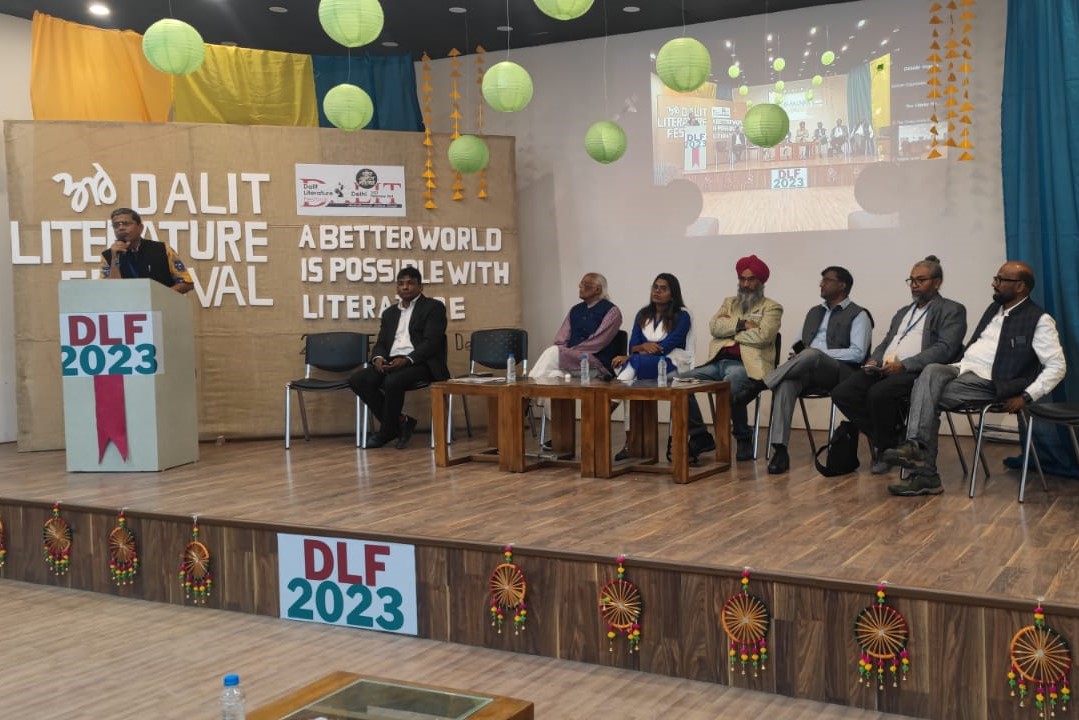
The 3rd Dalit Literature Festival (DLF) was organized by Ambedkarwadi Lekhak Sangh in collaboration with Aryabhatta College, Delhi University, on its premises on 3rd and 4th February, 2023.
Ambedkarwadi Lekhak Sangh has been consistently organizing the Dalit literature festivals since 2019. First two literature festivals were organized at Kirori Mal College, Delhi University, and then owing to pandemic, it was put on hold till 2023 when it was organized again. The third edition was brimming with ideas and evolution of humanity as in making this world a better place to co-exist.
It is precisely with this aim that the DLF worked on the theme: A better world is possible with literature. Prof Suraj Badatiya, the founder of Ambedkarwadi Lekhak Sangh and organizer of DLF stated, “Literature is the reflection of the society. Its purpose is to excel us more as a human. What’s the purpose of literature if it cannot give us strength to stand for humanity?”
Prof Parmod Mehra, co-convener of the festival and Professor of English, Indira Gandhi National Open University (IGNOU), asserted, “A festival unites people and radiates positive vibes, brotherhood and prosperity. DLF also celebrates the camaraderie by uniting the writers, poets, thinkers, enthusiasts of marginalized communities from all over the world who partake in each other’s pains, sufferings, struggles, memories and strengths and aiming for an equitable world.”
The stage, galleries, lawns and corridors were suggestive of Dalit aesthetics wherein one could witness the transfiguration of spaces into the ones promoting dialogues, debates, discussion and celebration. Auditoriums dedicated to Martin Luther and Savitribai Phule and Fatima Sheikh, posters of national/regional and international thinkers/writers; gonfalons and pennons with 3rd Dalit Literature Festival 2023 printed in colourful paints and vigorous young volunteers delineated Ambedkarite thought process. While DLF was an ardent endeavour towards “paying back to the society”, it was also a wonderful way of paying homage to Dr BR Ambedkar and his dream of a just and a casteless society.
On both days (3rd & 4th February) the audience witnessed speakers, writers, poets and performers from different parts of the country and it became a confluence of literatures and artistic performances.
On day one, the inaugural session was graced with a spell-bounding performance by renowned Dhrupad singer Surekha Kamble. She teaches Dhrupad, a unique singing style, at ‘The Art House’ in Bhopal. Ambedkarite folk singer Deshraj Singh also made a deep impact on the minds of audiences. Deshraj’s folk songs depicted Babasaheb Ambedkar as the hero of the people and aimed at spreading social awareness among subaltern classes.
Another vibrant performance was made by Kathak dancer, Rahul Kumar Rajak. He is the disciple of Padma Vibhushan Pandit Birju Maharaj and Vidushi Saswati Sen. His wonderful attempts on songs like ‘Chhap Tilak Moho Lini Re, Tose Naina Milaike' drew the entire college towards the stage and left them speechless. Thereafter, Rashika Barodia, a student of Kalindi College and her team presented an excellent play on women problems and women empowerment.
The audience thoroughly enjoyed the inaugural session.
'Malkhan Singh Book Fair' also became a part of the event which included criticism, poetry, short stories, novels, plays, memoirs, autobiographies and children's magazines. Eklavya Prakashan also displayed a stock of books based on Ambedkarite ideology based on children's literature which attracted everyone. Along with this event, a few important books were also released. ‘Cinema Ka Alochnatmak Samvad’ (Critical Dialogue of Cinema) authored by Dr Anita and Balraj Sinhmar and a poetry collection viz ‘Jung Jaari Hai’ by Dr Seema Mathur were also released in the presence of eminent writers/poets and esteemed audience.
Dr Balraj Sinhmar, convener, DLF proudly shared, “An important aspect of this festival is that it is not a pawn in the hands of industrialists, capitalists or any political organisation. It is funded by the people it is meant for. In this way, as DLF is totally immune from any market/capitalist influence, we don’t have to instruct our speakers/writers on what to speak and what not to. DLF works on the clarion call of Dr Ambedkar, i.e., “educate, organise and agitate” and aims at spreading consciousness among subaltern groups and building a casteless society.”
After the inaugural session, there were sessions scheduled on various literary and social themes. The thematic sessions were on
- Marginalised Women: Literature and Society;
- Dalit Literature: Past, Present and Future;
- Voices in Dalit English Literary Discourses: 21st Century; and
- Adivasi-Dalit Communities: Oppression-Resistance and Rights.
The mainstream literature has managed only a bleak portrayal of Dalit/tribal women, largely leading to their objectification wherein they are getting molested, tortured and yet remain unstirred. It is mainly the Ambedkarite values, ethos and movements which brought consciousness among women that they took batons in their hands writing narratives, autobiographies, poetry, stories to narrate their version of oppression.

Before the end of the first day, 'Raidas Cultural Evening' was organized in which Niyati Rathod enthralled everyone with her excellent performance on Rudali by 'Mahashweta Devi'.
On day two, February 4, parallel sessions were held on
- 'Cinema and Marginalized Communities';
- 'Minority Communities: Literature and Society in the Contemporary Times';
- Women’s Oppression and Consciousness of Resistance; and
- LGBTQIA Community: Evictions from Socio-Literary Dignity.
A rupture, however, could be seen when directors with Ambedkarite perspective like Pa Ranjith have come to the fore and established a counter-argument within mainstream cinema. The same rupture could be felt in the attempts made by minority and LGBTQIA communities. The Trans activists like Grace Banu demanding horizontal reservation have compelled the academia to review the gender sensitisation programmes. The demand for horizontal reservation is a self-aware journey of claiming that they are not different as they are viewed.
In the above sessions, Dr Jayprakash Kardam, popular writer/poet Asangghosh, Jan Kavi Balli Singh Cheema; Bahujan thinker/critic and poet Chauthiram Yadav, Prof. Rajesh Paswan, Arun Khote, Dr Rajat Rani Meenu, Prof. Sheoraj Singh “Bechain”, Rajendra Badgujar, LGBT icon, Grace Bano made the audience aware of the cultural/academic pockets they all hail from. Padma Shri Awardee, Ravi Kumar Narra, a businessman, a social worker and the coordinator of Dalit Indian Chamber of Commerce and Industry (DICCI) too joined the panel and shared his views.
Post lunch there was a Kabir Kavya Ghosthi wherein poets with enormous/diverse range recited their poems, sung songs and ghazals on discrimination and casteist society. Poets of stature like Sheoraj Singh Bechen, Mahendra Beniwal, Saroj Kumari, Ramesh Bhangi, Neelam, Rajni Anuragi, Pushpa Vivek, Mukesh Mirotha, Hemlata, Seema Mathur, Balraj Sinhmar, Snehlata Negi, Ashok Banjara, Mamchand Sagar, Sudama Rathod, Shivdutt Vavlakar, Haresh Parmar, Namit Kumar Singh graced the event. Their relentless poetry made a huge impact on the audience. Famous Dalit scholar/thinker Suraj Yengde too joined the DLF late evening and shared his views with the audience.
Dr Balraj Sihmar, the Convener of the program, announced the next Dalit Literature Festival at the end of the program and said that the next Dalit Literature Festival will be organized in 2024. In making this event successful, the students of Aryabhatta College gave their full cooperation, due to which this event could be completed in an orderly manner. Sanjeev Kumar Danda, the organizer of the festival, concluded the event with a sky-high-spirited slogan of “Abhi toh yeh angadai hai aage aur ladai hai”.
---
*Secretary, Dalit Adivasi Shakti Adhikar Manch (DASAM). Organisers: Ambedkarvadi Lekhak Sangh (ALS), Dalit Adivasi Shakti Adhikar Manch (DASAM), , Aryabhatta College, Delhi University (South Campus), Delhi Solidarity Group (DSG), Magadh Foundation, Peoples Media Advocacy & Resource Centre-PMARC, National Domestic Workers Union, Research Institute for Dalit Adiwasi and Minorties (RIDAM), Apni Mati Patrika, Kahani Punjab Patrika, Ridam Patrika
Comments