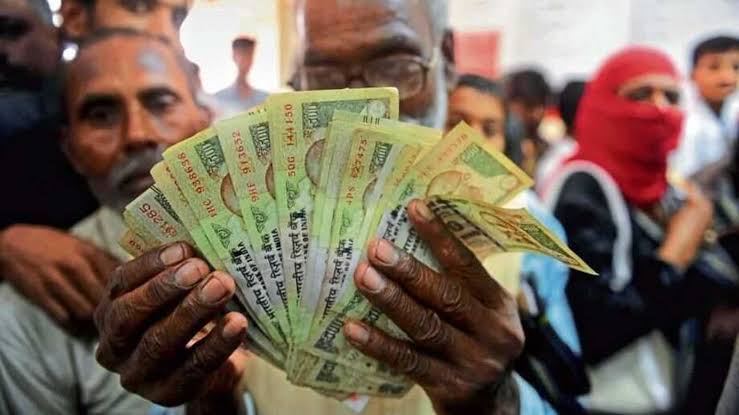
In November 2016, Indian Prime Minister Narendra Modi sprang a surprise on the country men by announcing demonetisation of high value currency notes. After announcing the decision, Modi spoke to the surprised and confused people and explained as to why demonetisation was necessary.
Modi said that considering the urgent need to wipe out black money circulating in the country, root out corruption and eliminate counterfeit notes , he had taken this measure. While stating that demonetisation was one of the measures that he would initiate to achieve the objectives, Modi also implied that curbing currency in circulation is a pre condition to achieve such objectives.
The demonetisation announcement was followed by long queue in front of the banks, causing hardships to people in several ways.
Of course, the pledged admirers of Modi appreciated his courage of conviction to take such bold decision and sworn critics of Modi opposed his move bitterly . However, the fact is that, by and large,common people in India viewed Modi’s move as necessary and appropriate, which became clearly evident when Modi’s party was voted back to power with clear majority in subsequent election to parliament.
The consensus view was that the demonetisation measure put huge fear in the mind of the corrupt people and black money holders and huge quantity of unaccounted money was brought to light, which justified the demonetisation measure.
Huge increase in currency circulation
One of the claims made at the time of demonetisation by Modi government was that the currency in circulation would be significantly brought down and digitalisation would be promoted in a big way.While the currency in circulation was significantly brought down immediately after demonetisation, the present ground reality is that the currency in circulation has now increased by over around 83% after the demonetisation period in 2016.
Soon after demonetisation, the currency in circulation fell to a low of about Rs 9 lakh crore on January 6, 2017, nearly 50% of Rs 17.74 lakh crore on November 4, 2016.
The currency in value terms has soared from Rs 17.74 lakh crore on November 4, 2016, to Rs 32.42 lakh crore on December 23, 2022. Currency in circulation, which was Rs 18.04 lakh crore at end-March 2018, jumped to Rs 31.34-lakh crore at end-March 2022 and further to Rs 32.42-lakh crore as on December 23, 2022.
Reaping the benefits?
The question now is as to whether India has reaped the benefits of demonetisation measures subsequently. It appears that it has not happened, which is unfortunate.Due to such high currency circulation level at present, the use of unaccounted money (mainly cash) has now soared. Recently, record seizures amounting Rs 6.6 crore in cash were made in one single assembly constituency in Telangana. Almost every day, news Is appearing in the media that Enforcement Directorate and Income s Tax authorities have been conducting raids and seizing huge amount of cash from the black money holders. Some people think that seizure of such black money is only a tip of the iceberg.
With such large currency circulation, parallel economy is now in full flow in the country, accompanied by corruption in government departments and business dealings. Real estate deals are now increasingly being done by cash transaction using black money.
The country seems to be back to square one at present, with parallel economy happening and increasing at alarming level.
Justification
The Government of India has not so far provided any credible explanation for increasing the currency in circulation multifold, which is much against the objective pronounced by the Prime Minister at the time of announcing demonetisation.Some economists justify such huge cash in circulation by stating that it is necessary, as the national economy is growing at a very impressive rate and people and business houses need cash to meet their requirements. Another argument that is advanced in favour of increase in currency circulation is that so long as people pay tax properly directly or indirectly , total amount of cash in circulation is not a matter of concern.
Increase in tax collection by government is nowhere in proportion to the huge increase in the cash circulation
To support this view, it is pointed out that the GST (Goods and Services Tax) collection has been increasing steadily. Further, it is argued that even as cash in circulation is increasing multi fold , the digital transaction has also been increasing significantly.
There appears to be some fundamental flaw in the above argument and there should be a better way of fiscal management than printing currency notes in a developing country like India, unlike USA.
In fact, in the last few years, the Government of India has been spending huge money by way of subsidy support , extending cash benefits to the farmers and welfare measures and distributing free vaccine to the countrymen, particularly to reduce to the sufferings to the people during the COVID period.
With the significant increase in currency circulation by the Reserve Bank of India, the Government of India collects the money from the people in variety of ways by issuing bonds etc. and several state governments also do so.
The net impact of the overall Rs 32.12 lakh crore currency in circulation at present is that the benefit of demonetisation has been undone, resulting in disturbing level of growth of parallel economy and corruption in the country.
It is necessary to note that increase in tax collection by the government is nowhere in proportion to the huge increase in the cash circulation in the country.
Finally, the increase in currency circulation has resulted in steep increase in the price of goods and services, creating huge burden on the family budget of those living in lower and middle income group, pensioners and those belonging to unorganised class in the country.
---
Trustee, Nandini Voice For The Deprived, Chennai
In fact, in the last few years, the Government of India has been spending huge money by way of subsidy support , extending cash benefits to the farmers and welfare measures and distributing free vaccine to the countrymen, particularly to reduce to the sufferings to the people during the COVID period.
With the significant increase in currency circulation by the Reserve Bank of India, the Government of India collects the money from the people in variety of ways by issuing bonds etc. and several state governments also do so.
Benefits undone
This strategy of the Government of India amounts to finding a short-term remedy for a long term problem, which is bound to be counter productive in the long run.The net impact of the overall Rs 32.12 lakh crore currency in circulation at present is that the benefit of demonetisation has been undone, resulting in disturbing level of growth of parallel economy and corruption in the country.
It is necessary to note that increase in tax collection by the government is nowhere in proportion to the huge increase in the cash circulation in the country.
Finally, the increase in currency circulation has resulted in steep increase in the price of goods and services, creating huge burden on the family budget of those living in lower and middle income group, pensioners and those belonging to unorganised class in the country.
---
Trustee, Nandini Voice For The Deprived, Chennai
Comments