Street Art has origins from a time we are yet to fathom and, in time, discover. Limited as we are by man-made language, nomenclature, and terminology besides the means so simplistic and apparent like paper and other media, like say walls, Art, and in particular, Street Art, is an extension of that what can be generated on traditional medium but extends to public spaces.
On the European front, skewedly propagated as a world platform, it was in the French Revolution’s iconoclasm era, when rebels defaced high-end art to protest French society’s toxic hierarchy creating a niche called graffiti that became synonymous with vandalism. It was the waves of political and economic turbulence that triggered the rise of street art around the world: The Berlin Wall's ‘one-sided’ graffiti being projected as a fight of colourful expression on one side versus the stark totalitarianism of bland emptiness on the other being a rather simplistic definition.
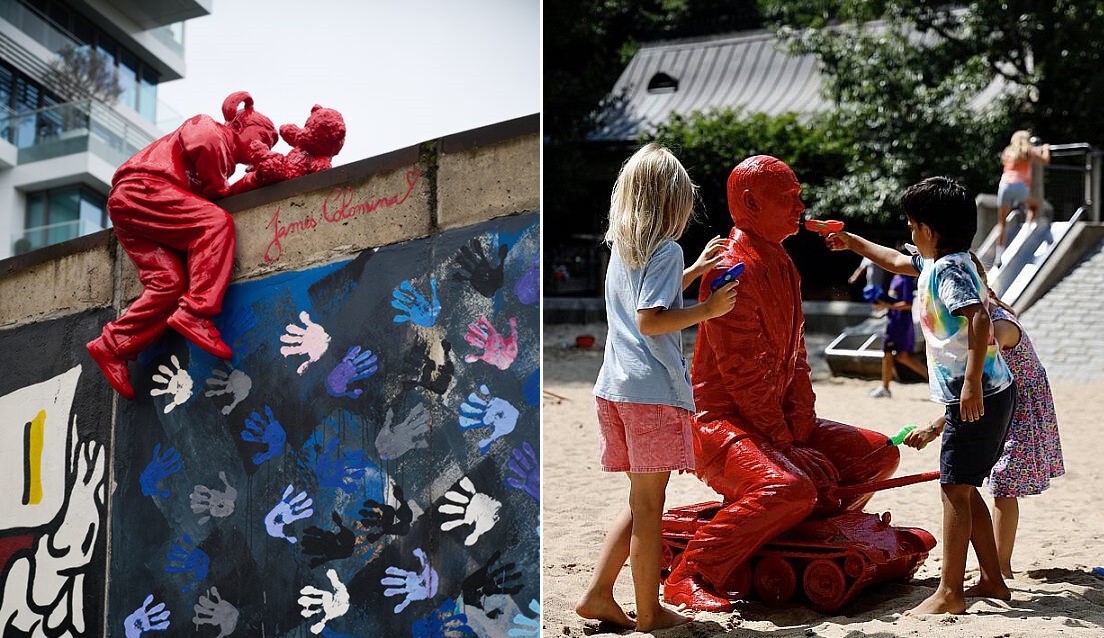
So, French Street Artist James Colomina's installation of Vladimir Putin in Central Park in early August 2022, five months after the Ukraine war started, was predictably bold in both its content and process. The artist who does not reveal himself because most of his installations "are unauthorised," is "already facing problems with the authorities." Ironically the installation, bold as it was, appeared in New York City of the United States of America where, according to a recent Data USA study, 85.4 per cent of archivists, curators, and museum technicians were White and the next most common ethnicity (Hispanic White) clocked in at a mere five per cent.
The statistics conveniently exclude those who do not “fit in” with them. Technically, and those valued, artists are predominantly White men, with 85.4 per cent of works in all major US museums belonging to White artists, 87.4 per cent by men. The diversity is not much greater for museums that specialise in modern art. At the Museum of Modern Art in New York City, for example, only 11 per cent of the artists in the collection are female, 10 per cent are Asian, and two per cent are black or African-American. At the San Francisco Museum of Modern Art, 18 per cent of the artists are female, seven per cent Asian, and two per cent black or African-American.
Wealthy patrons decide merit of art
It is the acute dearth of public funding owing to which museums and galleries are forced to rely on the wealthy patrons sitting on their executive boards to influence what art is “worthy” for public display. In October 2019, a New York Times analysis revealed that 40 per cent of museum trustees are Wall Street tycoons revealing that control on high-end art world isn't merely determined by if a trustee is wealthy, but also where they derive their wealth from.
James' last installation in Berlin where he installed a sculpture of a little girl going over the wall and another above the railway tracks caused quite a flurry. The authorities had to close the tracks for two hours to remove the sculpture.
"Why, even train-drivers slowed down as they approached the sculpture. They thought it was a real child," he recalls with relish. Another facet of Street Art is that it must not, ordinarily, always be liked or be popular. "A lot of people don't like me, but that's okay. It's even so much the better. It would bother me to please everyone. I try to tell the truth with my sculptures and sometimes it hurts," he says.
Art can be politically incorrect, hurt too
Much on the lines of James’ installation in New York City's Central Park, a thousand odd miles away in South Minneapolis, atop the Cup Foods convenience store, where a 911 call led to George Floyd's police killing, today stands a hoarding complete with memorial art. This one, as opposed to Putin’s, for sure, is not as popular.Local illustrator, muralist and teacher Melodee Strong created 'Mama' after George Floyd's dying plea, depicting grieving black mothers, against a backdrop of the US flag. "I am a mother, and when George cried out for his 'mama' as he was taking his last breaths, I also cried," revealed Strong adding, "That's what we do when we are in trouble or scared, we cry out for God or our mothers. My son has been harassed and mistreated by the police. I have witnessed numerous times how the people I love have been abused by police. The anguish we feel from the fear and the experiences of those too many incidences is what I feel in the faces I painted… Even though this piece is about George Floyd, it's more a dedication to all the mothers who have lost their child to police violence." Melodee’s cry resonates with those of mothers across the world and how.
 Predictably, following Black Lives Matter protests erupting in cities, large corporations all around the country responded by nailing plywood across their doors and massive windows, to deter the possibilities of violent interludes. Street Art, however, finds its own way to meander in and register protest across public walls…peacefully.
Political graffiti, as critical intervention in urban space, is faced with legislative opposition as municipalities and police attempt to shut down the streets and the protests therein. Yet, even after protests end, it's the Street Art in the form of graffiti that stands tall as a testament to the protestors' collective voice. It is, today through social media that belongs to the masses instead of selective and controlled fora, that protests get documented and become a part of history. (Part 1 of 6 | To Be Continued)
---
This report is part of The Art Of Cause Project - a DraftCraft International initiative that documents Art Projectsand Street Art campaigns that reach out, rectify and resolve strife, across the world

Political graffiti, as critical intervention in urban space, is faced with legislative opposition as municipalities and police attempt to shut down the streets and the protests therein. Yet, even after protests end, it's the Street Art in the form of graffiti that stands tall as a testament to the protestors' collective voice. It is, today through social media that belongs to the masses instead of selective and controlled fora, that protests get documented and become a part of history. (Part 1 of 6 | To Be Continued)
---
This report is part of The Art Of Cause Project - a DraftCraft International initiative that documents Art Projectsand Street Art campaigns that reach out, rectify and resolve strife, across the world
Comments
Post a Comment
NOTE: Hateful, abusive comments won't be published. -- Editor