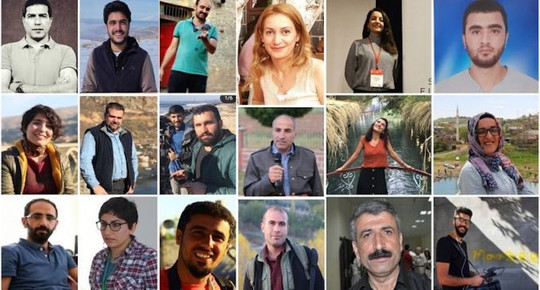
Media attack in Turkey: 16 Kurdish journalists jailed for spreading 'terrorist' propaganda

A note on 16 Kurdish journalists behind bars pending trial over terrorism charges in Turkey, issued by the European Federation of Journalists (EFJ), the largest journalists' organisation in Europe representing more than 320,000 journalists in 70 journalists' organisations across 44 countries in Europe:

***
A Turkish court imprisoned pending trial 16 Kurdish journalists and media workers for allegedly "spreading terrorist propaganda" on 16 June 2022. The European and International Federation of Journalists (EFJ-IFJ) and their four Turkish affiliates strongly condemn these massive arrests of journalists on groundless charges and urge for the immediate release of all of them.
Turkish police detained 21 Kurdish journalists and media workers in a massive operation in the Kurdish-majority southeastern province of Diyarbakir on terrorism charges. Police raided the homes of several journalists working for the pro-Kurdish Mezopotamya News Agency, the all-female Jin News website, a production company called Pel, and the Dicle Firat Journalists' Association. Police officers seized computers, hard drives and other work equipment from the journalists’ houses and media offices. Among the 21 detained journalists, five of them were released under judicial supervision yesterday.
Authorities declined to comment on the legal reason for arrests, as the investigation was officially declared classified. Citing anonymous police sources, media reported that the journalists were arrested over “spreading terrorist propaganda” in connection with a TV broadcast from Belgium and the UK, which authorities labeled as terrorist organisation propaganda.
EFJ newly elected Vice-President and General Secretary of the Journalists' Union of Turkey (TGS) Mustafa Kuleli said:
"Today is one of the darkest days for press freedom in Turkey’s history. Authorities continue to crack down on journalists, accusing them of terrorism. We stand in solidarity with all Kurdish media workers currently in prison for doing their job and urge for the immediate release of all of them."
The massive arrests come a few weeks after the governing alliance of Justice and Development Party (AKP) and Nationalist Movement Party (MHP) submitted to the Parliament a bill on 'disinformation and fake news’. If passed, it will lead to further restrictions on freedom of expression by punishing those convicted of deliberately publishing "disinformation and fake news" with up to three years in prison.
EFJ General Secretary Ricardo Gutiérrez condemned the latest attempts to muzzle the press: "European journalists who met in Izmir earlier this week expressed their full solidarity with jailed and prosecuted journalists in Turkey. Your struggle is our struggle and together we can resist censorship and repression."
Today, 39 journalists are behind bars for doing their job, according to the Journalists' Union of Turkey.

Comments

TRENDING

Was Netaji forced to alter face, die in obscurity in USSR in 1975? Was he so meek?

  By Rajiv Shah   This should sound almost hilarious. Not only did Subhas Chandra Bose not die in a plane crash in Taipei, nor was he the mysterious Gumnami Baba who reportedly passed away on 16 September 1985 in Ayodhya, but we are now told that he actually died in 1975—date unknown—“in oblivion” somewhere in the former Soviet Union. Which city? Moscow? No one seems to know.

Love letters in a lifelong war: Babusha Kohli’s resistance in verse

By Ravi Ranjan*  “War does not determine who is right—only who is left.” Bertrand Russell’s words echo hauntingly in our times, and few contemporary Hindi poets embody this truth as profoundly as Babusha Kohli. Emerging from Jabalpur, Madhya Pradesh, Kohli has carved a unique space in literature by weaving together tenderness, protest, and philosophy across poetry, prose, and cinema. Her work is not merely artistic expression—it is resistance, refuge, and a call for peace.

Swami Vivekananda's views on caste and sexuality were 'painfully' regressive

By Bhaskar Sur* Swami Vivekananda now belongs more to the modern Hindu mythology than reality. It makes a daunting job to discover the real human being who knew unemployment, humiliation of losing a teaching job for 'incompetence', longed in vain for the bliss of a happy conjugal life only to suffer the consequent frustration.

Asbestos contamination in children’s products highlights global oversight gaps

By A Representative   A commentary published by the International Ban Asbestos Secretariat (IBAS) has drawn attention to the challenges governments face in responding effectively to global public-health risks. In an article written by Laurie Kazan-Allen and published on March 5, 2026, the author examines how the discovery of asbestos contamination in children’s play products has raised questions about regulatory oversight and international product safety. The article opens by reflecting on lessons from the COVID-19 pandemic, noting that governments in several countries were slow to respond to early warning signs of the crisis. Referring to the experience of the United Kingdom, the author writes that delays in implementing protective measures contributed to “232,112 recorded deaths and over a million people suffering from long Covid.” The commentary uses this example to illustrate what it describes as the dangers of underestimating emerging threats. Attention then turns...

Echoes of Vietnam and Chile: The devastating cost of the I-A Axis in Iran

​ By Ram Puniyani  ​The recent joint military actions by Israel and the United States against Iran have been devastating. Like all wars, this conflict is brutal to its core, leaving a trail of human suffering in its wake. The stated pretext for this aggression—the brutality of the Ayatollah Khamenei regime and its nuclear ambitions—clashes sharply with the reality of the diplomatic landscape. Iran had expressed a willingness to remain at the negotiating table, signaling a readiness to concede points emerging from dialogue. 

Authoritarian destruction of the public sphere in Ecuador: Trumpism in action?

By Pilar Troya Fernández  The situation in Ecuador under Daniel Noboa's government is one of authoritarianism advancing on several fronts simultaneously to consolidate neoliberalism and total submission to the US international agenda. These are not isolated measures, but rather a coordinated strategy that combines job insecurity, the dismantling of the welfare state, unrestricted access to mining, the continuation of oil exploitation without environmental considerations, the centralization of power through the financial suffocation of local governments, and the systematic criminalization of all forms of opposition and popular organization.

Buddhist shrines were 'massively destroyed' by Brahmanical rulers: Historian DN Jha

Nalanda mahavihara By Rajiv Shah  Prominent historian DN Jha, an expert in India's ancient and medieval past, in his new book , "Against the Grain: Notes on Identity, Intolerance and History", in a sharp critique of "Hindutva ideologues", who look at the ancient period of Indian history as "a golden age marked by social harmony, devoid of any religious violence", has said, "Demolition and desecration of rival religious establishments, and the appropriation of their idols, was not uncommon in India before the advent of Islam".

The kitchen as prison: A feminist elegy for domestic slavery

By Garima Srivastava* Kumar Ambuj stands as one of the most incisive voices in contemporary Hindi poetry. His work, stripped of ornamentation, speaks directly to the lived realities of India’s marginalized—women, the rural poor, and those crushed under invisible forms of violence. His celebrated poem “Women Who Cook” (Khānā Banātī Striyāṃ) is not merely about food preparation; it is a searing indictment of patriarchal domestic structures that reduce women’s existence to endless, unpaid labour.

The price of silence: Why Modi won’t follow Shastri, appeal for sacrifice

By Arundhati Dhuru, Sandeep Pandey*  ​In 1965, as India grappled with war and a crippling food crisis, Prime Minister Lal Bahadur Shastri faced a United States that used wheat shipments under the PL-480 agreement as a lever to dictate Indian foreign policy. Shastri’s response remains legendary: he appealed to the nation to skip one meal a day. Millions of middle-class households complied, choosing temporary hunger over the sacrifice of national dignity. Today, India faces a modern equivalent in the energy sector, yet the leadership’s response stands in stark contrast to that era of self-reliance.