
'No water supply': Toilets in less than 30% Odisha rural houses, mostly 'not in use'

By A Representative

Various areas of Kandhamal district in Odisha are experiencing acute water shortage and infrastructure woes adding to the problems of the people, reveals a recent study on Water availability and sources” conducted by non-profit Atmashakti Trust and its allies Odisha Shramajeebee Mancha , Mahila Shramajeebee Mancha, Odisha and Jeebika Suraksha Mancha, Kandhamal.
Conducted online that covered 304 villages under 15 Gram Panchayats of Kotagada block of Kandhamal, the survey result found that erratic and inadequate water supply has made life difficult for the people living on hilly and remote areas of the district and recommends immediate repair of water structure/infrastructure to meet water needs of these communities.
Odisha has set a target to cover all rural households to have access to safe and adequate drinking water at their doorsteps by 2024. A whopping Rs 50,000 crore is projected to be spent under different schemes and projects to ensure the same. However, the survey results from Kotagada block urges immediate and time bound implementation of government schemes to ensure access to safe water for all.

Survey findings

In 304 surveyed villages, there are 604 tube-wells, out of which 215 (35.6%) tube-wells are not in usable condition due to defunct structures, iron contaminated water & water scarcity. It is contrary to the official data of the Rural Water Supply and Sanitation (RWSS) department which claims that all tube-wells are functioning properly.
The study report says that out of 604 tube wells, only 49 (8%) tube wells have Proper sock pits and 272 (45%) tube wells have no platform.
Out of 304 villages, only 54 (17.76%)villages have a solar tank from which 22 (40.7%) are running and remaining are 32(59.3%) in defunct conditions due to problems in the motor pump, groundwater level & damage of the stand-post.
As many as 174 (57.2%) villages depended on dug-wells but in summer due to the depletion of groundwater level the villagers are facing problems and in other 109 (35.85) villages due to muddy water during the rainy season the villagers are enduring for drinking water.
Only 85 (28%) villages have a drainage system in their villages, from the total 22 (25.88%) villages' drainage structures are defunct and 28 (33%) villages' drainage structures are partially damaged and not functioning well.
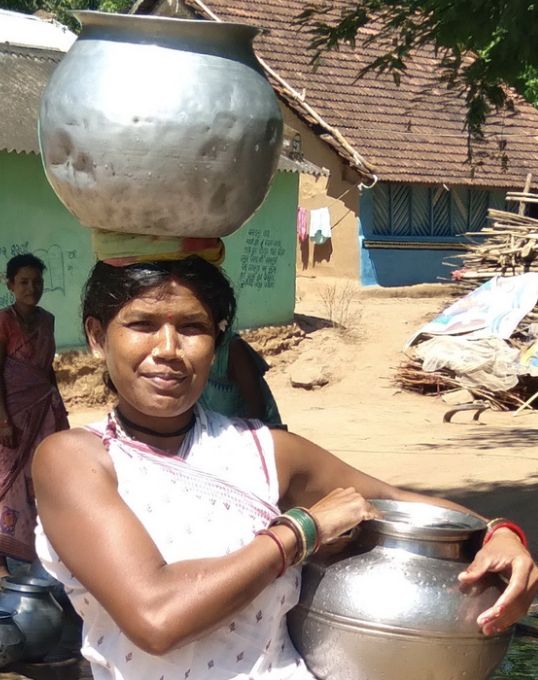
In all, 226 (74.3%) villages are getting contaminated water like Muddy and Iron water which is not drinkable. As a fall out of this, water-borne diseases among communities such as Diarrhea is a common case in these communities. Secondly, communities often rely on the rain water but it may carry varying contaminants from the surfaces on which it lands. In fact, rainwater can carry bacteria, parasites, viruses, and chemicals that make humans sick.
“Access to safe and clean water is a basic necessity to meet water needs and has a correlative impact to combat malnutrition. The government has a provision of installing a bore-well for every 200 to 250 populations but in tribal areas, people live scattered. So, even if bore wells are available, they can hardly access water due to distance”, said Nityananda Thanapati, Programme Manager of Atmashakti Trust.
“Since we have been working to combat malnutrition in Kotagada since 2018, we believe that it cannot be combated until the lack of access to safe water is addressed” , he added.
Kotagada block has over 18,000 households with a population of nearly 60,000. The study which covered all households in the block revealed that only 5,008 (28%) households have constructed toilets in their houses, out of which only 1,536 (31%) of them are using toilets. The findings reveal that the major reason for not using toilets by communities is mainly due to the lack of available water and damaged toilet structures.

Comments

TRENDING

From algorithms to exploitation: New report exposes plight of India's gig workers

By Jag Jivan   The recent report, "State of Finance in India Report 2024-25," released by a coalition including the Centre for Financial Accountability, Focus on the Global South, and other organizations, paints a stark picture of India's burgeoning digital economy, particularly highlighting the exploitation faced by gig workers on platform-based services. 

'Condonation of war crimes against women and children’: IPSN on Trump’s Gaza Board

By A Representative   The India-Palestine Solidarity Network (IPSN) has strongly condemned the announcement of a proposed “Board of Peace” for Gaza and Palestine by former US President Donald J. Trump, calling it an initiative that “condones war crimes against children and women” and “rubs salt in Palestinian wounds.”

Gig workers hold online strike on republic day; nationwide protests planned on February 3

By A Representative   Gig and platform service workers across the country observed a nationwide online strike on Republic Day, responding to a call given by the Gig & Platform Service Workers Union (GIPSWU) to protest what it described as exploitation, insecurity and denial of basic worker rights in the platform economy. The union said women gig workers led the January 26 action by switching off their work apps as a mark of protest.

India’s road to sustainability: Why alternative fuels matter beyond electric vehicles

By Suyash Gupta*  India’s worsening air quality makes the shift towards clean mobility urgent. However, while electric vehicles (EVs) are central to India’s strategy, they alone cannot address the country’s diverse pollution and energy challenges.

Jayanthi Natarajan "never stood by tribals' rights" in MNC Vedanta's move to mine Niyamigiri Hills in Odisha

By A Representative The Odisha Chapter of the Campaign for Survival and Dignity (CSD), which played a vital role in the struggle for the enactment of historic Forest Rights Act, 2006 has blamed former Union environment minister Jaynaynthi Natarjan for failing to play any vital role to defend the tribals' rights in the forest areas during her tenure under the former UPA government. Countering her recent statement that she rejected environmental clearance to Vendanta, the top UK-based NMC, despite tremendous pressure from her colleagues in Cabinet and huge criticism from industry, and the claim that her decision was “upheld by the Supreme Court”, the CSD said this is simply not true, and actually she "disrespected" FRA.

Stands 'exposed': Cavalier attitude towards rushed construction of Char Dham project

By Bharat Dogra*  The nation heaved a big sigh of relief when the 41 workers trapped in the under-construction Silkyara-Barkot tunnel (Uttarkashi district of Uttarakhand) were finally rescued on November 28 after a 17-day rescue effort. All those involved in the rescue effort deserve a big thanks of the entire country. The government deserves appreciation for providing all-round support.

Whither space for the marginalised in Kerala's privately-driven townships after landslides?

By Ipshita Basu, Sudheesh R.C.  In the early hours of July 30 2024, a landslide in the Wayanad district of Kerala state, India, killed 400 people. The Punjirimattom, Mundakkai, Vellarimala and Chooralmala villages in the Western Ghats mountain range turned into a dystopian rubble of uprooted trees and debris.

Over 40% of gig workers earn below ₹15,000 a month: Economic Survey

By A Representative   The Finance Minister, Nirmala Sitharaman, while reviewing the Economic Survey in Parliament on Tuesday, highlighted the rapid growth of gig and platform workers in India. According to the Survey, the number of gig workers has increased from 7.7 million to around 12 million, marking a growth of about 55 percent. Their share in the overall workforce is projected to rise from 2 percent to 6.7 percent, with gig workers expected to contribute approximately ₹2.35 lakh crore to the GDP by 2030. The Survey also noted that over 40 percent of gig workers earn less than ₹15,000 per month.

Fragmented opposition and identity politics shaping Tamil Nadu’s 2026 election battle

By Syed Ali Mujtaba*  Tamil Nadu is set to go to the polls in April 2026, and the political battle lines are beginning to take shape. Prime Minister Narendra Modi’s visit to the state on January 23, 2026, marked the formal launch of the Bharatiya Janata Party’s campaign against the ruling Dravida Munnetra Kazhagam (DMK). Addressing multiple public meetings, the Prime Minister accused the DMK government of corruption, criminality, and dynastic politics, and called for Tamil Nadu to be “freed from DMK’s chains.” PM Modi alleged that the DMK had turned Tamil Nadu into a drug-ridden state and betrayed public trust by governing through what he described as “Corruption, Mafia and Crime,” derisively terming it “CMC rule.” He claimed that despite making numerous promises, the DMK had failed to deliver meaningful development. He also targeted what he described as the party’s dynastic character, arguing that the government functioned primarily for the benefit of a single family a...