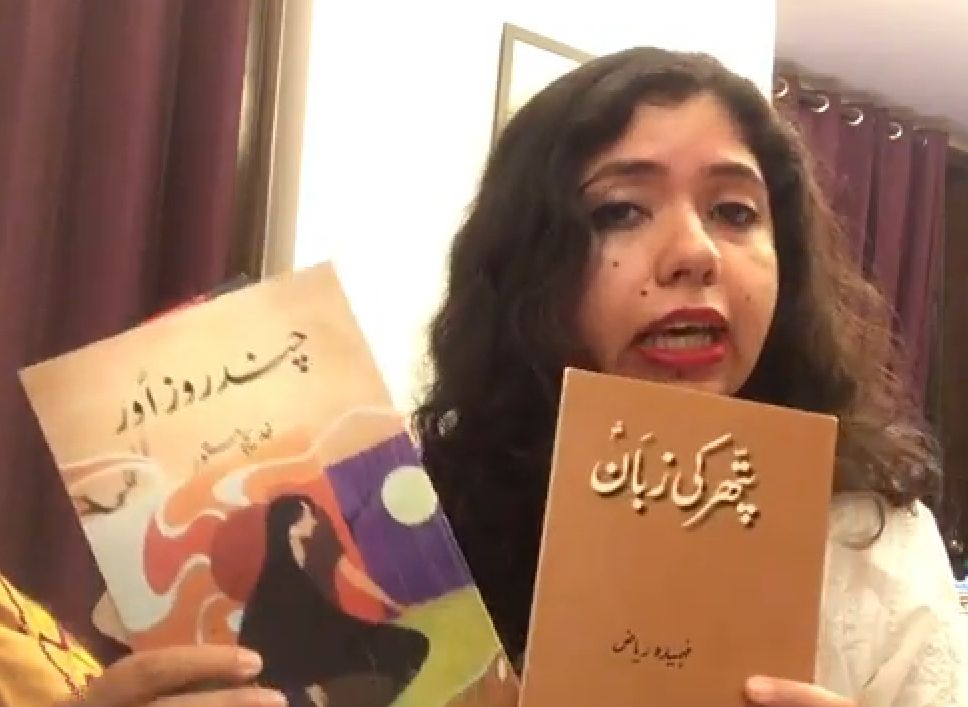
Akshita Nagpal, who worked for several years as a journalist, has less time now for journalism. She teaches Urdu online. During the Covid-19-induced lockdown in 2020, she too fell sick and isolated herself though it wasn’t the infection that caused the malaise.
During that period of isolation, she picked up a little booklet with poems by Parveen Shakir – and discovered she could read and understand Urdu! She had long been teaching herself the Persio-Arabic script of Urdu, using resources available online. The discovery that she could read poetry made her sit up and think of teaching others too.
What began as that realization has rippled outwards, gathering about 300 students so far. On May 8, 2022 about 25 of her students from different batches met up online to discuss the experience, banter and recite Urdu couplets.
Akshita launched her classes online during the lockdown, in 2020. Her first students were mostly friends who paid Rs 1,500 for the course. The course itself is spread over 16 weeks, with a class each week.
Students who had enrolled for one batch would spread the word to their friends, and a steady set of batches has learnt Urdu from Akshita in the past two years. These days, she charges Rs 3,000 per head, and has so far taught 16 batches of about 20 students each preliminary Urdu in the Persio-Arabic script. A slightly advanced level is also now available.
Abhinav Srivastava, an academic who has previously worked as a journalist, said at the Sunday online meeting that he came to Urdu classes because his father had enrolled for Urdu lessons at Jamia Millia Islamia in New Delhi, and would tease him about his poor Urdu.
In Delhi and other cities, signboards are written in several languages, including English, Hindi and Urdu. Many students feel the thrill of having learnt something new when they discover that they can decipher the Persio-Arabic script on signboards, and actually read Urdu.
Tabinda Usmani, who had joined the online meeting from Mumbai, said she had begun her classes while living in Delhi, in the hope of being able to decipher her late father’s notebooks. Her father was an Urdu poet, and her mother was keen that the children learn the language. The Urdu script when hand-written can be very different from what appears in print, so Tabinda still struggles to read her father’s notebooks.
Akshita launched her classes online during the lockdown, in 2020. Her first students were mostly friends who paid Rs 1,500 for the course
Rohan Valecha, also from Mumbai, said he had begun to learn Urdu, and hoped one day to also learn Sindhi. He said a Sindhi newsletter, meant for his grandfather, continues to arrive at his house even though his grandfather passed away. Given that Sindhi too is written in the same script, he hopes one day to be able to read it fluently.
Other participants noted that among the many languages in which Konkani script is written – Roman, Telugu and Devanagri, is also the Persian-Arabic script, similar to Urdu.
Virat Nehru, who joined the online meeting from Australia, said he worked as an advertising man by day and attempted to write Urdu poetry by night. He was fascinated with Urdu, and that was what led him to join the classes – but having joined, he was thrilled to find several people who were like him. He felt he had found people among whom he belonged.
Akshita Nagpal says she has been making a more steady income with the Urdu classes than with journalism, and has in the past two years spent more time teaching.
What one small Sunday online meeting showed was that Urdu will continue to flourish, state-patronized or not.
If you would like to enroll for lessons, please write to Akshita Nagpal: zabaaneurdu@gmail.com
---
*Freelance journalist
Other participants noted that among the many languages in which Konkani script is written – Roman, Telugu and Devanagri, is also the Persian-Arabic script, similar to Urdu.
Virat Nehru, who joined the online meeting from Australia, said he worked as an advertising man by day and attempted to write Urdu poetry by night. He was fascinated with Urdu, and that was what led him to join the classes – but having joined, he was thrilled to find several people who were like him. He felt he had found people among whom he belonged.
Akshita Nagpal says she has been making a more steady income with the Urdu classes than with journalism, and has in the past two years spent more time teaching.
What one small Sunday online meeting showed was that Urdu will continue to flourish, state-patronized or not.
If you would like to enroll for lessons, please write to Akshita Nagpal: zabaaneurdu@gmail.com
---
*Freelance journalist
Comments