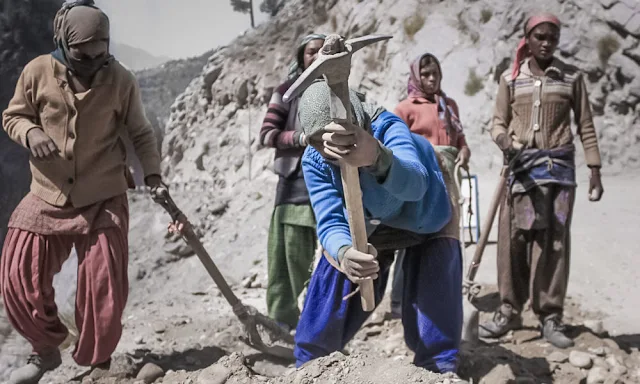
On the morning of February 22 in a very tragic accident in an illegal firecrackers factory at Baathu (Una district of Himachal Pradesh), six women migrant workers were burnt to death. These included mother and daughter from a single family. Fourteen other workers, most of them also women migrant workers, were injured. In most cases injuries are serious. In fact, most of the injured had to be rushed to Chandigarh. The sight of badly burnt bodies was an extremely painful one.
Almost 60 per cent of the workers employed in this factory have been injured or have perished. The worst affected are stated are stated to be those filling explosives into crackers. All the victims come from very poor households.
Clearly there was a glaring violation of safety norms. A highly hazardous unit was functioning without the necessary clearances and without there being much awareness of preventing measures needed in the context of its high hazard potential. As the workers were very poor, docile and unable to raise safety issue in an effective way and as there were no inspections of the highly hazardous unit, the alarming violation of safety norms had continued unabated.
In fact a smaller accident had taken place just about a week back in this unit but had been hushed up. If timely action had been taken at that time in the interests of safety, this bigger tragedy on February 22 could have been avoided.
It has been noticed that in such cases local people are generally keen to cooperate in any efforts to improve safety. In fact they were in the forefront of helping workers to be rushed to hospital when ambulance was initially delayed.
This helpful attitude of neighbouring people, who too are keen to avoid hazardous units being set up in their area, should be used to identify high hazard units and takely timely safety measures.
Women migrant workers in such conditions suffer from triple vulnerability -- they are very poor, they are outsiders lacking local support and they are women. The triple vulnerability of gender, region and class renders them so docile that they are unable to raise even the most urgent issues, a reason why employers prefer to employ them.
However this is all the more reason why the local authorities and particularly the labour officials should play a more active role on their own in keeping track of their problems, particularly safety risks, and extending protection to them.
Unfortunately such a pro-active role of labour departments is seldom seen, with the result that highly unsafe conditions go undetected for too long till they result in some big accident.
This had been noticed widely in the context of another serious accident in recent times in the neighbouring state of Haryana in Dadam mines ( Bhiwani district). In fact the year started with this serious accident on January 1 in which three deaths were immediately reported and other deaths were also feared.
Around the time of this accident, widespread safety violations, including excessive excavation and blasting, were widely reported and several local persons made statements criticising the high risk, excessive working of mines to get more profits, resulting in conditions where an accident was just waiting to happen.
Painful tragedy of six women migrant workers burning to death in Himachal accident emphasizes urgent need for better safety
A stone mine is not something that can be hidden from public view. If conditions over a period of time were so obviously risky, what prevented the authorities from taking timely action to protect safety and save human lives?
Even after the accident of January 1, doubts lingered that adequate steps had not been taken to find out if a larger number of workers or other had been buried in the stone mines in this accident.
In recent weeks increasing numbers of occupational accidents have been reported, whether in the Haryana-Himachal belt or in the country as a whole. Clearly occupational safety is not receiving the attention it needs, and improvements at several levels are urgently needed.
In several contexts risks to industrial, mining , construction, transport and even farm workers ( who now have to handle more hazardous pesticides and weedicides and use more machinery) are becoming more serious and safety steps have to become more extensive, but this is being neglected.
To save human lives and to prevent serious accidents, the neglected area of occupational safety should receive more attention. In addition the concerns of occupational safety should also reach the more neglected sections like migrant workers, women workers and workers employed in more remote areas.
---
*Honorary convener, Campaign to Save Earth Now. His recent books include ‘India’s Quest for Sustainability and Healthy Food’ and ‘Man Over Machine’
Even after the accident of January 1, doubts lingered that adequate steps had not been taken to find out if a larger number of workers or other had been buried in the stone mines in this accident.
In recent weeks increasing numbers of occupational accidents have been reported, whether in the Haryana-Himachal belt or in the country as a whole. Clearly occupational safety is not receiving the attention it needs, and improvements at several levels are urgently needed.
In several contexts risks to industrial, mining , construction, transport and even farm workers ( who now have to handle more hazardous pesticides and weedicides and use more machinery) are becoming more serious and safety steps have to become more extensive, but this is being neglected.
To save human lives and to prevent serious accidents, the neglected area of occupational safety should receive more attention. In addition the concerns of occupational safety should also reach the more neglected sections like migrant workers, women workers and workers employed in more remote areas.
---
*Honorary convener, Campaign to Save Earth Now. His recent books include ‘India’s Quest for Sustainability and Healthy Food’ and ‘Man Over Machine’
Comments
Post a Comment
NOTE: Hateful, abusive comments won't be published. -- Editor