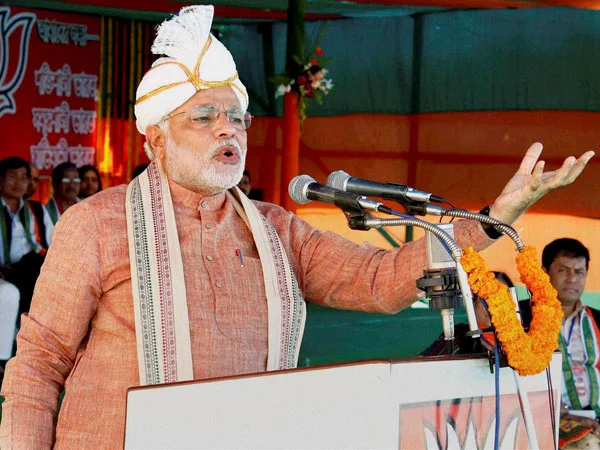
A high-level briefing organised in Washington DC, in which as many as 17 human rights and interfaith organizations -- including Amnesty International USA, Genocide Watch and Hindus for Human Rights, apart from several persons in their individual capacity -- participated, has come down heavily on what they called "Prime Minister Narendra Modi’s Islamophobic policies and tolerance of open incitement by Hindu extremists for a genocide of Muslims."
His policies are "pushing India towards mass violence against and massacres of Muslims", the participants said, pointing out, Modi’s failure to condemn and act against "anti-Muslim bigotry, hate speeches by leading religious and political figures has proliferated." It is "specifically aimed at inciting such mass violence against Muslims", they told experts a Congressional briefing organized in Washington DC.
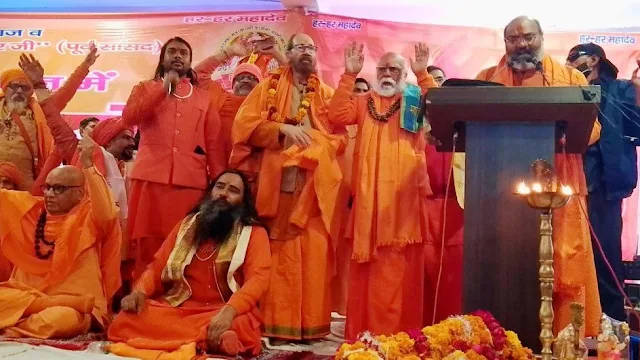
A gathering of saffron-robed Hindu monks held last month at the north Indian Hardiwar city “was exactly aimed at inciting the genocide of Muslims,” said Dr Gregory Stanton, President of Genocide Watch. “As the leader of India he has an obligation to denounce this genocidal speech... Yet, Modi has not spoken against it.”
“That the participants at the gathering would openly urge Hindus to emulate the violence against Rohingya Muslims and boast about it in the days afterwards in the media is illustrative of the atmosphere of bigotry that pervades these groups,” added Govind Achayra, India/Kashmir Specialist with Amnesty International USA. “The calls to large-scale massacres of Muslims [aim] to institute Hindu supremacy over India.”
The fact that Keshav Prasad Maurya, a leader of Modi’s Bharatiya Janata Party (BJP) and the deputy chief minister of Uttar Pradesh, had this week defended the “open incitement and hate from the dharma sansad in an interview to the BBC speaks to the current atmosphere” of peak hatred and bigotry against India’s Muslims, Acharya said.
At the Haridwar event a top religious leader of the Hindu Mahasabha openly called for raising an “army” of Hindus to “kill two million Muslims.” At another event held in New Delhi, hundreds of participants took a public oath to kill in order to protect Hinduism. Elsewhere, schoolchildren were recorded taking similar oaths to “kill and die” to create a Hindu nation. Politicians have defended the right to incite violence against Muslims, he added.
Cautioning that “genocide is not an event” but “a process,” Dr Stanton, who is former Research Professor in Genocide Studies and Prevention at the George Mason University, US, noted that Modi has "a long history of presiding over mass violence against Muslims, beginning with the Gujarat pogroms of 2002 and continuing into the present day."
“Modi has used anti-Muslim, Islamophobic rhetoric to build his political base,” he said. Stressing that the UN Genocide Convention covered genocides specifically “aimed at the destruction, in whole or in part, of a national, ethnic, religious, or racial group,” he added, that was “exactly what the Myanmar government did against the Rohingya” and “we’re now facing in India a very similar kind of plot… and the victims are the 200 million Muslims who live in India.”
Genocide Watch had warned of impending genocide in India since 2002, when anti-Muslim violence in Gujarat occurred, Dr Stanton said, adding, “There is a lot of evidence that Modi as Gujarat chief minister then actually encouraged those massacres.”
Upon becoming India’s prime minister, Modi has “used anti-Muslim Islamophobic” policies such as the revocation of Kashmir’s autonomous status and the passage of the Citizenship Amendment Act (CAA) that excludes Muslims, “to build his political base,” he said.
“The idea of India as a Hindu nation, which is the Hindutva movement, is contrary to the history of India and to the Indian constitution. The Indian Constitution is specifically set up to make India a secular country to allow for equality between all religions. It was not aimed at making a Hindu nation”, he asserted.
With Modi as prime minister, an “extremist has taken over the government,” Stanton said, adding, the ten processes of genocide begins with classification by “trying to exclude people from citizenship.” Polarisation leads to hatred for all Muslims hatred, and preparation for genocide is what “we are seeing right now.”
Bulli Bai abusers are not fringe elements. Many of them are backed by none other than the Prime Minister
Referring to the CAA as a bigoted law which specifically discriminates against Muslims seeking citizenship, he said, "When you combine it with the CAA, the National Register of Citizens (NRC) is weaponized against Muslims in India."
 "Because of the bigotry of these laws, India stands to create the biggest statelessness crisis in the world which will create unimaginable suffering. And of course the vast majority of those affected would be Muslims”, he added.
“Once an organization has the support of the state machinery, or if the state machinery is willing to look away, it does not remain a fringe organization,” said Anas Tanwir, a lawyer for the Indian Supreme Court and founder of the Indian Civil Liberties Union.
“The speeches made in Haridwar are an explicit call for genocide against Muslims by religious leaders who are close to the ruling party, the government,” said Sunita Viswanath, Executive Director of Hindus for Human Rights.
“According to research from the US Holocaust Memorial Museum, India is at a high risk -- number two in the world -- for a genocide… We call on all of you to recognize that the hatred being expressed in India is at a very serious level. We can't let the Biden Administration repeat the mistakes of the past”, Viswanath added.
Also speaking at the briefing was Amina Kausar, an IT entrepreneur who was one of the many victims of Bulli Bai, an app that was designed by Hindu extremists to “auction” and harass vocal Muslim women, said, “The sheer humiliation of being put up for ‘sale,’ and called a ‘Bulli Bai,’ a vulgar slang phrase implying a woman is a prostitute, is hard to describe in words.”
“Being objectified, being reduced to a virus, normalizing the abuse, is one of the decisive stages of genocide… These online abusers are not fringe elements. Many of them are backed by none other than the Prime Minister of India, Narendra Modi. I urge US government to take note of the systemic violence that Indian Muslim women are subjected to”, she added.
“Once an organization has the support of the state machinery, or if the state machinery is willing to look away, it does not remain a fringe organization,” said Anas Tanwir, a lawyer for the Indian Supreme Court and founder of the Indian Civil Liberties Union.
“The speeches made in Haridwar are an explicit call for genocide against Muslims by religious leaders who are close to the ruling party, the government,” said Sunita Viswanath, Executive Director of Hindus for Human Rights.
“According to research from the US Holocaust Memorial Museum, India is at a high risk -- number two in the world -- for a genocide… We call on all of you to recognize that the hatred being expressed in India is at a very serious level. We can't let the Biden Administration repeat the mistakes of the past”, Viswanath added.
Also speaking at the briefing was Amina Kausar, an IT entrepreneur who was one of the many victims of Bulli Bai, an app that was designed by Hindu extremists to “auction” and harass vocal Muslim women, said, “The sheer humiliation of being put up for ‘sale,’ and called a ‘Bulli Bai,’ a vulgar slang phrase implying a woman is a prostitute, is hard to describe in words.”
“Being objectified, being reduced to a virus, normalizing the abuse, is one of the decisive stages of genocide… These online abusers are not fringe elements. Many of them are backed by none other than the Prime Minister of India, Narendra Modi. I urge US government to take note of the systemic violence that Indian Muslim women are subjected to”, she added.
Comments
Post a Comment
NOTE: Hateful, abusive comments won't be published. -- Editor