
Elementary education a fundamental right? Not in this Jharkhand village

Nemi Devi
Freelance scholars and student volunteers interested in action-oriented research, socio-economic rights and related issues have carried out a survey on primary school children in a village in Jharkhand. A small writeup based on Road Scholarz’s twitter thread:
***
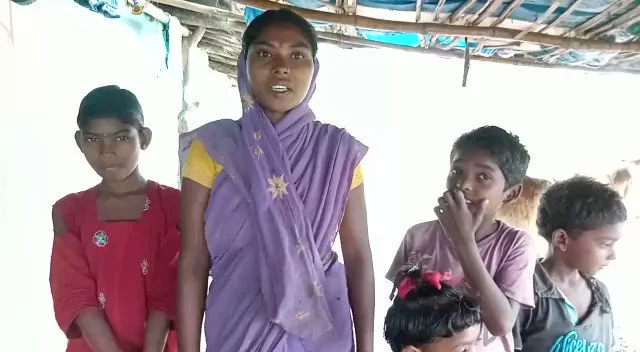
We did a house-to-house survey of primary-school children in Dumbi, a fairly typical Dalit-Adivasi hamlet of Jharkhand. Out of 36 children, 30 could not read a single word. Many parents feel that their children are lapsing into illiteracy. Nemi Devi explains.
Online learning is a fiction in Dumbi. With the village closed in the last 16 months, primary education is at a standstill. Most children are just milling around, some are working in the fields.
Kusmi Devi
In almost every house there was a sad story of poor parents who are struggling to educate their children, but most have no smartphone and no money for tuitions. Kusmi Devi, mother of 4 illiterate children, explains.
One of Kusmi’s daughters, Chandni, is in Class 5. She is unable to read a single word in hindi but she is expected to read this thick English textbook, with sentences like “gravity speeds up communication means, it also explains why Pisa leans”.
Even in the few houses of Dumbi where there is a smartphone, it is rarely used for online studying. Children easily get side-tracked – here in a game of Ludo.
Bottom line: every single parent in Dumbi wants the local school to re-open as soon as possible. Who would guess that elementary education is a fundamental right in India?

Comments

TRENDING

BRICS ends, but Bangladesh's empty chair says more than any declaration

By Nava Thakuria  The 18th BRICS Leaders' Summit, hosted by India at Bharat Mandapam in New Delhi on 12-13 September 2026, has concluded with leaders formally adopting the New Delhi Declaration. The gathering, themed "Building for Resilience, Innovation, Cooperation and Sustainability," drew Russian President Vladimir Putin, Chinese President Xi Jinping, Iranian President Masoud Pezeshkian and other leaders of the now 11-member bloc, along with heads of partner organisations such as ASEAN, the African Union and the Eurasian Economic Union. Diplomats had worked through the final hours to bridge differences — notably between Iran and the UAE over West Asian tensions — before the declaration was signed.

Swaminarayan, untouchability and the 'we are not Hindu' argument

By Rajiv Shah   Following my blog on why the Eiffel Tower authorities should take all the blame for giving in to the Swaminarayan sadhus ’ bizarre demand to “invisibilise” women, including its female staff, during their visit to the internationally renowned Paris tourist centre on September 5, an interesting comment by one of the top academics drew my attention to something I vaguely knew about one of India’s most powerful and richest religious sects.

BAPS, the Eiffel Tower and the curious silence on secularism

By Rajiv Shah   I was a little surprised to see how some of those whom I respect for taking a firm stand on patriarchal issues reacted to the manner in which they responded to the recent incident in Paris, in which women employees of the Eiffel Tower were asked to remain "invisible" on September 5 when 100 BAPS sadhus visited one of the world's top tourist destinations.