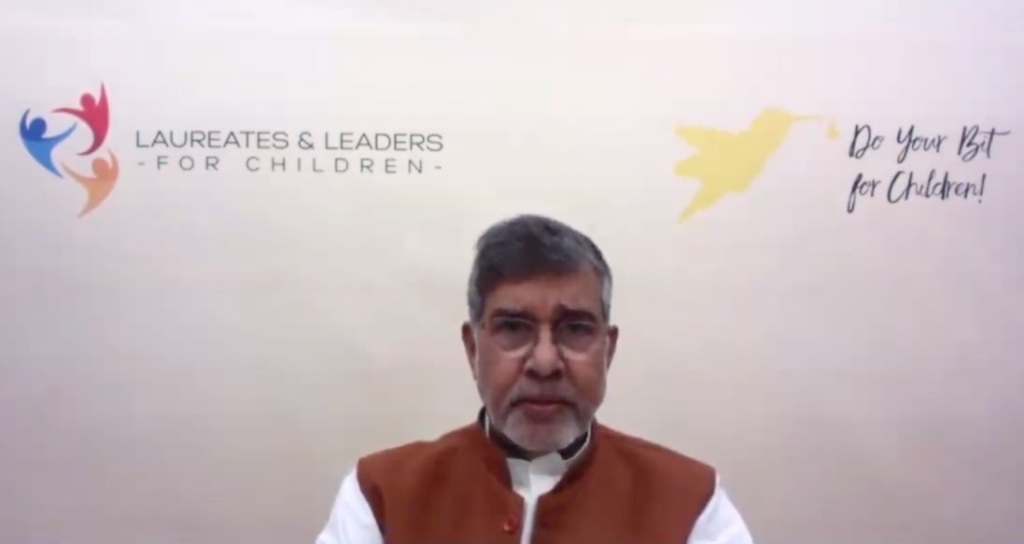
Global ‘Fair Share for Children’ report, release at the Laureates and Leaders for Children Summit*, exposes child trafficking in India during Covid-19 lockdown. A note:
The Union government is prepared to soon bring an anti-trafficking Bill in Parliament, Union Textiles Minister Smriti Irani said during an online panel discussion following the release of a scathing report on the inadequate global response to the adverse consequences of the Covid-19 pandemic on children and the restrictions imposed on people on September 9.The report, ‘A Fair Share for Children: Preventing the Loss of a Generation to COVID-19’ launched at the Laureates and Leaders for Children Summit, reveals the impact of the COVID-19 pandemic and subsequent actions on the world’s most marginalised children. It specifically notes that of the US$8.02 trillion in financial relief announced to date, primarily by G20 countries, is less than 1 percent, or US$10.2 billion, has been allocated to multilateral COVID-19 appeals for those most vulnerable to the pandemic-induced economic crisis.
Over 40 million of India’s internal migrant workers faced the brunt of a severe lack of government support systems even as between March 25 and May 31 there was a spurt in complaints related to domestic violence against women, the report, which focuses on India, among other poor countries, the report said.

It further said, “The deep global inequality before the crisis, the virulence and scale of the disease, the severe economic consequences of the lockdown, the absence of unemployment safety nets for the world’s most vulnerable families, the impact on food supply and prices and the closure of school feeding programmes, and the increasing violence against children have all combined to create the perfect storm for a disaster for children’s rights”.
The report demonstrates the shocking inequality of the world’s multilateral response to protect the futures of hundreds of millions of children, with just US$10 billion of the COVID-19 global economic bailout of US$8 trillion announced so far.
Commenting on the report’s findings, Kailash Satyarthi, the founder of Laureates and Leaders for Children and 2014 Nobel Peace Laureate, stated, “For the first time in two decades, we are facing increases in child labour and slavery, poverty, and out-of-school rates. This is a direct consequence of the world’s unequal response to COVID-19. I have dedicated my life to ending child labour and collective efforts have resulted in significant progress. I am not prepared to let this catastrophic reversal happen. The world’s wealthiest governments have announced trillions, but not for those who need the help the most. We are allowing the world’s poorest children to pay with their lives. Inaction is not an option.”
In the light of the pandemic, civil society, UN agencies, and other multilateral organisations have worked quickly to publish a wealth of information and projections spanning the full breadth of human development issues. The Fair Share for Children report brings these together to demonstrate the scale of devastation that the global economic response to COVID-19 will have on the world’s poorest children.

In the light of the pandemic, civil society, UN agencies, and other multilateral organisations have worked quickly to publish a wealth of information and projections spanning the full breadth of human development issues. The Fair Share for Children report brings these together to demonstrate the scale of devastation that the global economic response to COVID-19 will have on the world’s poorest children.
- The world economy is expected to contract by 5.2% this year; if the pandemic endures beyond 2020 and the economy contracts further, up to 400 million people are at risk of slipping into extreme poverty.
- 2 billion people work in the informal economy, which has seen a 60% drop in average incomes. Families that no longer have any income from work are already facing starvation – despite the availability of food.
- 347 million children are still not able to access school feeding programmes due to school closures.
- When families cannot put food on the table, the youngest children are set to suffer the most: 1.2 million more children under the age of five are projected to die from undernutrition in the next six months alone.
- Interrupted immunisation schemes have put c. 80 million children aged one or younger at risk of disease.
- School closures – for children with access – are still affecting c.1 billion children. Over 400 million children have been unable to access online learning programmes due to lack of internet access at home.
- Massive reductions in household incomes will prevent the poorest families sending their children back to school, leaving them vulnerable to child labour, slavery, trafficking, and child marriage. Where lockdowns have eased, child labourers are already being trafficked back to work.
- Incidents of violence or abuse of children have risen steeply during lockdowns; victims are being left without respite from their abuser in the absence of the protection that school offers them, and they have suffered the double blow of limited or no access to protection services.
- Over 30 million children are refugees or internally displaced. Already subject to the same multiple deprivations as non-displaced poor children – lack of access to learning, reduced access to food, the threats of being forced into child marriage or child labour and trafficking – they have even fewer means to protect themselves against the virus or its wider impacts.
- With the pitiful amount of financial support allocated to their needs, a generation of the world’s most marginalised children is faced with disaster.
—
*Speakers at the Laureates and Leaders ‘Fair Share for Children’ Summit on September 9-10, 2020 include HH the Dalai Lama, HE Stefan Löfven the Prime Minister of Sweden, Henrietta Fore, Executive Director of UNICEF, and Dr. Tedros Adhanom Ghebreyesus, Director-General of the World Health Organization alongside Nobel Laureates, including Kailash Satyarthi and Leymah Gbowee. The summit was organized at the initiative of the Kailash Satyarthi Children’s Foundation (KSCF), which envisages a world where every child is free to be a child
Comments