Muharram: Sufi saints, Shia ulema encouraged merger from indigenous heritage


By Firoz Bakht Ahmed*
What is very heartening is that most of the religious festivals in India have become cosmopolitan in nature despite being harmoniously glued to their roots. Quite spiritedly, fervently and emotionally like the Ramlila, Muharram in India observes the victory of virtue over evil. It commemorates the martyrdom of Hussain, the younger grandson of Prophet Mohammed. Muharram, every year, reminds us of the most treacherous, heart-rending, testing and cruel time faced by Hazrat Imam Hussain owing to the tyrannical ways of Muawiyah and his son Yazeed.
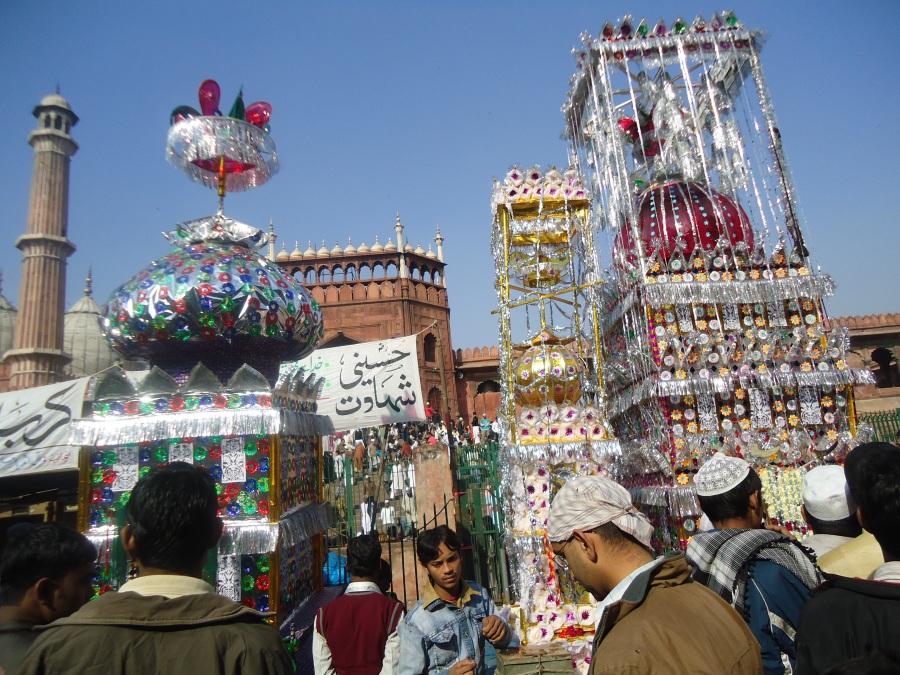
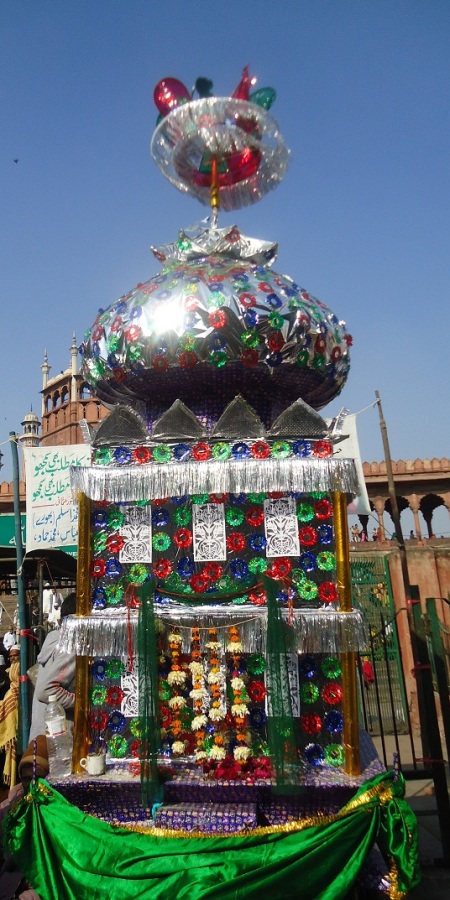
Muharram’s message and moral are the same as in how the virtuous Lord Rama fought against the tyrannical Ravana, the only difference being that Hussain was martyred while Rama slew Ravana. Etchings by Italian artist Bruno Cabrini show how Muharram processions had tazias (mausoleum like artifacts) in the shape of rathas (chariots) during the 18th and 19th centuries in Rajasthan, Gujarat and Maharashtra.
Even the Scindia rulers of Baroda and the Holkars of Indore conducted majlis (Muharram congregation). In Lucknow even today, Hindus join Muslims in mourning sessions. Most Hindus greet these Muharram alams (processions) reverently just like they receive Ramlila processions, as the passing-by of a holy memory. Indeed Varanasi, the heart of Hinduism, has a mixed tradition of observing Muharram: many Hindu families participate with their Muslim brethren by fasting that day.
In India it has been revered by all the communities, especially the Hindu communities dwelling in Varanasi, Lucknaw, Allahabad, Amroha, Indore, Nagpur, Jaipur, Phagwara in Punjab, Bhopal and Kanpur. First thing to be remembered about Muharram is that it is not a festival and is not to be celebrated with fanfare rather it is to be observed with solemnity as it is a day of mourning. It was on the 10th day of Muharram that Hazrat Imam Hussain with many members of his family and 72 others, was brutally killed in public by Muawiah, the ruler of the day in Syria.
That’s why in Muharram processions, Shias beat their chests, heads and backs with sharp metallic chains and recite elegies called marsiyas to recreate the physical torture and mental anguish of Imam Hussain and his followers. Yet, these self-inflicted wounds miraculously heal without medication. Our Sufi saints and Shi’ite ulema encouraged the merging of indigenous elements from the rich cultural heritage of India in their followers’ practice of Islam.
That’s why our Muharram is like nowhere else in the world, conveying both the message of peaceful co-existence and of not yielding to the authority of those who unjustly have an upper hand on things.

*Chancellor, Maulana Azad National Urdu University Hyderabad, grandnephew, Maulana Azad

Comments

TRENDING

Buddhist shrines were 'massively destroyed' by Brahmanical rulers: Historian DN Jha

Nalanda mahavihara By Rajiv Shah  Prominent historian DN Jha, an expert in India's ancient and medieval past, in his new book , "Against the Grain: Notes on Identity, Intolerance and History", in a sharp critique of "Hindutva ideologues", who look at the ancient period of Indian history as "a golden age marked by social harmony, devoid of any religious violence", has said, "Demolition and desecration of rival religious establishments, and the appropriation of their idols, was not uncommon in India before the advent of Islam".

The golden crop: How turmeric is transforming women's lives in tribal India

By Vikas Meshram*   When the lush green fields of turmeric sway in the tribal belt of southern Rajasthan, Madhya Pradesh, and Gujarat, it is not merely a spice crop — it is the golden glow of self-reliance. In villages where even basic spices once had to be bought from the market, the very soil today is yielding a prosperity that has transformed the lives of thousands of families. At the heart of this transformation is the initiative of Vaagdhara, which has linked turmeric with livelihoods, nutrition, and village self-governance — gram swaraj.

Swami Vivekananda's views on caste and sexuality were 'painfully' regressive

By Bhaskar Sur* Swami Vivekananda now belongs more to the modern Hindu mythology than reality. It makes a daunting job to discover the real human being who knew unemployment, humiliation of losing a teaching job for 'incompetence', longed in vain for the bliss of a happy conjugal life only to suffer the consequent frustration.

Authoritarian destruction of the public sphere in Ecuador: Trumpism in action?

By Pilar Troya Fernández  The situation in Ecuador under Daniel Noboa's government is one of authoritarianism advancing on several fronts simultaneously to consolidate neoliberalism and total submission to the US international agenda. These are not isolated measures, but rather a coordinated strategy that combines job insecurity, the dismantling of the welfare state, unrestricted access to mining, the continuation of oil exploitation without environmental considerations, the centralization of power through the financial suffocation of local governments, and the systematic criminalization of all forms of opposition and popular organization.

Echoes of Vietnam and Chile: The devastating cost of the I-A Axis in Iran

​ By Ram Puniyani  ​The recent joint military actions by Israel and the United States against Iran have been devastating. Like all wars, this conflict is brutal to its core, leaving a trail of human suffering in its wake. The stated pretext for this aggression—the brutality of the Ayatollah Khamenei regime and its nuclear ambitions—clashes sharply with the reality of the diplomatic landscape. Iran had expressed a willingness to remain at the negotiating table, signaling a readiness to concede points emerging from dialogue. 

False claim? What Venezuela is witnessing is not surrender but a tactical retreat

By Manolo De Los Santos  The early morning hours of January 3, 2026, marked an inflection point in Venezuela and Latin America’s centuries-long struggle for self-determination and independence. Operation Absolute Resolve, ordered by the Trump administration, constituted the most brutal and direct military assault on a sovereign state in the region in recent memory. In a shocking operation that left hundreds dead, President Nicolás Maduro and First Lady Cilia Flores were illegally kidnapped from Venezuelan soil and transported to the United States, where they now face fabricated charges in a New York federal detention facility. In the two months since this act of war, a torrent of speculation has emerged from so-called experts and pundits across the political spectrum. This has followed three main lines: One . The operation’s success indicated treason at the highest levels of the Bolivarian Revolution. Two . Acting President Delcy Rodríguez and the remaining leadership have abandone...

Beyond the election manifesto: Why climate is now a kitchen table issue

By Vikas Meshram*  March has long been a month of gentle transition, the period when winter softly retreats and a mild warmth signals nature’s renewal. Yet, in recent years, this dependable rhythm has been disrupted. This year, since the beginning of March, temperatures across vast swathes of the country have shattered previous records, soaring to between 35 and 40 degrees Celsius in some regions. This is not a mere fluctuation in the weather; it is a serious and alarming indicator of climate change .

The selective memory of a violent city: Uttam Nagar and the invisible victims of Delhi

By Sunil Kumar*  Hundreds of murders take place in Delhi every year, yet only a few incidents become topics of nationwide discussion. The question is: why does this happen? Today, the incident in Uttam Nagar has become the centre of national debate. A 26-year-old man, Tarun Kumar, was killed following a dispute that reportedly began after a balloon hit a small child. In several colonies of Delhi, slogans such as “Jai Shri Ram” and “Vande Mataram” are being raised while demanding the death penalty for Tarun’s killers. As a result, nearly 50,000 residents of Hastsal JJ Colony are now living in what resembles a state of confinement. 

As India logs historic emissions drop, expert warns govt against 'policy blunders'

By A Representative   In a significant development that underscores the rapid transformation of India's energy landscape, new data reveals the country recorded its largest drop in power sector emissions in 2025. However, a top power sector analyst has urged the Union Government to view this "silver lining" as a stark warning against continuing to invest in new coal, large hydro, and nuclear projects, which he argues could become "redundant" stranded assets.