By Firoz Bakht Ahmed*
What is very heartening is that most of the religious festivals in India have become cosmopolitan in nature despite being harmoniously glued to their roots. Quite spiritedly, fervently and emotionally like the Ramlila, Muharram in India observes the victory of virtue over evil. It commemorates the martyrdom of Hussain, the younger grandson of Prophet Mohammed. Muharram, every year, reminds us of the most treacherous, heart-rending, testing and cruel time faced by Hazrat Imam Hussain owing to the tyrannical ways of Muawiyah and his son Yazeed.
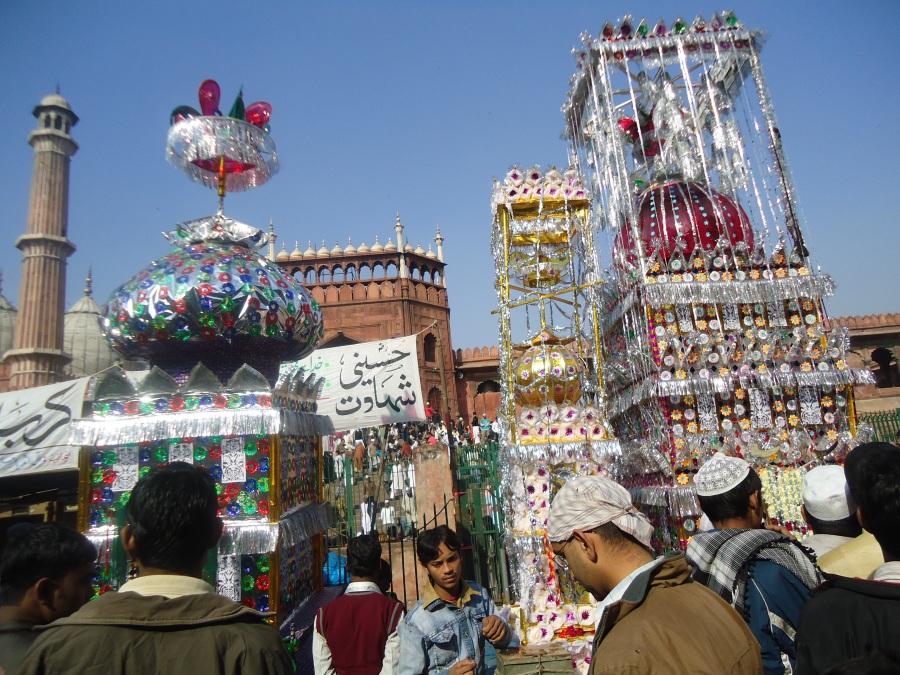
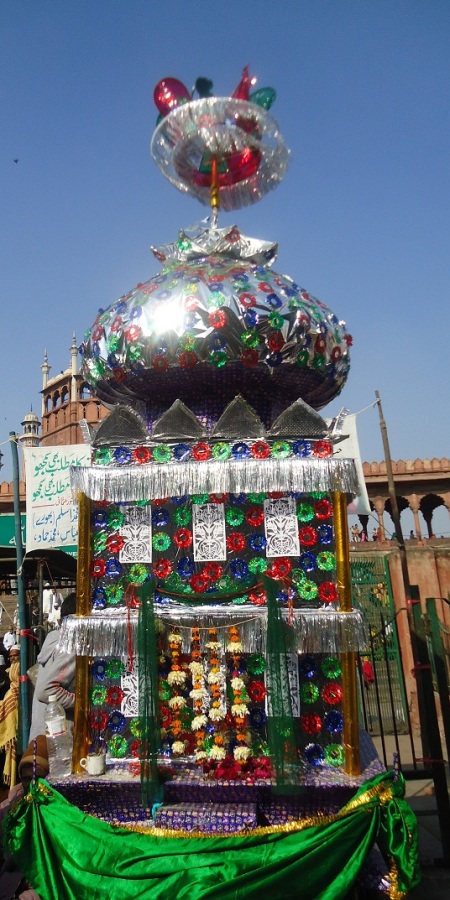
Muharram’s message and moral are the same as in how the virtuous Lord Rama fought against the tyrannical Ravana, the only difference being that Hussain was martyred while Rama slew Ravana. Etchings by Italian artist Bruno Cabrini show how Muharram processions had tazias (mausoleum like artifacts) in the shape of rathas (chariots) during the 18th and 19th centuries in Rajasthan, Gujarat and Maharashtra.
 |
Even the Scindia rulers of Baroda and the Holkars of Indore conducted majlis (Muharram congregation). In Lucknow even today, Hindus join Muslims in mourning sessions. Most Hindus greet these Muharram alams (processions) reverently just like they receive Ramlila processions, as the passing-by of a holy memory. Indeed Varanasi, the heart of Hinduism, has a mixed tradition of observing Muharram: many Hindu families participate with their Muslim brethren by fasting that day.
In India it has been revered by all the communities, especially the Hindu communities dwelling in Varanasi, Lucknaw, Allahabad, Amroha, Indore, Nagpur, Jaipur, Phagwara in Punjab, Bhopal and Kanpur. First thing to be remembered about Muharram is that it is not a festival and is not to be celebrated with fanfare rather it is to be observed with solemnity as it is a day of mourning. It was on the 10th day of Muharram that Hazrat Imam Hussain with many members of his family and 72 others, was brutally killed in public by Muawiah, the ruler of the day in Syria.
That’s why in Muharram processions, Shias beat their chests, heads and backs with sharp metallic chains and recite elegies called marsiyas to recreate the physical torture and mental anguish of Imam Hussain and his followers. Yet, these self-inflicted wounds miraculously heal without medication. Our Sufi saints and Shi’ite ulema encouraged the merging of indigenous elements from the rich cultural heritage of India in their followers’ practice of Islam.
That’s why our Muharram is like nowhere else in the world, conveying both the message of peaceful co-existence and of not yielding to the authority of those who unjustly have an upper hand on things.
—
*Chancellor, Maulana Azad National Urdu University Hyderabad, grandnephew, Maulana Azad
In India it has been revered by all the communities, especially the Hindu communities dwelling in Varanasi, Lucknaw, Allahabad, Amroha, Indore, Nagpur, Jaipur, Phagwara in Punjab, Bhopal and Kanpur. First thing to be remembered about Muharram is that it is not a festival and is not to be celebrated with fanfare rather it is to be observed with solemnity as it is a day of mourning. It was on the 10th day of Muharram that Hazrat Imam Hussain with many members of his family and 72 others, was brutally killed in public by Muawiah, the ruler of the day in Syria.
That’s why in Muharram processions, Shias beat their chests, heads and backs with sharp metallic chains and recite elegies called marsiyas to recreate the physical torture and mental anguish of Imam Hussain and his followers. Yet, these self-inflicted wounds miraculously heal without medication. Our Sufi saints and Shi’ite ulema encouraged the merging of indigenous elements from the rich cultural heritage of India in their followers’ practice of Islam.
That’s why our Muharram is like nowhere else in the world, conveying both the message of peaceful co-existence and of not yielding to the authority of those who unjustly have an upper hand on things.
—
*Chancellor, Maulana Azad National Urdu University Hyderabad, grandnephew, Maulana Azad
Comments
Post a Comment
NOTE: Hateful, abusive comments won't be published. -- Editor