 |
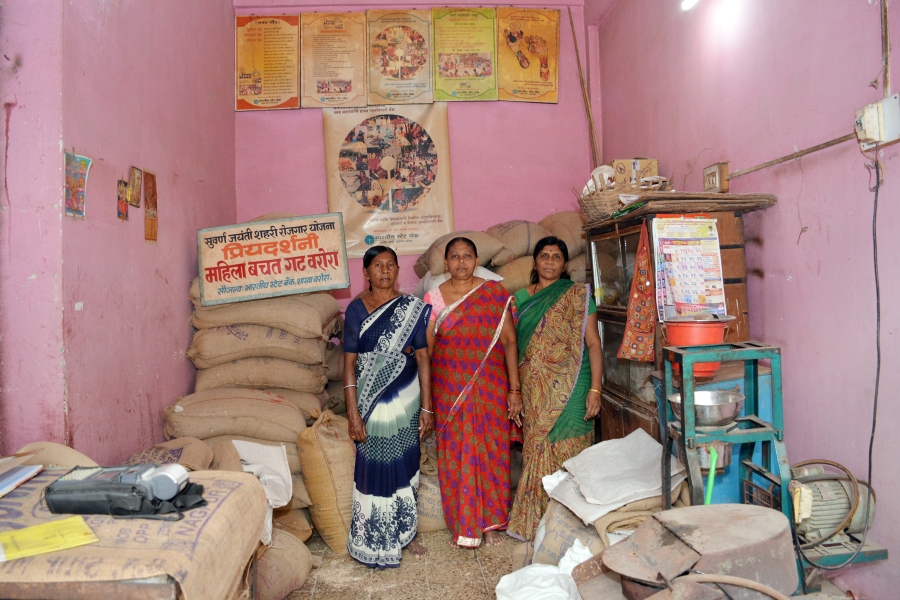
| Original founder members Zaibun, Minakshi and Shashikala |
I vividly remember my moment of epiphany. It was a balmy afternoon in early 1996 in Warora, a small township in northern Maharashtra. I was posted as a manager of my bank’s branch, dealing mostly with rural clients. I was busy trawling through the day’s mail and going about my tasks.Although transactions had not commenced, there was, as usual, an undisciplined crowd of customers waiting for the main door to swing open.
I was distracted by the yells of customers and the clumping of heavy boots of clients from the military barracks when my assistant interrupted me, saying that a group of women wanted to meet me.At first, I hesitated, but my instincts suggested otherwise. I agreed. I beckoned them to sit. Their leader didn’t waste much time and said they had come to seek a loan to set up a business.
I lobbed a few soft questions at them. They answered them confidently. Finally, I fired a fast one, “How will you repay the money? It is not a government dole. Every pie has to be returned. What can you offer as security in lieu of this loan?” The women turned to each other, for answers. The chirpiest in the group was the demure and petite Veena Raut, a commerce graduate, who later assumed the stewardship of the group.
The content of their pitch was that if I trusted them and gave them a chance, they would live up to my expectations. These women represented the aspiring generation that was trying its luck with innovative development strategies that were being aggressively promoted, both by the government and the banking sector.
This was also the time when, if you asked somebody about the most promising innovation for women’s development, the answer would invariably be ‘microcredit’.
Microcredit had emerged as a powerful tool for shaping the entrepreneurial impulses of the impoverished–particularly women. It was based on the extension of small loans (microloans) to a group of people, who typically lacked collateral, steady employment and verifiable credit history; yet they could ensure hundred percent repayment by using peer pressure.
Group loans to women were highly popular, and we had received good results in rural areas. They had already given us a hint of their potential. The idea had excited me a great deal, and I was thus keen to try it with the women in Warora. I visited these women in their homes and was impressed by their determination and solidarity. Their cautious approach could be mistaken as a lack of confidence, but with time, I understood them better.
After a few meetings, in which I addressed all their queries, the group was formally launched.
With the help of the district administration, I secured a grant for a two-week Entrepreneurship Development Programme (EDP) for development of relevant business and managerial skills; business planning; technical training related to the production of goods; book-keeping and inventory management; preparation of business plans for loans; and storage and warehousing. This incubation helped them refine their overall confidence and interaction skills.
The group was christened Priyadarshini Mahila Udyog. I decided to devote each Sunday for a month, to help the group establish its business.
 |
| Shashikala Narole serves customer watched by Minakshi Wankhede and Zaibun |
The nearest industrial township was in Nagpur and the manufacturers helped us in designing gadgets and machinery. We would travel to Nagpur by jeep in the morning and return to Warora in the evening. A few visits helped crystallise our plans.
We decided to purchase scaled-down versions of the equipment used for manufacturing food items for schoolchildren.
One of the industrial units supplied a modified popcorn-manufacturing machine suitable for local needs. It could be operated on petroleum gas. The unit owner also introduced us to a local printer who agreed to supply polythene packets in bulk with the group’s logo branded on them.
A candle manufacturer had one standard mould. He later helped us acquire several moulds from Mumbai, for fancy candles which won the unit a strong brand in the district.
The Municipal Council of Warora solved the marketing issue with bulk orders for chalk sticks, candles and broomsticks. The local grocers offered to serve as retail outlets for the unit.
The Hindustan Petroleum Corporation provided priority connection for LPG, and the Municipal Council provided a shop in its commercial complex at a fair discount. The State Electricity Board provided a priority electric connection.
Veena later graduated to become an assistant in the government’s development administration and is now a Village Officer heading the administration of a large village in Yavatmal district.
The group has since been shepherded by Minakshi Wankhede, who also doubles as a home guard with the local police authorities. Her association with the local police has boosted the business in various ways. Minakshi’s leadership augured well for the group. She lacked Veena’s capabilities, but the consolidation of business took place during her leadership.
As the group’s capital increased, it decided to diversify, acquiring a machine for making vermicelli and another for camphor balls. In their spare time, the women would engage in tailoring work, the most popular being the stitching of pico falls.
Soon, a flood of accolades followed, with Priyadarshini Mahila Udyog even being facilitated by the prime minister.The group also bid and won the tender for supplying mid-day meals to school children.Earlier these contracts were being cornered by underlings of local political leaders. The unit now supplies mid-day meals to over thousand children, ensuring dignified employment for a dozen women.
Cooking begins at 9 am in the industrial kitchen, which is a tarp hung on four posts, jabbed into an empty patch. An all-female crew prepares giant vats of savoury rice and lentil porridge. Workers cook several kilograms of rice, curry and vegetables in giant steel pots. They stir curry with paddles the size of oars. Amidst the sounds of clanging metal, I often found the women hard at work.
During one of my visits to the schools where these ladies served the meals, the teachers complimented me for the excellent quality of food. Earlier, they had to throw away half the supply on account of its insipid taste, I was told. Now, there were no leftovers. Children also brought tiffins to take some food to their homes. When they ate nutritious food, their attendance also improved.
The group’s latest success is the sanction of an outlet of the Public Distribution System (PDS), the government programme that supplies subsidised food grains to the poor.
The honesty of the group members is reflected in the happiness of consumers; they get the full eligible ration on time and at fair rates. This has helped customers of other PDS outlets too. As in all spheres, benchmarking improves ethical practices.
We decided to purchase scaled-down versions of the equipment used for manufacturing food items for schoolchildren.
One of the industrial units supplied a modified popcorn-manufacturing machine suitable for local needs. It could be operated on petroleum gas. The unit owner also introduced us to a local printer who agreed to supply polythene packets in bulk with the group’s logo branded on them.
A candle manufacturer had one standard mould. He later helped us acquire several moulds from Mumbai, for fancy candles which won the unit a strong brand in the district.
The Municipal Council of Warora solved the marketing issue with bulk orders for chalk sticks, candles and broomsticks. The local grocers offered to serve as retail outlets for the unit.
The Hindustan Petroleum Corporation provided priority connection for LPG, and the Municipal Council provided a shop in its commercial complex at a fair discount. The State Electricity Board provided a priority electric connection.
Veena later graduated to become an assistant in the government’s development administration and is now a Village Officer heading the administration of a large village in Yavatmal district.
The group has since been shepherded by Minakshi Wankhede, who also doubles as a home guard with the local police authorities. Her association with the local police has boosted the business in various ways. Minakshi’s leadership augured well for the group. She lacked Veena’s capabilities, but the consolidation of business took place during her leadership.
As the group’s capital increased, it decided to diversify, acquiring a machine for making vermicelli and another for camphor balls. In their spare time, the women would engage in tailoring work, the most popular being the stitching of pico falls.
Soon, a flood of accolades followed, with Priyadarshini Mahila Udyog even being facilitated by the prime minister.The group also bid and won the tender for supplying mid-day meals to school children.Earlier these contracts were being cornered by underlings of local political leaders. The unit now supplies mid-day meals to over thousand children, ensuring dignified employment for a dozen women.
Cooking begins at 9 am in the industrial kitchen, which is a tarp hung on four posts, jabbed into an empty patch. An all-female crew prepares giant vats of savoury rice and lentil porridge. Workers cook several kilograms of rice, curry and vegetables in giant steel pots. They stir curry with paddles the size of oars. Amidst the sounds of clanging metal, I often found the women hard at work.
During one of my visits to the schools where these ladies served the meals, the teachers complimented me for the excellent quality of food. Earlier, they had to throw away half the supply on account of its insipid taste, I was told. Now, there were no leftovers. Children also brought tiffins to take some food to their homes. When they ate nutritious food, their attendance also improved.
The group’s latest success is the sanction of an outlet of the Public Distribution System (PDS), the government programme that supplies subsidised food grains to the poor.
The honesty of the group members is reflected in the happiness of consumers; they get the full eligible ration on time and at fair rates. This has helped customers of other PDS outlets too. As in all spheres, benchmarking improves ethical practices.
 |
| Shashikala Narole with former Prime Minister Dr Manmohan Singh |
.Fast forward to 2018
Twenty years has been a long period for women from varying religious, linguistic and caste hues to remain under a common umbrella. Life for them has changed in other ways too. They recall those days when they were rag-pickers and made a scant living by segregating and selling papers, plastics, metal and other scraps. They suffered scorn for being in a contemptible profession, but even in today’s better times, they face displeasure, the reason now is more modern–economic envy.The younger members left the town after getting married, while some retired. Of the original group, only three members remain–Minakshi Wankhede, Shashi Narole and Zaibun. Though age has mellowed them, the youthful glint is palpable. They now have improved dwellings; their children lead better and healthier lives, and they have investments in the form of bank deposits and plots of land.
The group’s journey has great lessons for me, as for the larger society. By tenaciously plotting the contours through the vicissitudes of time and negotiating rigid social norms, the group has shaped a heroic trajectory. It is a compelling and inspiring story of resolute perseverance and dignity inspired by the struggle to escape the enduring grasp of poverty.
Putting the right supporting structures in place can make the ecosystem for female entrepreneurs more congenial, fostering a culture of equality. Entrepreneurship is a powerful path to reducig poverty and empowering women. It creates financial independence which is modern society’s strongest currency.
In the words of Nobel Laureate Prof Mohammad Yunus, “Credit is one door through which people can escape poverty. Many more doors and windows can be created to facilitate an easy exit. It involves conceptualising about people differently; it involves designing a new institutional framework, consistent with this new conceptualisation.”
—
*Development expert
Comments