70% of Gujarat's resettled Narmada oustees not happy, 54% want to go back, 82% don't have pucca houses: Study
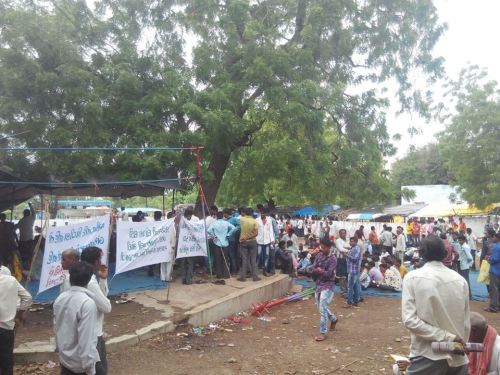 |
| Gujarat oustees' protest a year ago |
A London School of Economics and Political Science research, carried out by two Indian researchers, SA Ayiar, an economic journalist with the Cato Institute, and Prof Neeraj Kaushal of the Columbia University, has suggested 70% of the Narmada dam oustees who were sent packing to resettlement : colonies in late 1980s and early 1990s may still not happy with their living conditions.
The study, sponsored by the International Growth Centre (IGC) of the prestigious London School, says that says that on being asked whether they would “prefer returning to their old villages” from where they were uprooted, “around 54% said yes” and only “30% said no”, while the rest refused to answer.
The research, whose complete findings have still not been made public, though one of the authors, Ayiar, has written about it in a top Indian daily, also reveals that as many as 82% of the resettled oustees do not still have pucca houses, 55% of them do not have access to drinking water, and 84% do not have access to hospitals.
Written ahead of Prime Minister Narendra Modi’s birthday bash, scheduled for September 17, when he and BJP chief ministers of Gujarat, Madhya Pradesh and Maharashtra would celebrate the “completion” of the Narmada dam, the article, ironically, seeks to conclude that most tribals didn’t mind being ousted by the dam.
The reason Aiyar provides for this is, compared to their former neighbours, the resettled oustees are better off.
To quote him, “Comparing oustees with their former neighbours, the proportion with pucca houses was 18% versus 3%; with electricity was 95% versus 71%; and with drinking water was 45% against 33%. Access to schools was 99% versus 51%, to public health centres was 37% versus 12%, and to hospitals 14% versus 3%.”
 |
| A resettlement site in Madhya Pradesh |
Well-known development experts Shripad Dharmadhikary and Nandini Oza refute the argument, commenting, “Given that the oustees were resettled between 25-30 years ago, and that the Sardar Sardar project has poured in hundreds of crores of rupees for resettlement, these figures don’t speak of oustees being better off, but indeed, point to the pathetic case of the oustees.”
Other facts “suggesting” that the resettled tribals were better off are, again to quote him, “For the resettled, semi-evacuated and interior villages, respectively, the ownership of bicycles was 65%, 31% and 48%; of two-wheelers was 61%, 31% and 46%; of colour TVs was 39%, 23% and 36%; of mobile phones was 88%, 59% and 75%.”
Further, he says, “As for agriculture, tractor ownership was 7% versus 2%”, adding, “The resettled tribals used more purchased inputs like fertilisers and pesticides, and grew higher-value crops (with irrigation) like paddy and cotton.”
The objective of the research project, which ended in May this year, has been to study the well-being of tribal families ousted and resettled by the Sardar Sarovar Narmada authority. It is not known whether researchers the studied Madhya Pradesh oustees, too, who are currently protesting across the Narmada Valley against the dam’s completion.
The London School introduction to the project, refusing to give any credit to the government whatever facilities resettled oustees have been able to gain, says, “Sustained vigorous activism by civil society organizations and local communities helped create a resettlement package for the oustees that was unprecedented in Indian history and marked a significant change in Indian federal and state government policies towards resettlement and rehabilitation of tribes.”
Other facts “suggesting” that the resettled tribals were better off are, again to quote him, “For the resettled, semi-evacuated and interior villages, respectively, the ownership of bicycles was 65%, 31% and 48%; of two-wheelers was 61%, 31% and 46%; of colour TVs was 39%, 23% and 36%; of mobile phones was 88%, 59% and 75%.”
Further, he says, “As for agriculture, tractor ownership was 7% versus 2%”, adding, “The resettled tribals used more purchased inputs like fertilisers and pesticides, and grew higher-value crops (with irrigation) like paddy and cotton.”
The objective of the research project, which ended in May this year, has been to study the well-being of tribal families ousted and resettled by the Sardar Sarovar Narmada authority. It is not known whether researchers the studied Madhya Pradesh oustees, too, who are currently protesting across the Narmada Valley against the dam’s completion.
The London School introduction to the project, refusing to give any credit to the government whatever facilities resettled oustees have been able to gain, says, “Sustained vigorous activism by civil society organizations and local communities helped create a resettlement package for the oustees that was unprecedented in Indian history and marked a significant change in Indian federal and state government policies towards resettlement and rehabilitation of tribes.”
Comments