
Neoliberal growth in Gujarat has 'intensified social and economic inequalities'

By Rajiv Shah
A just-released report, “Reducing Inequality: Learning Lessons for the Post-1015 Agenda. India Case Study”, by Save the Children has regretted that “the rapid economic growth that Gujarat has experienced over the past decade has been of the nature of exclusionary growth where goals like social equality, sustainable livelihoods, access to education and health, justice and peace have been abandoned in the race for high-speed growth.”
The report, by the world’s leading independent organization that works to inspire breakthroughs in the way the world treats children to achieve immediate and lasting change in their lives, states that Gujarat's “expenditure in social sectors, both as a percentage of GSDP and as a percentage of total expenditure, has declined more than the average decline in other comparable States and stands below the national average pointing to a clear shift in the priorities.”
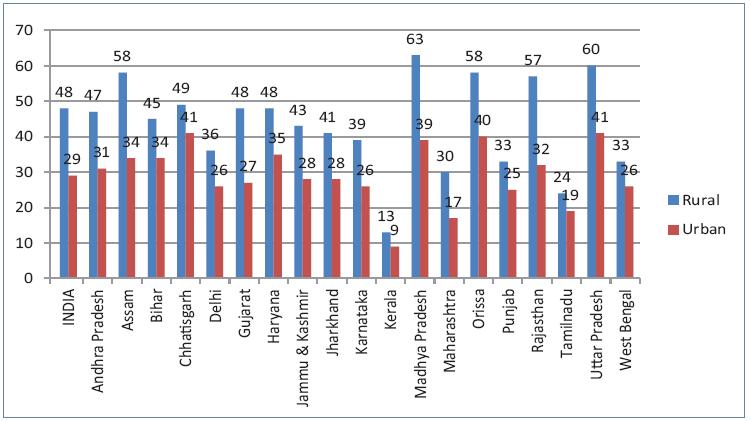
Infant mortality rate among states

The report observes, “There is a decline in the usage of government health services in both rural and urban areas of Gujarat and a very high reliance on the private sector. In urban areas, the decline has been quite significant for the lowest income group.”
It adds, “Data for some select states of IMR for 2010 (based on availability) reveal that across all states and across regions, the IMR for females are relatively higher. This is a clear reflection of the gender bias that exists in India even today. The Western states of Gujarat and Rajasthan and Northern state of Uttar Pradesh show higher differences than the other states.”
Hunger Index among states

The report has been prepared to study rising inequality, which it says has “emerged as one of the most important problems confronting societies across the world.” It underlines, “Within the Asian region, South Asia has experienced rapid increases in income/ consumption inequality during the recent period of its rapid growth. This is quite evident in case of India, the largest economy in the region with over a billion people. There is evidence to suggest that the poorer sections of India were actually further marginalised under the neoliberal economic regime introduced in India in the early 1990s.”
Calorie intake per capita among states
Singling out Gujarat in this context, the report states, “Poorer states like Bihar, Uttar Pradesh and Orissa witnessed only a marginal improvement in terms of per capita NSDP (Net State Domestic Product), whereas the richer states like Gujarat, Maharashtra, etc witnessed substantial rises.”
This has not helped reduce inequalities, it underlines: “States that witnessed greater rise in per capita NSDP during the period 1993- 94 to 2004-05 also witnessed higher rise in state-level Gini coefficients. This implies that the states that experienced more ‘growth’ actually had worsening inequalities.”
The report further says, “Within States, the rural-urban divide worsened. Urban consumption levels were double that of rural consumption levels. The social factor of caste plays a major role in determining household Monthly Per Capita Expenditure (MPCE) levels. The Social Category “Others” had higher MPCEs across both rural and urban sectors in India compared to the other categories, viz. the Scheduled Castes (SC), Scheduled Tribes (ST) and Other backward Classes (OBC).”
The report points towards how “the systematic withdrawal of the state from social welfare activities has undermined the previous progress towards universal access and has resulted in increased inequality and exclusion.” In this context, it believes, “Per capita NSDP does not capture the actual distribution amongst the population as it assumes equal shares for all.”
Life expectancy among states
The report underlines, “The easiest method of measuring actual distribution is by analysing differences in consumption expenditures, as given by the National Sample Survey Organization (NSSO) periodic sample survey reporting.” Even its “household consumption data tend to understate the extent of inequality by underestimating the tails of the distribution (excluding the very rich and the very poor) and because the poor are more likely to consume as much or even more than their income while the rich are more able to save.”
Coming to calorie intake as the criterion of health, the study says, “In the rural sector, Punjab has the highest per capita calorie intake of 2223 Cal while Jharkhand had the lowest of 1900 Cal. It is interesting to note that some of the poorer states like Orissa and Uttar Pradesh had  alorie intakes higher than the national average while comparatively richer states like Gujarat and Tamil Nadu had lower than the national average rate of calorie intake.”
Emphasising that “a significant dimension of health is life expectancy, which has been increasing over the years”, the study says, “It has increased more for females than males. According to 2002-06 estimates, life expectancy at birth for males was 62.6 years as compared to 64.2 years for females. Also the urban male (67.1 years) and urban female (70 years) have longer life spans as compared to their rural counterparts (61.2 and 62.7 years respectively).”
Maternal mortality rate among states
As for Gujarat, it reminds again that it “has one of the highest per capita incomes of all major states (per capita net state domestic product (NSDP) at constant (2004-05) prices of Rs 52,708 in 2010-11)”, but “has only been a moderate performer in this regard. Gujarat’s IMR in 2011 is close to that of much poorer and less developed Bihar despite the much higher per capita income in that state (per capita NSDP of Bihar in 2010-11 is Rs.13,632).”
It says, “Kerala has shown one of the lowest infant mortality rates historically. Its IMR has been many times less than the Indian average. Kerala’s performance is more creditable than any other states as it has managed to reduce the already low IMR even further over the period.”
It adds, “It is surprising to note that even urban IMR is high in the states of Delhi and Gujarat...The relatively richer states of Gujarat and Haryana have shown slower improvements in lowering IMR. incomes of all major states.”
Crude birth rate among states
As for the maternal mortality rate (MMR), the report says, “Gujarat again has proved to be a poor performer as the MMR has actually gone up in Gujarat over the period 1997-98 to 2007-09 recording a negative rate of decline.” It is in the company of “states of the north western region Uttar Pradesh, Rajasthan and Bihar, which still show quite high rates of maternal mortality.
As for education, “while states such as Tamil Nadu, Sikkim, Mizoram, Arunachal Pradesh, and Manipur spent 10.2 per cent, 9.8 per cent, 9.1 per cent, 7.1 per cent, and 6.4 per cent, respectively, of their total state domestic product (SDP) on education in 2007-08, there were several states (e.g. Maharashtra, Delhi, Gujarat, Haryana, Punjab, Andhra Pradesh, Goa) which spent less than 2 per cent of their SDP on education.”
Even on increase in pupil-teacher ratio (PTR), the report says, “In 2009-10, number of districts where PTR was above 30 has increased to 304 during 2009-10 compared to 284 in 2008-09. These districts are mainly concentrated in Bihar, Gujarat, Jharkhand, Madhya Pradesh, Orissa, Uttar Pradesh and West Bengal.”

Comments

TRENDING

Countrywide protest by gig workers puts spotlight on algorithmic exploitation

By A Representative   A nationwide protest led largely by women gig and platform workers was held across several states on February 3, with the Gig & Platform Service Workers Union (GIPSWU) claiming the mobilisation as a success and a strong assertion of workers’ rights against what it described as widespread exploitation by digital platform companies. Demonstrations took place in Delhi, Rajasthan, Karnataka, Maharashtra and other states, covering major cities including New Delhi, Jaipur, Bengaluru and Mumbai, along with multiple districts across the country.

Swami Vivekananda's views on caste and sexuality were 'painfully' regressive

By Bhaskar Sur* Swami Vivekananda now belongs more to the modern Hindu mythology than reality. It makes a daunting job to discover the real human being who knew unemployment, humiliation of losing a teaching job for 'incompetence', longed in vain for the bliss of a happy conjugal life only to suffer the consequent frustration.

CFA flags ‘welfare retreat’ in Union Budget 2026–27, alleges corporate bias

By Jag Jivan  The advocacy group Centre for Financial Accountability (CFA) has sharply criticised the Union Budget 2026–27 , calling it a “budget sans kartavya” that weakens public welfare while favouring private corporations, even as inequality, climate risks and social distress deepen across the country.

'Gandhi Talks': Cinema that dares to be quiet, where music, image and silence speak

By Vikas Meshram   In today’s digital age, where reels and short videos dominate attention spans, watching a silent film for over two hours feels almost like an act of resistance. Directed by Kishor Pandurang Belekar, “Gandhi Talks” is a bold cinematic experiment that turns silence into language and wordlessness into a powerful storytelling device. The film is not mere entertainment; it is an experience that pushes the viewer inward, compelling reflection on life, values, and society.

Budget 2026 focuses on pharma and medical tourism, overlooks public health needs: JSAI

By A Representative   Jan Swasthya Abhiyan India (JSAI) has criticised the Union Budget 2026, stating that it overlooks core public health needs while prioritising the pharmaceutical industry, private healthcare, medical tourism, public-private partnerships, and exports related to AYUSH systems. In a press note issued from New Delhi, the public health network said that primary healthcare services and public health infrastructure continue to remain underfunded despite repeated policy assurances.

The Epstein shock, global power games and India’s foreign policy dilemma

By Vidya Bhushan Rawat*  The “Epstein” tsunami has jolted establishments everywhere. Politicians, bureaucrats, billionaires, celebrities, intellectuals, academics, religious gurus, and preachers—all appear to be under scrutiny, even dismantled. At first glance, it may seem like a story cutting across left, right, centre, Democrats, Republicans, socialists, capitalists—every label one can think of. Much of it, of course, is gossip, as people seek solace in the possible inclusion of names they personally dislike. 

Gujarat No 1 in Govt of India pushed report? Not in labour, infrastructure, economy

By Rajiv Shah A report by a top Delhi-based think tank, National Council of Applied Economic Research (NCAER), prepared under the direct leadership of Amitabh Kant, ex-secretary, Department of Industrial Policy and Promotion (DIPP), Government of India, has claims that Gujarat ranks No 1 in the NCAER State Investment Potential Index (N-SIPI), though there is a dig. N-SIPI has been divided into two separate indices. The first one includes five “pillars” based on which the index has been arrived it. These pillars are: labour, infrastructure, economic conditions, political stability and governance, and perceptions of a good business climate. It is called N-SIPI 21, as it includes a survey of 21 states out of 29.

Gujarat agate worker, who fought against bondage, died of silicosis, won compensation

Raju Parmar By Jagdish Patel* This is about an agate worker of Khambhat in Central Gujarat. Born in a Vankar family, Raju Parmar first visited our weekly OPD clinic in Shakarpur on March 4, 2009. Aged 45 then, he was assigned OPD No 199/03/2009. He was referred to the Cardiac Care Centre, Khambhat, to get chest X-ray free of charge. Accordingly, he got it done and submitted his report. At that time he was working in an agate crushing unit of one Kishan Bhil.

Planning failures? Mysuru’s traditional water networks decline as city expands

By Prajna Kumaraswamy, Mansee Bal Bhargava   The tropical land–water-scape of India shapes every settlement through lakes, ponds, wetlands, and rivers. Mysuru (Mysore) is a city profoundly shaped by both natural and humanly constructed water systems. For generations, it has carried a collective identity tied to the seasonal rhythms of the monsoon, the life-giving presence of the Cauvery and Kabini rivers , and the intricate network of lakes and ponds that dot the cityscape. Water transcends being merely a resource; it is part of collective memory, embedded in place names, agricultural heritage, and the very land beneath our feet. In an era of rapid urbanization and climate-induced land–water transformations, understanding this profound relationship with the land–water-scape is strategic for sustainability, resilience, and even survival.